Amazon’s Zoox Robotaxis Join Uber App in Las Vegas in First Tie-Up
Uber riders in Las Vegas can now be matched with Zoox's steering-wheel-free robotaxis, Zoox's first deal with an outside ride-hailing platform.
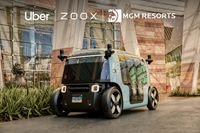
Uber riders in Las Vegas can now be picked up by a car with no steering wheel, no pedals and no driver. Zoox, the self-driving vehicle company owned by Amazon, began offering rides through the Uber app in the city on Monday. It is the first time Zoox has put its robotaxis on a ride-hailing platform it does not run itself, Uber and Zoox said in a joint announcement.
The launch also makes Las Vegas the first U.S. city where Uber customers can be matched with two separate fully driverless partners, according to TechCrunch. The other is Motional, a self-driving company owned by Hyundai. Alongside the launch, the two companies announced a multi-year partnership with casino and hotel operator MGM Resorts International.
How the service works
At first, riders cannot ask for a Zoox vehicle specifically. People who request an UberX, Uber Comfort, Uber Electric, Uber Comfort Electric or Wait & Save ride may be assigned one if a vehicle is available, and the companies said a Zoox ride costs no more than the category the rider picked. Riders can improve their chances of getting a robotaxi by switching on autonomous rides under “Ride Preferences” in the app’s settings.
TechCrunch reported that Uber plans to add a dedicated option for booking autonomous rides “as availability and reliability improve.” Neither company has said how many Zoox vehicles will be available to Uber customers.
Service covers resorts and venues on and around the Las Vegas Strip, as well as downtown Las Vegas and the Arts District, according to the companies’ statement. Zoox will keep taking bookings through its own app in the city. Unlike some of Uber’s other self-driving partners, Zoox will handle maintenance and day-to-day operations of its fleet itself, TechCrunch reported.
Zoox’s vehicle looks different from most robotaxis on U.S. roads. The boxy, carriage-style electric vehicle has two rows of seats facing each other and no driver’s seat. Al Jazeera reported it can reach speeds of up to 75 mph.
“Zoox has built something truly unique,” Samarth Kejriwal, Uber’s global head of autonomous mobility, said in the statement. Jesse Levinson, Zoox’s co-founder and chief technology officer, said the company is “seeing more riders choosing to ride with Zoox” as it expands in Las Vegas.
As part of the MGM Resorts deal, Uber and Zoox become the official rideshare and robotaxi partners at MGM’s Las Vegas properties. The companies said they plan clearer pickup and drop-off points, better signs and directions across MGM’s large resort complexes, guidance inside the app, and changes meant to keep traffic moving.
Why it matters
The deal helps both companies with their goals in self-driving cars. Uber has stopped building its own self-driving technology. Instead it hosts other companies’ vehicles on its network, and TechCrunch reported that it now works with more than 30 autonomous vehicle firms in North America, Europe and the Middle East, though not all of them are carrying paying passengers yet. Earlier this year, the Nevada Transportation Authority, the state’s regulator for ride-hailing and taxis, unanimously approved a permit allowing Uber to run up to 1,000 robotaxis in Clark County, which includes Las Vegas, through its partnerships with Motional and Zoox.
Dara Khosrowshahi, Uber’s chief executive, said on the company’s third-quarter earnings call this month that Uber would start with limited fleets in Las Vegas and add vehicles over the coming months, TechCrunch reported.
For Zoox, the partnership puts its vehicles in front of the large number of people who already use Uber. TechCrunch described Zoox as trailing the market leaders, Waymo, the self-driving unit of Google parent Alphabet, and Tesla.
The timing also matters because of a change in Uber’s relationship with Waymo. TechCrunch reported that the exclusive arrangement under which Waymo robotaxis serve Uber riders in Austin and Atlanta will end in January 2028. After that, Waymo will offer rides there through its own app, as it already does in other cities. Uber told the outlet it still intends to keep Waymo vehicles on its platform for as long as both companies agree.
Background: a federal first
Zoox, based in Foster City, California, operates as an independent subsidiary of Amazon, which bought the startup for about $1.2 billion. It began offering free rides in Las Vegas and San Francisco in 2025.
In July, the National Highway Traffic Safety Administration (NHTSA), the federal auto safety regulator, approved limited commercial use of Zoox’s robotaxis. Al Jazeera reported that the decision was the first of its kind for a vehicle without human controls. The decision exempts Zoox from federal rules requiring things such as a steering wheel, lets it deploy up to 2,500 vehicles in each of two years, and adds reporting requirements for crashes and for vehicles stopping in improper places.
Jonathan Morrison, NHTSA’s administrator, said at the time that Zoox’s systems “exceed the equivalent performance requirements.” Safety advocates were less convinced. Peter Kurdock, general counsel of the Advocates for Highway and Auto Safety, a consumer and safety group, said “there really was no data behind the promises,” according to Al Jazeera. Zoox also recalled 105 vehicles in July for a software update after NHTSA raised concerns about driverless vehicles getting in the way of emergency responders, the outlet reported.
What comes next
Los Angeles is next. The companies said Zoox will begin initial operations there by the end of 2026, launching first through its own app, and will bring the Uber partnership to the city in 2027. TechCrunch reported that the early Los Angeles rides will be limited to Zoox employees and their friends and family, with commercial service planned for next year.