Baidu Revenue Falls 1% as AI Cloud Offsets Ad Slump
Baidu posted its sixth straight quarterly revenue decline as a 22% drop in advertising outweighed a 94% jump in AI cloud infrastructure sales.
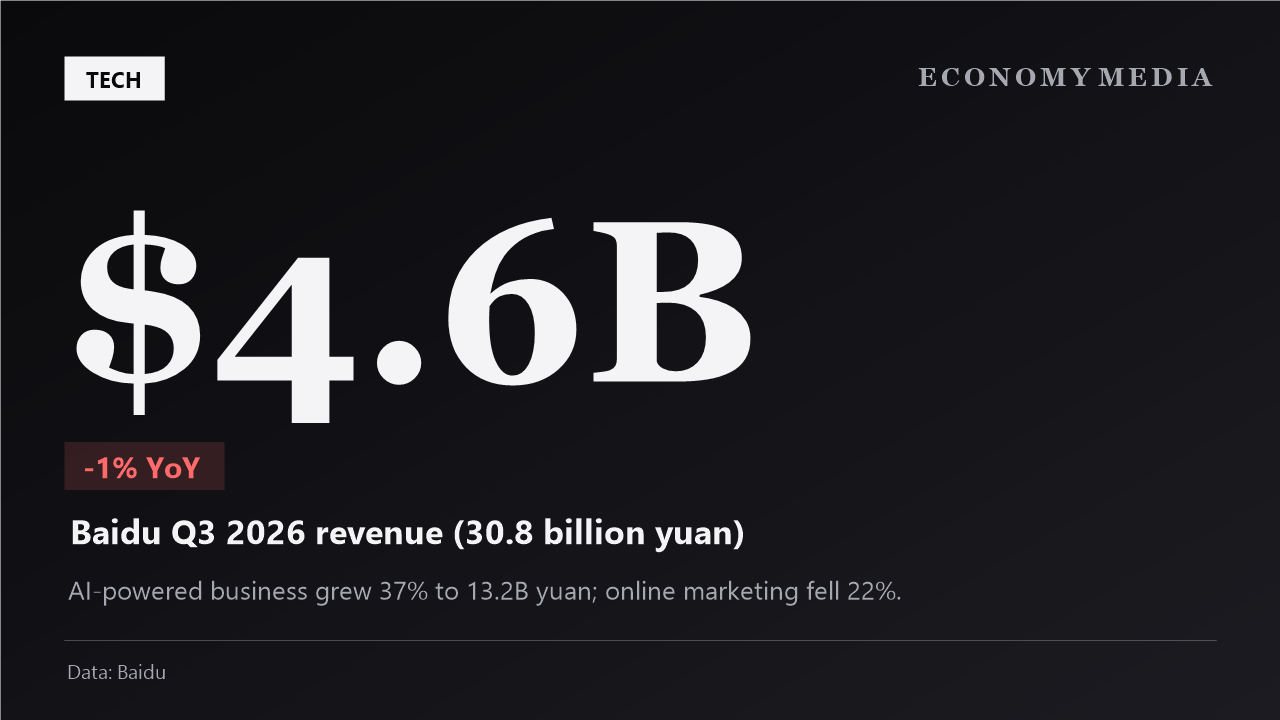
Baidu, the Chinese search and artificial intelligence company, reported a 1% year-over-year drop in third-quarter revenue to 30.8 billion yuan (about $4.6 billion), its sixth consecutive quarterly decline, as growth in AI cloud services only partly made up for a weakening advertising business.
What happened
The results for the quarter ended Sept. 30 were in line with expectations. Reuters reported that analysts surveyed by LSEG, the financial data provider, had forecast about 30.86 billion yuan. According to Baidu’s earnings release, revenue also fell 2% from the previous quarter. Bloomberg described the result as underscoring the urgency of Baidu’s push to commercialize AI to offset a faltering legacy search business.
Online marketing, the company’s core advertising line, fell 22% from a year earlier to 11.9 billion yuan, Baidu said. Reuters noted that advertisers have trimmed budgets amid sluggish consumer spending in China. Online marketing now makes up 48% of Baidu General Business revenue, down from 62% a year earlier, according to the company.
AI-related products moved the other way. Baidu said its AI-powered business rose 37% to 13.2 billion yuan and accounted for 53% of General Business revenue, compared with 39% a year earlier. Within that, AI Cloud Infrastructure revenue climbed 94% to 8.2 billion yuan, and GPU cloud revenue, which comes from renting out graphics processing chips used to train and run AI models, grew 191%. AI Applications were flat at 2.6 billion yuan, while AI-native marketing services fell 15% to 2.4 billion yuan.
Baidu General Business, which covers the company’s operations excluding its iQIYI streaming unit, generated 25.0 billion yuan, up 1% and its first year-over-year increase in the period tracked in the release. Revenue from iQIYI, the video streaming platform Baidu controls, fell 10% to 6.0 billion yuan.
Profit and cash
Net income attributable to Baidu was 1.4 billion yuan (about $208 million), a 5% net margin. Non-GAAP net income, which excludes certain items such as share-based compensation, was 2.4 billion yuan. Operating income under GAAP, or standard U.S. accounting rules, was 626 million yuan, a 2% margin. Baidu reported cash and investments of 276.6 billion yuan at the end of September.
Why it matters
Baidu has long dominated Chinese web search, and its results are a gauge of whether a legacy search giant can turn heavy AI spending into new revenue. Robin Li, Baidu’s co-founder and chief executive, said in the release that the company’s long-term investments in full-stack AI are “translating into meaningful growth at scale.” Haijian He, the chief financial officer, said AI Cloud Infrastructure is “becoming a new growth engine,” contributing more to both revenue and profit.
Reuters reported that investors remain concerned Baidu is lagging rivals such as Alibaba, DeepSeek and Moonshot, partly because it has not delivered a major upgrade to its Ernie AI model. It said a preview of Ernie 5.5 Flash drew a much more muted response than earlier Ernie versions. Baidu’s U.S.-listed shares fell more than 1% in premarket trading, according to Reuters.
What comes next
The results show the company’s mix shifting, with AI-linked businesses now more than half of General Business revenue, but total sales are still shrinking. It is not yet clear when advertising will stabilize, and the company has not given figures in this release that settle that question. Investors are likely to watch whether AI cloud growth can keep outpacing the advertising decline and whether new Ernie releases win back developer and user attention.