Binance Fully Lifts Withdrawal Suspension After Record Hack
Binance says its recovery work is complete and withdrawals are fully restored, four weeks after a record $6.3 billion theft.
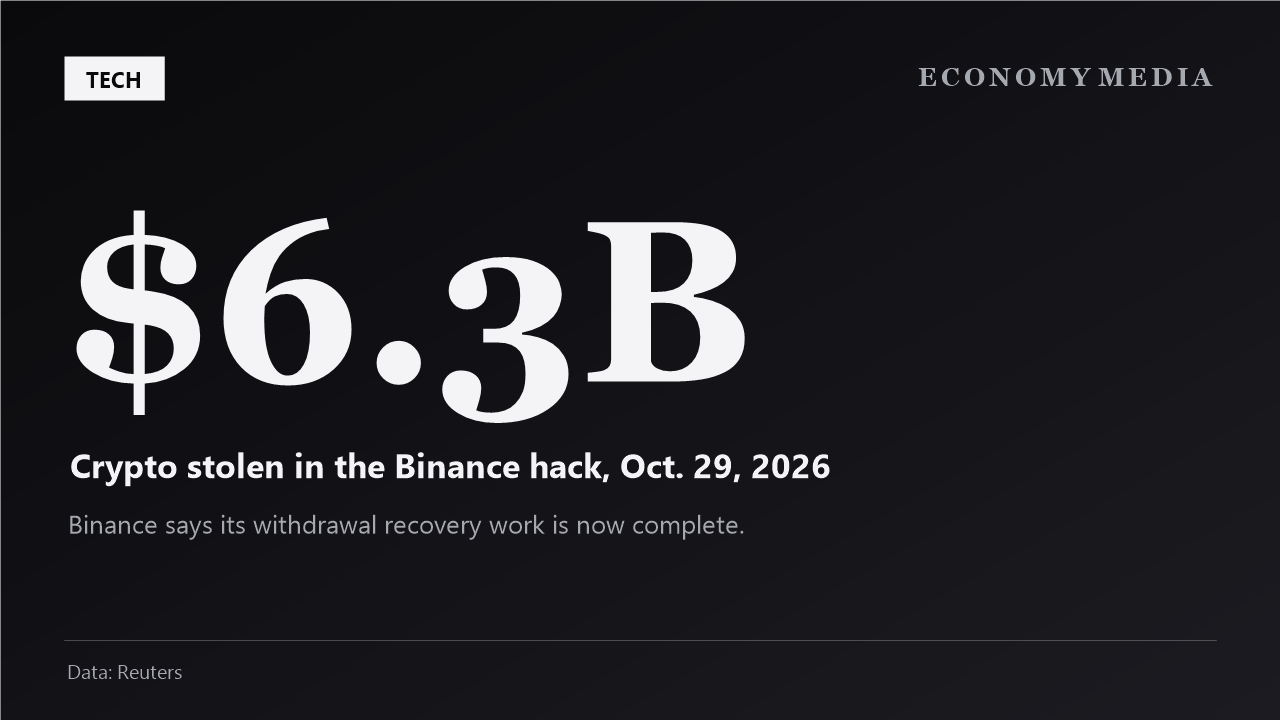
Binance, the world’s largest cryptocurrency exchange by trading volume, said on Thursday that its withdrawal recovery work is complete and that it has fully lifted the suspension imposed after hackers stole a record $6.3 billion from the platform last month, Reuters reported.
The company said a small number of blockchain networks remain temporarily paused for maintenance or planned upgrades, and stressed that those pauses are separate from the completed recovery work. Reuters did not name the networks.
What happened
Binance froze deposits and withdrawals on Oct. 29 after attackers drained funds from its wallets. Blockchain analytics firm TRM Labs said an attacker moved roughly $6.36 billion out of Binance wallets across 10 blockchains, according to Al Jazeera. The theft is the largest in crypto history, far above the roughly $1.5 billion taken from the exchange Bybit in February 2025.
Binance began reopening withdrawals in stages on Nov. 1, starting with bitcoin, ether and some stablecoins, Al Jazeera and TechCrunch reported. At the time, Binance said it had covered about 95% of the affected assets and would absorb the losses itself. “These losses will not be passed on to users,” the company said, according to TechCrunch. Between 6 a.m. and 3:30 p.m. UTC that day, Binance processed $4.6 billion in withdrawals and $1.0 billion in deposits, a net outflow of $3.6 billion, or 2.1% of assets under management, TechCrunch reported.
Crypto.news reported that Binance said it committed more than $6.34 billion in company funds to buy back the affected tokens. The money came from its corporate treasury, part of its Secure Asset Fund for Users (SAFU), an emergency reserve set up in 2018, and a portion of its futures insurance fund. Binance also pledged to bring the user protection fund back to about $1 billion, the outlet said. The same report said Binance published a proof-of-reserves snapshot covering 198 tokens, which lets users check that their assets are backed at least 1:1.
Who is blamed, and what is still unclear
The FBI said on Oct. 31 that a North Korean group it tracks as TraderTraitor was responsible, and that the attackers were converting stolen assets mainly into ether, according to Al Jazeera and TechCrunch. TRM Labs and Chainalysis, two blockchain analytics firms, reached the same conclusion, Al Jazeera reported. North Korea has routinely denied involvement in hacking in the past, and Al Jazeera did not report a response from Pyongyang to this case.
Binance’s own position has been more cautious. Richard Teng, Binance’s co-CEO, said on X early in the crisis that the company’s investigation “has not attributed responsibility to any individual,” according to Al Jazeera. Binance first said a compromised engineer’s laptop may have been the entry point, then reported “additional points of breach.” It said it had found no evidence that a private key leaked, a claim that Mark Karpeles, the former head of the Mt. Gox exchange, disputed in comments to Reuters. Binance has promised a detailed incident report once its investigation ends. The Reuters report on the final lifting of the suspension did not say when that report will be published.
Why it matters and what comes next
The restoration ends a nearly four-week disruption at an exchange used by millions of customers worldwide. The episode also tested the SAFU fund, which holds about $1 billion, a sixth of the amount stolen.
Law enforcement action is continuing. Crypto.news reported that the U.S. Justice Department announced a civil forfeiture action three days earlier targeting more than $1.1 billion in USDC, a dollar-linked stablecoin issued by Circle, tied to 36 addresses on 18 blockchains. The department said U.S. authorities have helped freeze, seize or return nearly $3 billion in crypto since the breach.
Not yet known is how much of the stolen money can ultimately be recovered, how the attackers got in, and whether Binance’s reported figure of about $6.3 billion will be revised. Some outlets cite $6.34 billion, a difference that appears to come down to rounding and the source of the estimate.