BMW Cuts Profit Outlook Again as 8,000 Job Cuts Move Faster
BMW now sees its 2026 car margin between -0.5% and 0.5%, its second warning in five months, as severance costs rise and China sales slump.
BMW, the German luxury carmaker, has cut its profit forecast for the second time in five months. It warned that its core car business could break even or slip into a small operating loss this year, because the cost of cutting thousands of jobs is arriving faster than planned.
The Munich-based company said late Tuesday that it now expects an operating (EBIT) margin of between minus 0.5% and plus 0.5% for its automotive segment in 2026, down from the 1% to 3% range it set in June, Reuters and Agence France-Presse reported. On Wednesday, BMW reported third-quarter results that were largely in line with analysts’ forecasts, and its shares rose.
What happened
BMW’s redundancy program is moving faster than expected, which means bigger severance payments than anticipated in the final quarter of the year, according to AFP. The company also said the reduction in management functions “will be implemented faster than announced” and that it would speed up a broader overhaul of its organization and processes.
Strong demand for models built on the Neue Klasse, BMW’s new generation of electric-vehicle technology, is also adding costs because factories need extra shifts, AFP reported. The company cited weak demand in China as well. It now expects automotive deliveries to fall moderately this year, which Reuters said means a decline of 5% to 9.9%. BMW still expects automotive free cash flow of more than 2.5 billion euros (about $2.8 billion).
The restructuring centers on about 8,000 job cuts in Germany. Reuters reported that they are being made through a voluntary redundancy program that launched in July and was completed within three weeks.
The quarter in numbers
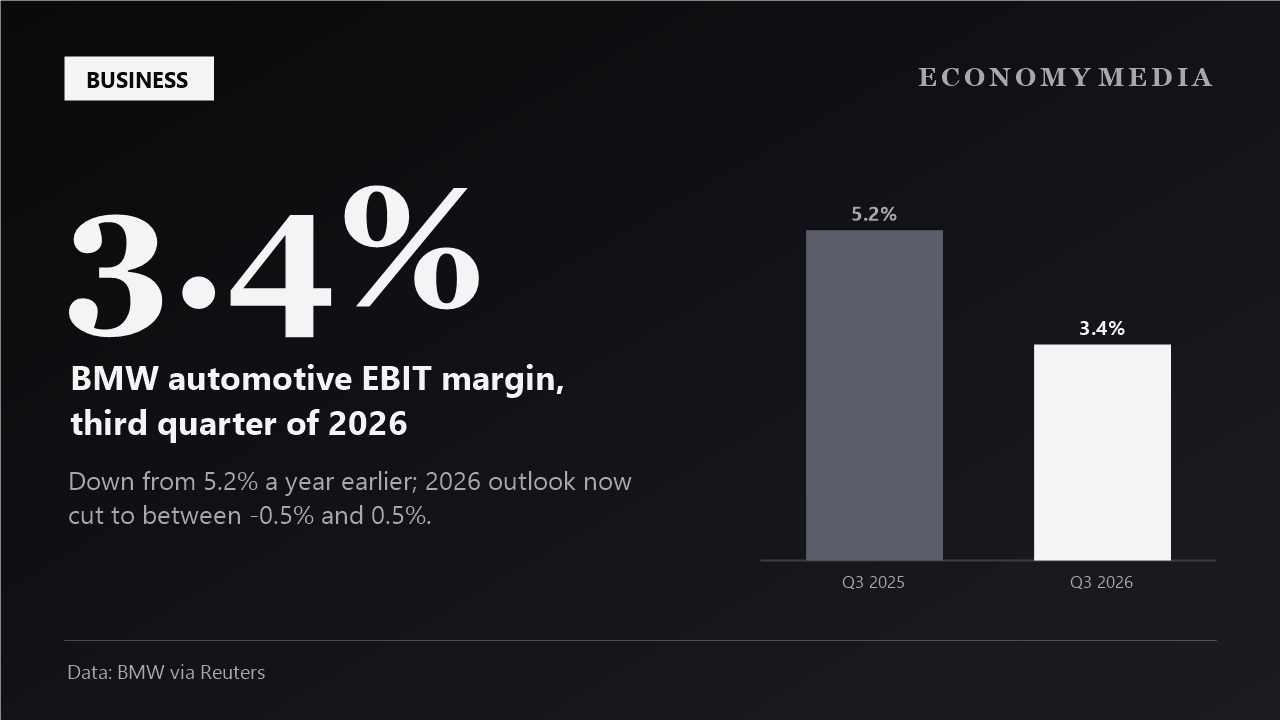
BMW posted third-quarter pretax earnings of 2.1 billion euros ($2.4 billion), according to Reuters. Its automotive operating margin was 3.4%, a little ahead of the 3.1% analysts had expected but well below the 5.2% of a year earlier. Restructuring charges are expected to land in the fourth quarter.
- Automotive EBIT margin, third quarter of 2026: 3.4% (analyst forecast: 3.1%)
- Same measure a year earlier: 5.2%
- Full-year 2026 margin outlook: -0.5% to 0.5%, down from 1% to 3%
- Long-term margin target: 8% to 10%
- China sales, first nine months of 2026: down 22%
Investors appeared to take the news in stride. BMW’s Frankfurt-listed shares were 3.4% lower late Tuesday after the warning, Reuters reported, but rose 2.3% on Wednesday after the quarterly results.
Milan Nedeljkovic, BMW’s chief executive, said that “current developments in our industry call for decisiveness and swift implementation,” and added that the company did not want to lose momentum.
Why it matters
For years China, the world’s largest car market, was a reliable source of profit for German premium brands. Reuters noted that Chinese buyers are increasingly choosing cheaper domestic brands. BMW’s sales in China fell 22% in the first nine months of the year, in line with a broader market downturn there. European carmakers are also contending with steep U.S. tariffs on their exports.
BMW is not alone. Mercedes-Benz cut its profit outlook last week because of prolonged weakness in China, according to Reuters. Volkswagen, Europe’s largest carmaker, is in a months-long dispute with unions over expanding its planned cuts to 100,000 jobs. AFP reported that Mercedes-Benz and Volkswagen have both issued profit warnings this year and plan job cuts to lower costs.
Some observers expect the difficulties to continue. “I would not assume this is the end of the turbulence,” Matthias Hellstern, an analyst at Scope Ratings, a European credit rating agency, told Reuters.
What comes next
BMW is counting on its Neue Klasse vehicles to revive growth. Reuters reported that the iX3 electric SUV, built on the new platform, launches in China this month after a strong start in Europe. Its reception there will be watched closely, since China has been the main drag on BMW’s results.
Trade policy is another open question. Democratic gains in Tuesday’s U.S. midterm elections raised hopes in the industry for a less confrontational U.S. trade stance, Reuters reported, but a BMW spokesperson declined to comment on the election results or on possible changes to tariffs or regulation.
BMW, which also owns the Mini and Rolls-Royce brands, delivered 2.46 million vehicles last year, according to AFP. The new outlook leaves the company far below its long-term margin target of 8% to 10%, and the bulk of this year’s restructuring costs has yet to show up in its accounts.