Chinese Chip Stocks Post Record Gain as Beijing Vows Market Support
China's semiconductor index jumped a record 17.6% after the State Council pledged a bigger role for state-backed funds in steadying the stock market.
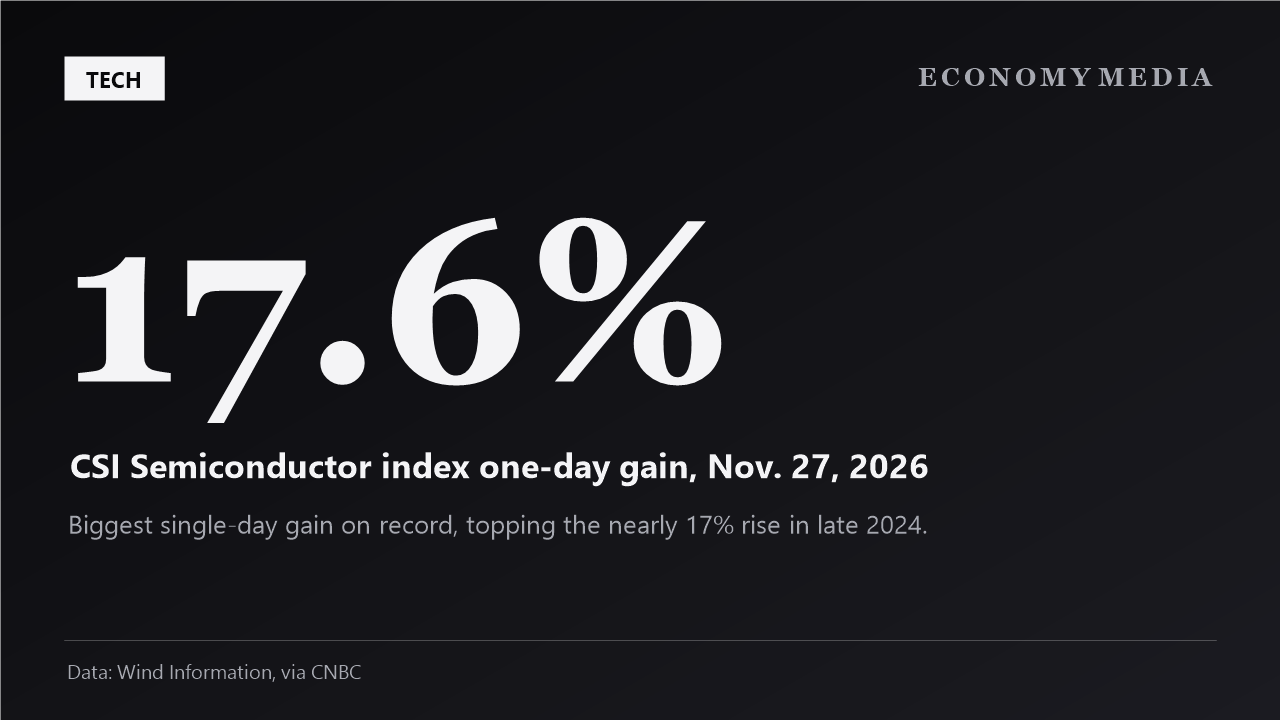
Chinese semiconductor stocks posted their biggest one-day gain on record Friday after China’s cabinet issued an unusual midday statement promising that state-backed investors would do more to stabilize the country’s battered stock market. The CSI Semiconductor index, which tracks 40 Chinese chip companies, climbed 17.6%, CNBC reported, citing data from Wind Information, a Chinese financial data provider. That beat the previous record of nearly 17%, set in late 2024.
The rally spread well beyond chipmakers. CNBC reported that the CSI 300, a benchmark of the largest companies listed in Shanghai and Shenzhen, rose about 4%, its biggest jump since October 2024, while Hong Kong’s Hang Seng index gained 2%. The move came one day after the CSI 300 had fallen to its lowest level since the U.S.-China tariff fight escalated in the spring of 2025.
What happened
The trigger was a Friday meeting of the State Council, China’s top governing body, overseen by Premier Li Qiang. According to a readout published by the state news agency Xinhua and relayed by several outlets, officials pledged to strengthen the role of the so-called “national team,” a term for state-backed funds that buy shares to support prices, in order to stabilize markets and keep liquidity ample.
The readout singled out Central Huijin Investment, a state-owned firm that holds stakes in major companies on behalf of the government and is a unit of the sovereign wealth fund China Investment Corp. The meeting said it would sharpen Central Huijin’s function as a stabilization fund. Officials also said they would:
- Steer more medium- and long-term money, such as insurance and social security funds, into stocks.
- Encourage listed companies to pay larger dividends and buy back more shares.
- Crack down on financial fraud to protect investors.
The Telegraph, in a report carried by Yahoo Finance, quoted the readout as saying that “the capital market remains vital to the economy” and that regulators would strengthen the market’s resilience to “imported risks.”
Timing amplified the reaction. Such readouts are typically released after markets close, but this one appeared during the trading day. Zong Ke, a portfolio manager at a Shanghai-based quantitative fund, told CNBC that turnover across the Shanghai, Shenzhen and Beijing exchanges for the full day was 52% higher than in the previous session. “That’s very strong language from the top officials,” Zong said.
Chipmakers in the spotlight
CNBC said the STAR Market’s tech-heavy index, Shanghai’s board for innovative companies, surged 14%, led by chipmakers including memory maker CXMT, AI chip designer Cambricon and contract manufacturer SMIC. Figures varied somewhat across outlets: The Telegraph put the STAR 50’s rebound at 15% and the CSI 300’s gain at 3.7%, while the news site N Globe reported that SMIC rose about 15% and several other chip companies, including Hua Hong Semiconductor, hit the 20% daily trading limit.
The sector had been under heavy pressure. The STAR 50 had fallen 40% from its June record before Friday, according to The Telegraph, which said a rally driven by enthusiasm for Chinese AI and robotics firms faded as the tech industry struggled to secure enough chips and data center capacity. CNBC noted that the U.S. unveiled a rule last week further restricting Chinese companies’ access to advanced AI chips, including through overseas data centers, adding to pressure on Beijing to build its own semiconductor supply.
Why it matters
Analysts said the significance lay as much in the message as in the measures. Bob Chen, a Shanghai-based venture capitalist and economist, told CNBC that “stock market performance is now prioritized at the highest level for the Chinese government,” and said the explicit mention of the national team was a first for a State Council meeting. Xinhua commentary cited by N Globe made the same point.
Hong Hao, managing partner of Lotus Asset Management, told CNBC the statement “effectively institutionalized” Central Huijin’s role as a state stabilization fund and argued the rebound would last longer than earlier policy-driven bounces, which faded within days.
What comes next
Not everyone is convinced. CNBC noted that Beijing’s reliance on intervention has raised questions about whether the market can sustain longer-term gains, and N Globe reported that analysts cautioned a single strong session may not overcome deep investor wariness. China’s economy faces a prolonged property slump, weak consumer demand and rising unemployment, The Telegraph reported. Zong said he expects further support, such as easing rules that have limited long-term funds from investing in stocks, with the near-term goal of keeping the market from falling much further.