Chip Stocks Drag Nasdaq Lower as Nvidia Slides After Huang Exit
AMD, Broadcom and Intel led a renewed chip selloff on Friday as Nvidia fell again after Jensen Huang's exit and Treasury yields stayed near 5.1%.

A renewed selloff in semiconductor stocks pushed the Nasdaq Composite sharply lower on Friday, Nov. 13, as investors kept reacting to Jensen Huang’s abrupt departure as chief executive of Nvidia, the world’s most valuable chipmaker. Nvidia shares fell again, and rivals that had rallied a day earlier gave back their gains. Advanced Micro Devices dropped about 10%.
By early afternoon in New York, the Nasdaq was down about 1.2% at roughly 25,066, according to Yahoo Finance market data. The S&P 500 had lost about 0.7% to around 7,540, and the Dow Jones Industrial Average was almost flat near 52,250. Earlier in the session, Yahoo Finance reported deeper losses of about 1.6% for the Nasdaq and 0.9% for the S&P 500, so the indexes had recovered some ground by then.
What happened
Nvidia shares erased early gains and turned lower. They traded around $161, down about 3%, after falling more than 4% at one point, Yahoo Finance reported. The stock was on track to end the week below a $4 trillion market value. On Thursday, Nvidia’s market value had briefly fallen below that level for the first time since 2025, NBC News reported. The shares dropped as much as 16% during that session before closing down 4.3%, and the company lost about $500 billion in market value over the week as reports about Huang spread.
The damage was wider on Friday. According to 24/7 Wall St., AMD was down about 11% just before noon, while Broadcom and Intel each fell about 6%. Yahoo Finance reported declines of roughly 5% for memory maker Micron Technology and about 9% for flash-storage company Sandisk. CoreWeave, a cloud provider that rents out Nvidia-powered computing capacity, fell about 7%.
Why it matters
Huang co-founded Nvidia and had run it since the 1990s. He resigned effective immediately on Nov. 12. NBC News reported that his resignation followed a New York Times report that he had a relationship with an executive who reported to him. Colette Kress, Nvidia’s chief financial officer, is now interim CEO. The Wall Street Journal reported that she is expected to face questions about financing deals Huang struck when the company reports quarterly earnings on Tuesday.
Analysts disagree about what the leadership change means for the rest of the industry. HSBC downgraded Nvidia to hold and lowered its price target to $170 from $365, Yahoo Finance reported. HSBC analyst Frank Lee said investor confidence had been “shaken” and that the company’s leadership succession plan was unclear. Dan Ives, a technology analyst at Wedbush Securities, told Bloomberg TV that Huang’s exit “clearly evens the playing field” for Nvidia’s competitors, 24/7 Wall St. reported. That view helped explain Thursday’s rotation into rival chipmakers.
Friday’s reversal was blamed partly on profit-taking. 24/7 Wall St. said much of AMD’s drop reflected investors cashing in after a fast run-up. AMD had reported 44.7% year-over-year revenue growth to $13.38 billion for its third quarter on Nov. 3. Michael Burry, the investor known for betting against the U.S. housing market before 2008, wrote in a Substack post on Thursday that he believes chip valuations “still have a ways to fall,” the outlet reported.
Rates and other pressures
Chip stocks were not the only problem. The yield on the 10-year Treasury note was around 5.14% and had reached as high as 5.17%, its highest since October, Yahoo Finance reported, as traders prepared for a possible Federal Reserve rate increase in December. The Journal said the bond selloff had eased after Thursday’s sharp jump in yields, although longer-dated yields kept climbing.
October producer prices rose 0.3% from September, below the 0.4% economists expected. The annual rate of 6.5% was the largest since November 2022. Fed governor Michelle Bowman said inflation pressures had “persisted for longer than I had hoped” and were showing signs of broadening. The Cboe Volatility Index, a measure of expected stock swings, rose above 20, and bitcoin traded below $70,000.
What comes next
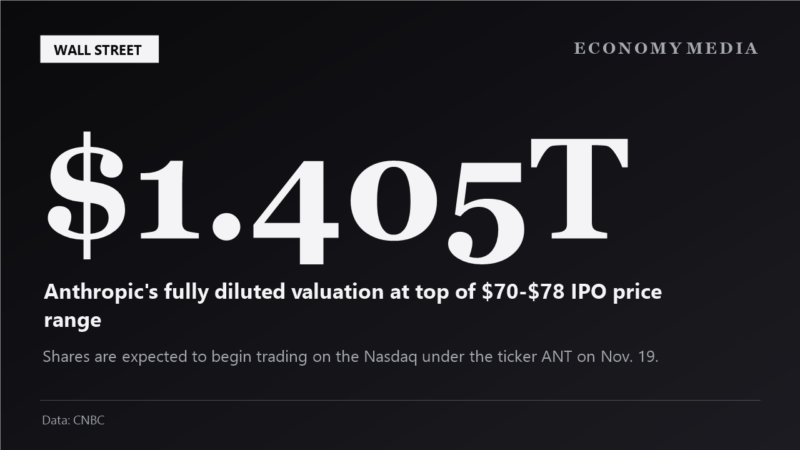
Investors are focused on Nvidia’s results on Tuesday, its first report without Huang in charge. The Journal noted that an initial public offering by Anthropic, an AI developer and one of the largest users of Nvidia’s chips, is expected on Thursday. Both events are likely to test how much demand for AI hardware is still there after a turbulent week for the sector.