EU Weighs Letting UK Cars Into ‘Made in Europe’ Without China Tariffs
An Irish EU presidency draft would let British-built cars qualify for 'Made in Europe' rules without the UK matching tariffs on Chinese EVs.
European Union governments are weighing a compromise that would let cars and components built in Britain count as “Made in Europe” under the bloc’s new industrial rules, without first requiring London to copy EU tariffs on Chinese electric vehicles. The draft, drawn up by Ireland, which currently holds the rotating presidency of the Council of the European Union, was reported by the Financial Times on Tuesday and would mark a significant shift from earlier demands by France and Germany.
The proposal is not final. According to Business Upturn, which summarized the Financial Times report, ministers are expected to discuss it next week, and the measure would still need approval from the European Parliament.
What the proposal says
The “Made in Europe” rules are part of the Industrial Accelerator Act, a European Commission plan that would require companies to use a set share of European-made components in order to tap EU subsidies or sell to EU governments and public agencies. The scheme targets strategic sectors such as electric vehicles and batteries and is designed in large part to shield European manufacturers from cheaper Chinese competition.
Under the Irish draft, Britain would be treated as a “partner” for car assembly. The Guardian reported that the UK would not have to follow the EU in applying tariffs on Chinese car imports. Instead, according to the Financial Times account, Britain could qualify by offering EU-made goods reciprocal access to its own public funding and procurement programs.
The reported terms include several other details:
- Switzerland and countries in the European Economic Area would also be eligible, while Turkey would be left out.
- Car parts made in Japan and South Korea would be covered.
- British manufacturers would not gain access to EU-only CO2 “supercredits,” which help carmakers meet emissions targets.
- British companies could compete for public funding and contracts in other covered sectors, including steel, cement and clean technology, if access is reciprocal.
The Guardian also reported that Ed Miliband, the UK foreign secretary, told a parliamentary committee there had been “a transformation in the EU view” of Britain.
Why it matters
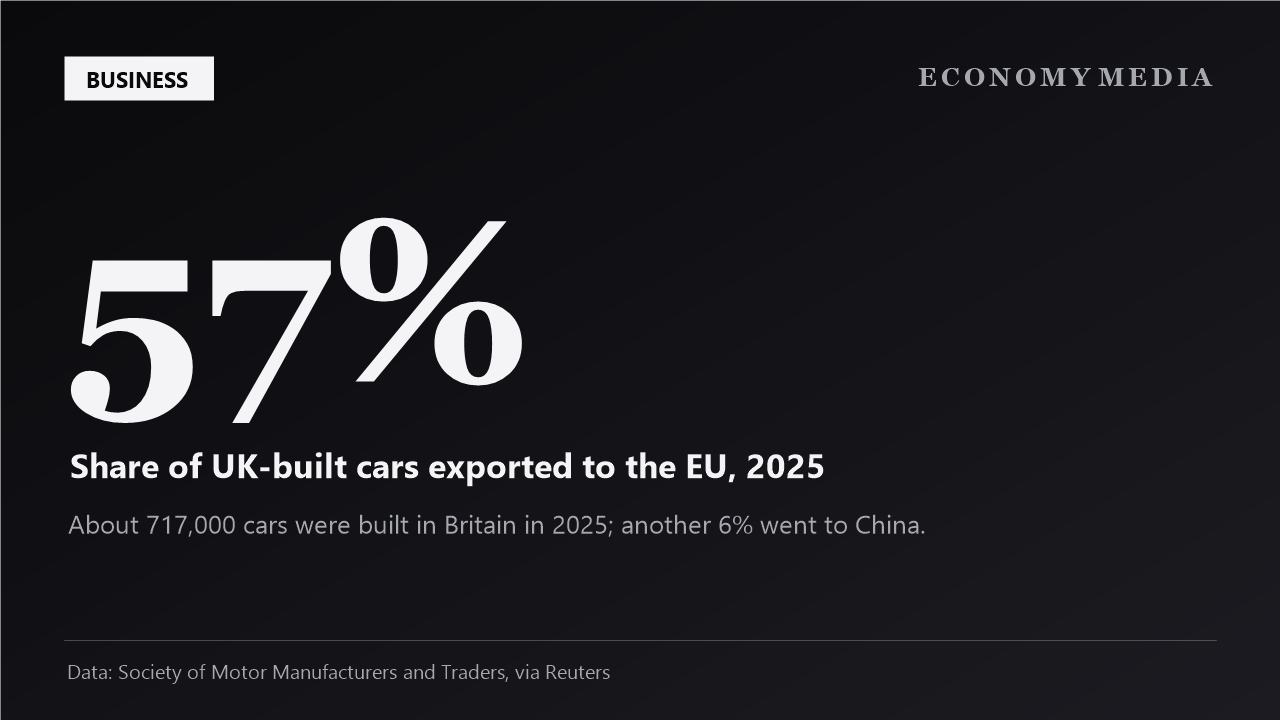
For Britain’s auto industry, the stakes are large. Of the roughly 717,000 cars built in the UK in 2025, nearly 57% were exported to the EU, Reuters reported, citing data from the Society of Motor Manufacturers and Traders (SMMT), the industry’s main trade group. The sector supported about 830,000 jobs and contributed around 18 billion pounds ($23.7 billion) in added value to the economy last year, according to the same data.
Being shut out of the new rules could make British-built vehicles and parts less attractive to European buyers and public agencies. David Bailey, a professor of business economics at the University of Birmingham, told Reuters the threat to the industry would be “existential.” Jim Baumbick, Ford’s president in Europe, told the news agency that the company’s 13,000 UK employees were “ready to compete.”
The tariff question has been the main obstacle. The EU has imposed duties on Chinese-made electric vehicles that, combined with its standard 10% import duty on foreign cars, reach about 45% for some manufacturers. Britain applies only the standard 10% duty, making it one of the largest car markets without China-specific levies. Chinese brands have been gaining ground there: their share of UK car sales rose to 17.8% in the year to the end of October, roughly double a year earlier, according to SMMT figures cited by Reuters.
Background
France, which authored much of the legislation, and Germany had pushed to tie British inclusion to alignment with EU trade-defense measures, which could have forced London to impose tariffs on Chinese EVs. In October, the Press Association reported that a spokeswoman for Downing Street called possible inclusion “good news for the British automotive industry” but said it was “premature to speculate” on the terms, adding that the UK keeps its tariffs under review. Jonathan Reynolds, the British business secretary, has said tariff decisions would be based on the UK’s interest.
As recently as last week, the path looked harder. Reuters reported on Nov. 19 that key EU member states were still insisting Britain align on trade protection ahead of a UK-EU summit, and that a later draft of the summit statement had dropped language about a “trusted partnership.” Adolfo Urso, Italy’s minister for enterprises, told Mr. Reynolds that Italy backed UK inclusion only with reciprocity on trade protections, including on steel, Reuters reported.
The issue is central to Prime Minister Andy Burnham’s effort, since taking office in July, to reset relations with the bloc. Beijing is watching closely: China’s embassy in London said in October that it was “firmly opposed to any discriminatory practice” and would respond accordingly.
What comes next
EU ministers are due to take up the Irish text in the coming days, and the reports differ on how settled the matter is. The Financial Times framed the condition as being dropped, while Reuters’ reporting from last week described member states still divided. Any final deal must also pass the European Parliament, leaving British carmakers facing continued uncertainty over their access to their biggest export market.