GDC Survey: A Third of Game Workers Laid Off as AI Use Climbs to 40%
GDC's latest industry survey finds 34% of game workers were laid off in the past two years, while 40% now use generative AI on the job.
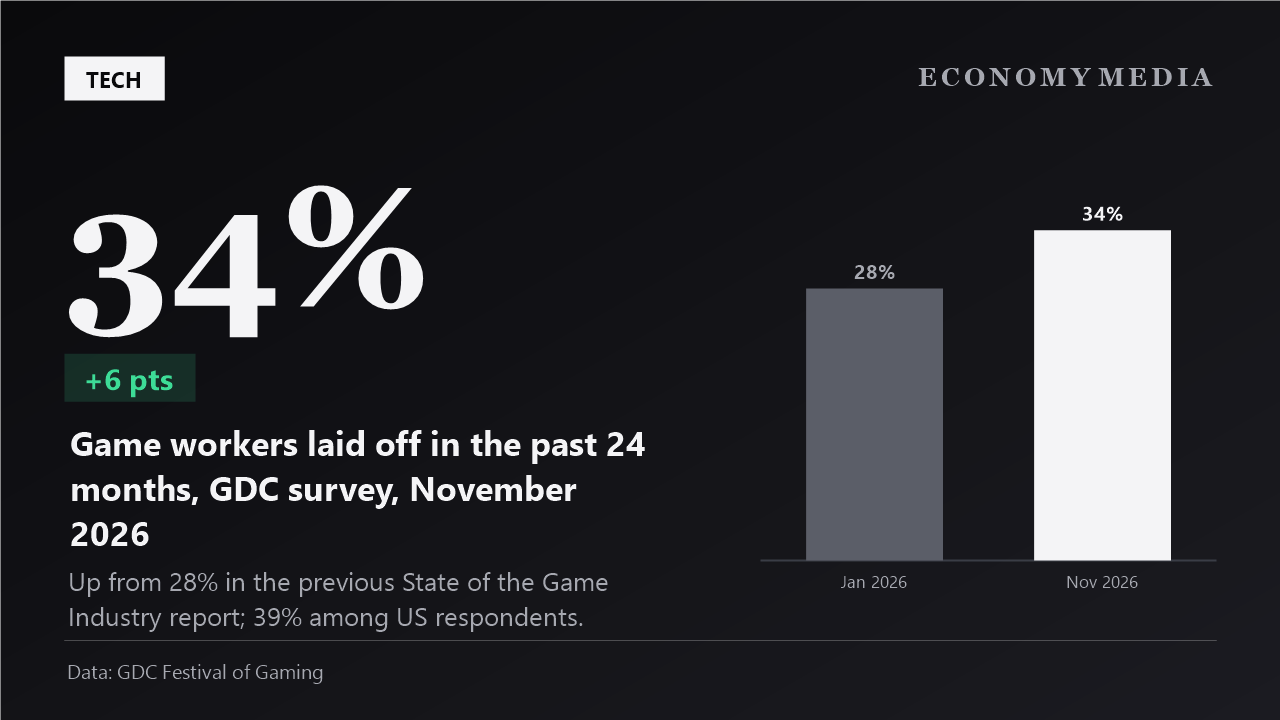
About a third of video game professionals say they lost their jobs in the past two years, and a growing share are now using generative AI at work, according to a new industry survey released Thursday by GDC Festival of Gaming, the organizer of the long-running Game Developers Conference. The report, based on responses from more than 2,600 people, shows layoffs rising for a third straight year even as more developers adopt AI tools for coding and research while still resisting the technology for creative work.
What the survey found
The State of the Game Industry report, now in its 15th edition, found that 34% of respondents had been laid off at some point in the previous 24 months, up from 28% in the prior edition published in January, GamesBeat reported. Among respondents based in the United States, the figure rose to 39%. Most of those job losses were recent: 68% of laid-off respondents said they lost their jobs within the past 12 months.
Finding new work has been difficult. According to GamesBeat, 54% of those laid off have not found another job, a quarter applied for 100 or more positions, and 21% of all respondents described themselves as unemployed, up from 13% in the previous report. Large studios were hit hardest: 68% of respondents at AAA studios, the industry’s term for big-budget publishers and developers, said their company had made cuts in the past year, compared with 14% at younger independent studios.
Game Developer, a trade publication that, like the conference, is owned by the events and publishing group Informa, said in its summary that the industry “continues to face tremendous adversity,” but that the love game makers feel for their work endures.
Generative AI: more use, little warming
Forty percent of respondents said they use generative AI as part of their job, up from 36% a year earlier, and 57% of those users rely on it daily, GamesBeat reported. Adoption was highest in business operations roles, at mobile-only studios (70%) and among developers of free-to-play games (58%). AAA workers were three times as likely as indie workers to say they felt encouraged or pressured to use the tools, 27% versus 9%.
The Verge, which also covered the report, said the tools are used mostly for support and engineering work: 73% of users cited research and brainstorming, 62% data analysis and summaries, and 56% code generation and debugging. Far fewer used AI for visual work, with 22% using it for concept art and 8% for final game assets.
Attitudes remain largely negative. According to GamesBeat, 55% of respondents said generative AI is having a negative effect on games, roughly unchanged from the previous survey. Beth Elderkin, content marketing manager at GDC Festival of Gaming, told the outlet it was the first year that figure had not risen. She said there is “still more widespread opposition” to using the technology for player-facing content. Respondents also raised newer worries, including the risk that junior developers’ skills could erode, alongside concerns about the environment, job security, privacy and intellectual property.
Crunch, mental health and unions
The report expanded its section on working conditions. GamesBeat reported that 65% of respondents said their job had hurt their mental health in the past year, rising to 81% among the unemployed. Eighty-six percent said they had worked more than 40 hours in at least one week, while 8% reported mandatory overtime, known in the industry as crunch, and most of that group believed it could have been avoided. Even so, 86% said working in games gave them more fulfillment than another industry would.
Union membership rose to 15% from 12%, but interest in joining a union dropped seven points to 55%, and support for unionizing the industry slipped to 80% from 82%.
Caveats and what comes next
The organizers cautioned against reading the results as a precise picture of the whole workforce. Elderkin told GamesBeat that “we do not believe that this is a one to one representation” of the industry, noting that people affected by layoffs may be more likely to respond. Amir Satvat, a game jobs analyst who sits on the report’s new advisory committee, estimates that about 14% of US developers were laid off in the past 12 months, GamesBeat said.
The survey also looked ahead to new hardware. About 10% of respondents said they are developing for the next PlayStation and 8% for Microsoft’s next Xbox, code-named Project Helix, while PC remained the dominant platform. This is the second edition published in 2026: GDC has moved the report from January to November so it reflects the year just ending. The next conference is scheduled for March 1 to 4, 2027, at the Moscone Center in San Francisco.