IMF’s Georgieva Says AI Circular Financing Has Topped $1 Trillion
The IMF chief says deals that recycle AI investment back to investors now exceed $1 trillion, mostly debt-funded, as AI stocks slide.
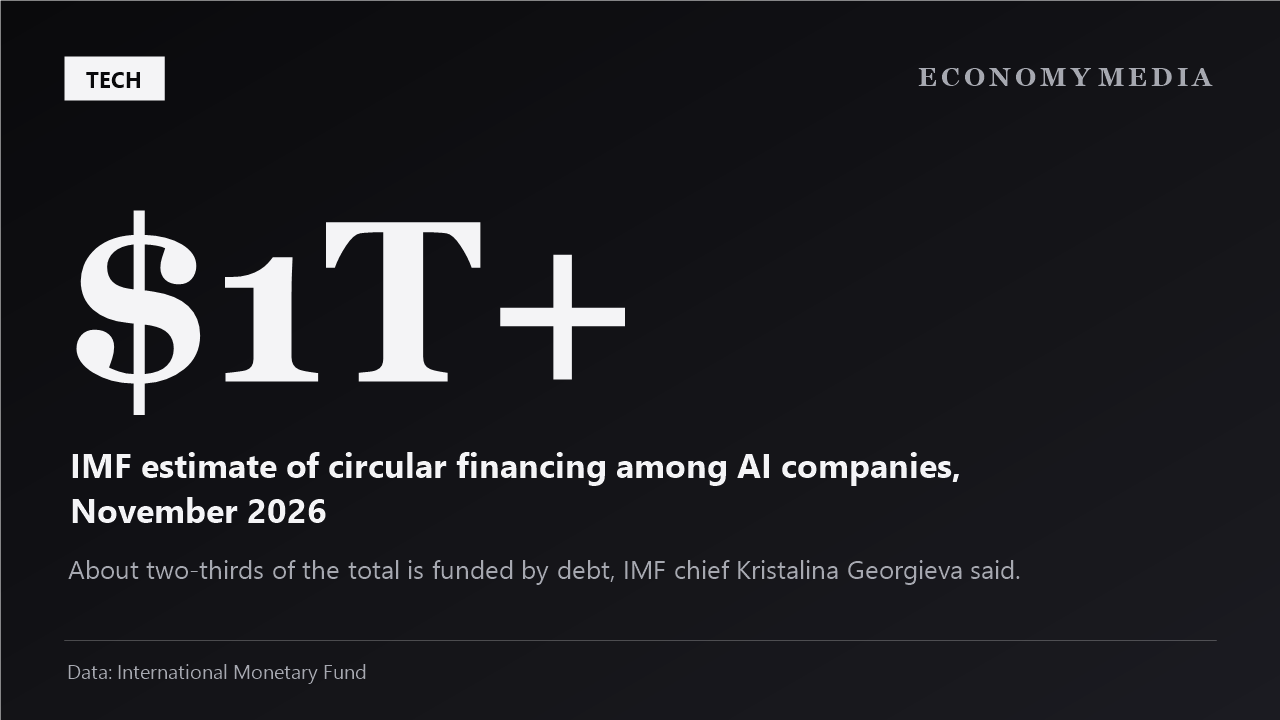
Kristalina Georgieva, managing director of the International Monetary Fund, warned on Monday that the world economy is leaning too heavily on artificial intelligence, saying so-called circular financing among AI companies has grown to a little over $1 trillion, with roughly two-thirds of it funded by debt. She made the remarks in an interview with CNBC on the sidelines of the summit of the Association of Southeast Asian Nations (ASEAN), the 11-member regional bloc, in the Philippines.
What Georgieva said
Circular financing describes arrangements in which money invested in an AI company eventually flows back to the investor, often through purchase orders for chips or computing capacity. According to CNBC, Georgieva said the total is not huge on its own, but that it has been rising quickly.
She described AI as the one leg the global economy is standing on and said that if that leg weakens, it could create problems for financial stability. CNBC reported that she singled out a sudden drop in investor confidence and a pullback from the AI sector as a risk to growth.
Georgieva also said investor enthusiasm is running ahead of what the technology has so far proven, noting that markets tend to rush ahead, and she said she expects some corrections. Even so, she characterized recent swings in stock prices as orderly and unlikely on their own to undermine the world economy, while urging caution and vigilance.
Why it matters now
The warning comes during a rough stretch for AI-linked stocks. Nvidia, the chipmaker whose processors power most advanced AI systems, has lost more than $1 trillion in market value over the past month, CNBC reported. The company sits at the center of many of the circular deals Georgieva described, because it has invested in AI developers and cloud providers that in turn buy its chips.
The sell-off has been tied in part to the turmoil surrounding Jensen Huang, Nvidia’s co-founder, who resigned as chief executive last week amid a personal scandal that CNBC said has drawn fresh scrutiny to Nvidia’s role as a major financier of AI infrastructure. Tim Arcuri, an analyst at the Swiss bank UBS, estimated that a pullback in Nvidia’s financing could pull $50 billion or more out of the system, according to CNBC. Rising interest rates have also made it more expensive for companies to borrow.
Investor appetite for AI faces further tests this week, with Nvidia due to report quarterly earnings and AI developer Anthropic expected to complete a large stock market listing.
Background: a theme the IMF has pressed for months
Georgieva has been building this argument since at least October. At a press briefing closing the IMF and World Bank annual meetings in Bangkok on Oct. 17, she said that depending on a single driver of growth “is like we stand on one leg,” according to The Nation, a Thai English-language newspaper. She added that the foundations of global resilience were showing cracks, pointing to depleted energy and fiscal buffers, stubborn inflation and higher interest rates that are raising debt-service costs.
In an Oct. 15 blog post on the IMF’s website titled “The World Can’t Afford to Get AI Wrong,” Georgieva described the AI industry as highly concentrated and highly leveraged, with large cloud companies, known as hyperscalers, investing in frontier-model developers that then buy data-center capacity from those same firms. She wrote that in a severe case, a market correction could cascade through that ecosystem and “the losses could spread around the world.” Key points from that post include:
- Hyperscalers’ share of investment-grade bond issuance has risen more than tenfold, from less than 1% to 10%.
- AI could lift growth by about half a percentage point a year over the next decade if productivity gains materialize.
- Roughly 40% of jobs worldwide are exposed to AI, rising to about 60% in advanced economies.
- The International Energy Agency expects data centers to account for 3% of global electricity use by 2030.
The IMF raised its 2026 global growth forecast to 3.1% in October, CNBC noted, as major economies counted on AI investment to offset a slowdown caused by an energy crunch linked to the war involving Iran. CNBC also cited an estimate from the research firm Capital Economics that as much as 80% of the recent growth in global exports is concentrated in AI-related goods.
What comes next
The IMF has already sketched out how a downturn could unfold. In October it warned that a short-term disappointment in AI could trigger a disorderly correction across asset classes; in its worst-case scenario, U.S. stock prices could fall 20% in 2026 and global output could be 1.1% below its baseline by 2028, CNBC reported.
In her blog post, Georgieva urged policymakers to prioritize stability by using capital and concentration requirements to contain risk, broadening the sources of financing for the AI sector, stress-testing banks and strengthening cyber defenses. She also called on governments to revisit medium-term budget plans, warning that AI could raise growth but also reduce labor income, widen inequality and erode tax bases.
For now, the IMF chief’s message is one of watchfulness rather than alarm: the circular financing loop is still modest relative to the global economy, she said, but it is growing fast enough to warrant close attention as markets digest a turbulent month for the industry’s biggest names.