NASA’s Swift Observatory Ends 22-Year Run After Failed Rescue Bid
Built for a two-year mission, NASA's Swift spent 22 years tracking cosmic explosions before a failed robotic rescue left it to burn up over Indonesia.
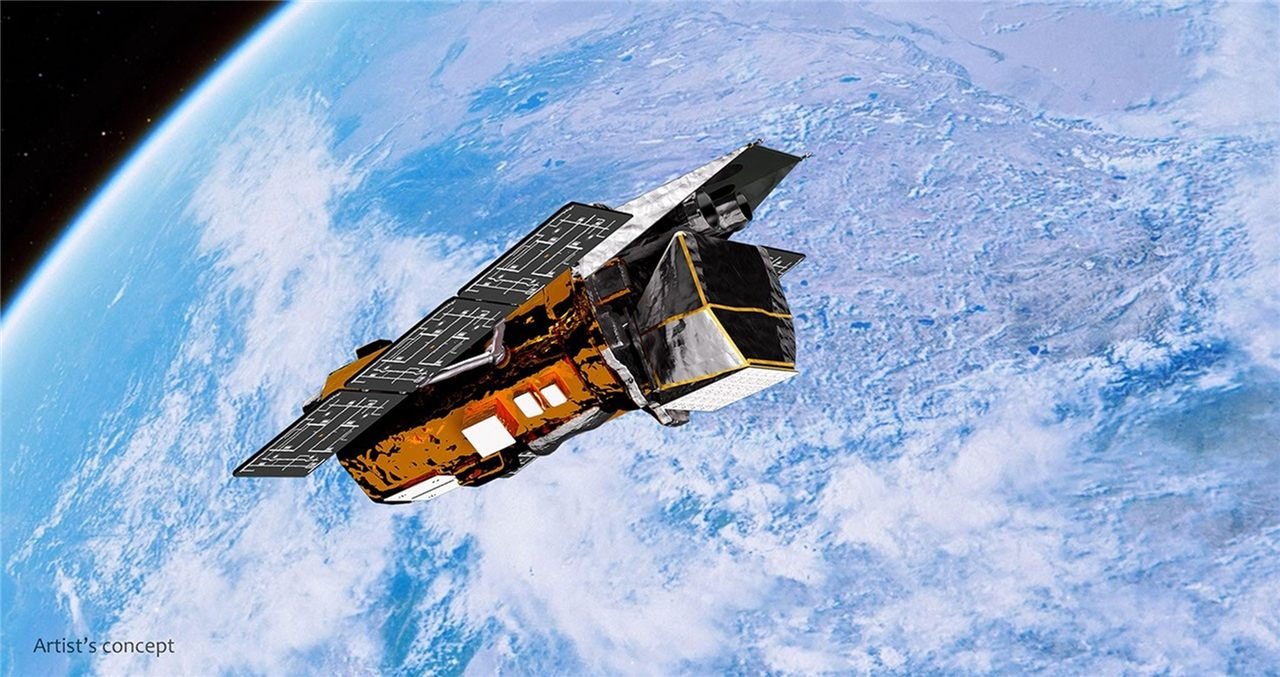
NASA’s Neil Gehrels Swift Observatory, a space telescope built to catch the most powerful explosions in the universe, has ended a nearly 22-year career that ran more than ten times longer than planned. The 3,200-pound spacecraft fell back into Earth’s atmosphere over Indonesia on Nov. 4. That came after a first-of-its-kind commercial attempt to boost it to a higher orbit failed over the summer. As scientists look back on the mission, WIRED described it this week as an observatory that recorded thousands of gamma-ray bursts and watched stars being torn apart by black holes before it was lost.
What happened
The U.S. Space Force reported that Swift reentered at 12:39 UTC on Nov. 4, or 7:39 a.m. Eastern time, over northern Sumatra, according to EarthSky, a science news site. Most of the spacecraft was expected to burn up. NASA had warned that some pieces could survive to the surface and had put the risk of harm to anyone on Earth at about 1 in 2,100, ABC7 reported in a story distributed by CNN Wire. That outlet said it was not immediately clear whether any debris reached land.
The reentry was not a surprise. Swift has no engines of its own, so it could not push itself back up as the thin upper atmosphere dragged on it. The sun reached the peak of its roughly 11-year activity cycle in 2024, and in the years since, intense solar flares and coronal mass ejections have heated and puffed up Earth’s outer atmosphere. That increased the drag on low-orbiting satellites and sped up Swift’s descent. In a statement quoted by ABC7, NASA said the spacecraft eventually “was no longer able to compensate for the effects of the increased drag.”
Swift’s instruments had been switched off for months to save power and were turned back on near the end. Penn State, which runs the mission’s operations center for NASA, sent what ABC7 called the final “kill-switch command” on Oct. 20, after the observatory had sunk to about 171 miles (275 kilometers) above the planet.
The rescue that fell short
NASA had tried to save the telescope. In September 2025 the agency hired Katalyst Space Technologies, a company based in Flagstaff, Arizona, to try to raise Swift’s orbit, according to NASA’s mission page. Katalyst built a servicing spacecraft called LINK in about nine months. LINK weighed about 880 pounds (400 kilograms) and had three robotic arms designed to grab Swift and lift it to a safer altitude.
LINK launched on July 3, 2026, on a Northrop Grumman Pegasus XL rocket, which is released from an airplane in flight rather than lifting off from a pad, over the Kwajalein Atoll in the Marshall Islands. NASA said the boost would have had its best chance of success while Swift’s average altitude stayed above about 185 miles (300 kilometers).
The mission ran into trouble within weeks. EarthSky reported that two of LINK’s three reaction wheels, the spinning devices a spacecraft uses to control which way it points, failed. That sent the vehicle into an uncontrolled spin with only patchy communications. On Aug. 19, NASA and Katalyst announced that LINK would not capture or boost Swift, citing what NASA called “an ongoing commercial spacecraft attitude control issue.”
“This is not the outcome we were working toward, but it does not change why this mission was worth attempting,” said Jared Isaacman, the NASA administrator, according to EarthSky. ABC7 reported that a successful boost could have kept Swift working for a decade or more.
Why the mission mattered
Swift launched on Nov. 20, 2004, with a planned mission of just two years. NASA renamed it in honor of Neil Gehrels, the mission’s late principal investigator. It carried three telescopes that worked together: the Burst Alert Telescope, which picks up gamma rays, plus an X-ray telescope and an ultraviolet and optical telescope. NASA managed the mission from its Goddard Space Flight Center, with partners that included the Italian Space Agency and the UK Space Agency.
Gamma-ray bursts are short, intense flashes of high-energy light. Many come from massive stars collapsing or from collisions between dense stellar remnants, and they can fade within seconds. Swift was designed to spot a burst, swing around automatically, and point its other instruments at the fading glow within moments. That gave astronomers worldwide a chance to follow up before the signal disappeared.
EarthSky tallied the mission’s output:
- More than 2,000 gamma-ray bursts observed
- More than 1,400 supernovae, or exploding stars, observed
- Data that contributed to roughly 7,000 scientific papers
The observatory also studied stars shredded by black holes, active galaxies, asteroids and comets. NASA highlighted a mosaic of the Andromeda galaxy built from 330 separate Swift images, which the agency called its highest-resolution ultraviolet view of that galaxy.
What comes next
Swift’s loss comes as NASA weighs the future of other aging observatories in low Earth orbit. ABC7 noted that NASA has asked industry for ideas about the Hubble Space Telescope, and that the agency’s own analysis gives Hubble a 10% chance of falling out of orbit by 2032 and a 50% chance by 2033.
The episode has also brought attention to the rules for uncontrolled reentries. Parker Wishik, a spokesperson for The Aerospace Corporation, a federally funded research center, told ABC7 that current U.S. standards, updated in 2019, require such reentries to carry an expected casualty risk of less than 1 in 10,000. He said a spacecraft launched today would likely face stricter end-of-life requirements than Swift did.
For NASA, the failed boost was also a test of whether commercial servicing vehicles can be built quickly enough to extend the lives of valuable science missions. The agency had hoped to show that such a rescue could preserve Swift’s capabilities for a fraction of the cost of building a new observatory. This time, it could not.