New York Opens AI Safety Registry, Putting OpenAI and Anthropic on Notice
New York opened a registration portal for frontier AI developers under its RAISE Act, with a Jan. 1 deadline and fines of up to $3 million.
New York on Tuesday began putting its sweeping artificial intelligence safety law into practice, opening an online portal where the largest AI developers, including OpenAI and Anthropic, must register with the state by Jan. 1, 2027. The move starts the clock on rules that will require those companies to publish safety plans, disclose details about their models and report serious safety incidents to regulators within 72 hours.
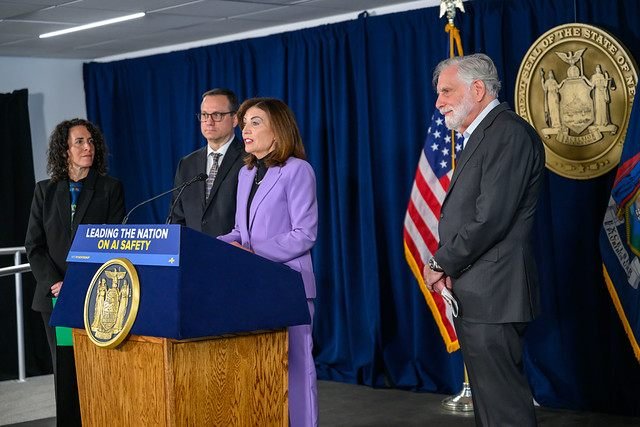
Kathy Hochul, the Democratic governor of New York, announced the portal at a press briefing in Albany alongside the launch of a new state-backed AI safety research center at Binghamton University, part of the State University of New York (SUNY) system.
What the law requires
The law, known as the Responsible AI Safety and Education Act, or RAISE Act, targets what it calls “large frontier developers,” defined as companies that, together with their affiliates, had more than $500 million in annual revenue in the prior year. Frontier models are the most advanced, general-purpose AI systems, such as those behind chatbots like ChatGPT and Claude.
According to TechCrunch and the governor’s office, covered companies will have to:
- Register with the state through the new portal by Jan. 1, 2027;
- Publish a safety framework on their websites starting in January;
- Report critical safety incidents to the state within 72 hours of learning about them;
- Issue public transparency reports about their models.
Violations can bring fines of up to $1 million for a first offense and up to $3 million for subsequent ones, TechCrunch reported. The state can also take enforcement action against companies that fail to register, though a spokesperson declined to give TechCrunch specifics on how that would work.
The law will be administered by the Office of Digital Innovation, Governance, Integrity, and Trust, or DIGIT, a new unit within the New York State Department of Financial Services (DFS). The governor’s office described it as the first office of its kind. Kaitlin Asrow, acting superintendent of DFS, said in a statement that the department was “proud to lead the implementation of the RAISE Act.”
Why it matters
New York’s rules arrive as states, rather than Congress, set the pace on AI oversight. Hochul framed the effort in those terms. “While the federal government fails to act, New York is leading the way on AI safety and holding big tech accountable,” she said in a statement released by her office.
At the briefing, Hochul also took aim at the industry’s messaging, saying that “tech moguls tell us that their vision for AI is inevitable” and that the public is told to “get on board or get left behind,” according to TechCrunch. She called the state’s approach “a national model for smart, sensible AI regulation.”
The New York law closely resembles California’s SB 53, a frontier AI transparency law that took effect in January 2026, but it is stricter on timing. California gives developers 15 days to report critical safety incidents, compared with New York’s 72 hours, which the governor’s office called the strongest requirement in the nation. Illinois has a similar measure, SB 315, taking effect at the start of 2027, which adds independent compliance audits, TechCrunch reported.
Hochul first signed the RAISE Act in late 2025 and later approved amendments that brought it closer in structure to California’s law, according to legal analyses of the measure.
A new research center
Alongside the portal, Hochul launched the New York Center for AI Responsibility and Research at Binghamton University. The governor’s office said the center will independently test advanced AI systems for safety and security, conduct basic research and train AI safety specialists. At the state’s request, it will also help DIGIT review companies’ safety frameworks and recommend stronger requirements.
The center is backed by a $30 million philanthropic gift led by Tom Secunda, a Bloomberg LP co-founder and Binghamton alumnus who chairs the board of Empire AI, the state’s $500 million public-private computing initiative, plus a $25 million initial research investment from SUNY. Greg Morrisett, dean of Cornell Tech, and Jeannette Wing, executive vice president for research at Columbia University, will serve as interim co-directors.
What comes next
Compliance obligations begin on Jan. 1, 2027. New York is also layering on other AI rules: a law requiring AI companion apps to remind users they are talking to a bot is already enforced, and a law restricting manipulative chatbot behavior toward minors, signed in October, takes effect June 1, 2027, according to TechCrunch.
Further measures remain under discussion. In September, Hochul raised the idea of an AI “kill switch” that could let the state order a model shut down, though she did not describe how it would work, CBS6 Albany reported. Zach Kahn, a senior adviser at the American Innovators Network, an industry group, told the station that any such power should be tied to specific risks, saying, “We would want the government to find specific risk for each model.”