Oil Slips Ahead of OPEC+ Meeting on 2027 Output; Brent Gains on Week
Brent settled at $95.44 and WTI at $83.08 on Nov. 27 as traders weighed Gulf attacks against an OPEC+ meeting set to decide 2027 supply policy.
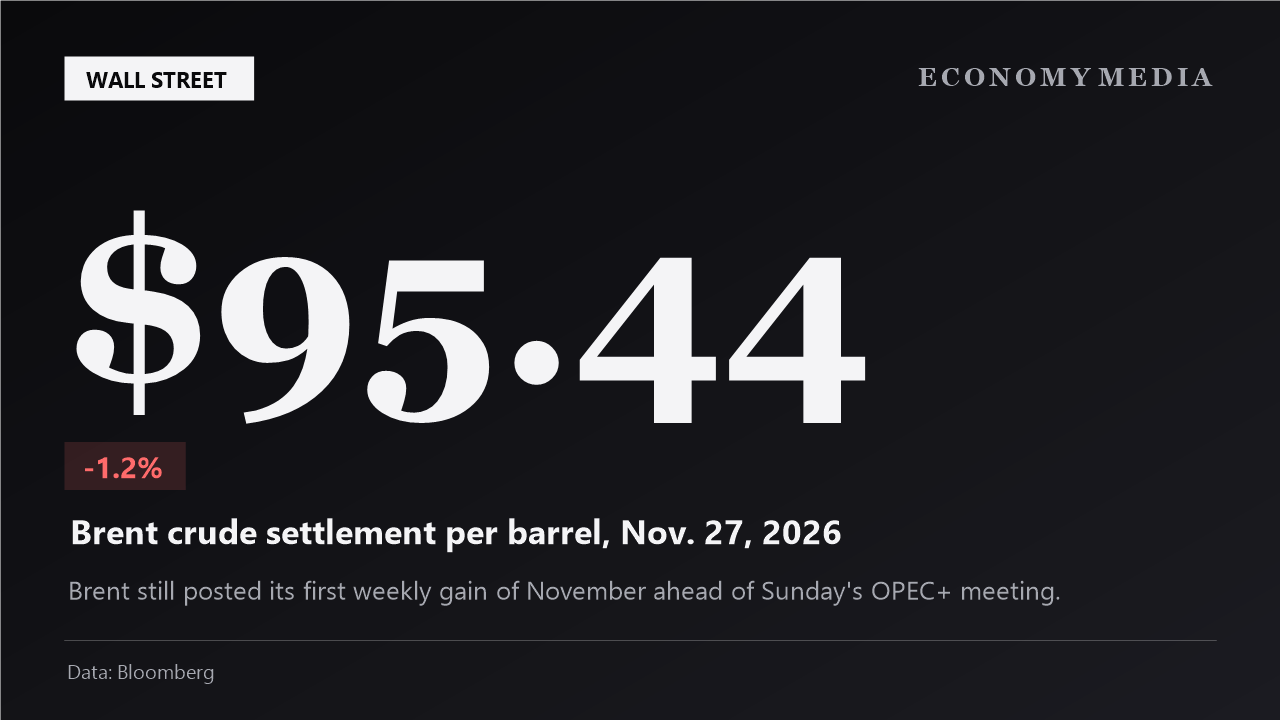
Oil prices settled lower on Friday, Nov. 27, as traders prepared for a weekend meeting of OPEC+ that is expected to shape crude supply for 2027. Attacks on Saudi energy facilities and on shipping around the Strait of Hormuz kept supply worries alive. Brent crude, the international benchmark, still finished with its first weekly gain of November.
Brent for January delivery fell 1.2% to settle at $95.44 a barrel, Bloomberg reported in a story republished by the energy news site Rigzone. West Texas Intermediate (WTI), the U.S. benchmark, slipped 0.7% to $83.08. Because of the U.S. Thanksgiving holiday, Thursday’s trades were booked together with Friday’s session. One report put Brent’s daily drop at $1.13 and WTI’s at 60 cents from Wednesday’s close.
What happened
Prices moved back and forth in a holiday-thinned session. Earlier in the day Brent rose as high as $98.06, according to a technical market note published by FXEmpire, a financial markets site. It then gave up those gains and stayed well below $100. Reports put Brent’s weekly advance at about 3%, ending a three-week losing streak. Brent briefly reached its strongest level since Nov. 9.
The latest violence in the Gulf gave the market support. A projectile struck Saudi Aramco’s Jazan refinery near the Red Sea on Thursday, temporarily halting some operations. One report said the strike killed a worker, citing Saudi Arabia’s Energy Ministry. Bloomberg said Iran-backed Houthi militants had attacked Jazan again, days after they claimed an attack on Ras Tanura, the kingdom’s main oil export hub on the Persian Gulf. Attacks on tankers in and around the Strait of Hormuz also continued as the Iran war entered its tenth month, Bloomberg reported. Ship-tracking data from the analytics firm Vortexa showed traffic through the waterway has stayed resilient.
“Traders are still focused on the escalation of Strait of Hormuz attacks, and that’s keeping a bid under prices,” Dennis Kissler, senior vice president for trading at BOK Financial Securities, told Bloomberg. Mark Schaefer, a director at the brokerage Liquidity Energy, said the attacks “have brought supply disruption back into focus.”
The OPEC+ decision
OPEC+ groups the Organization of the Petroleum Exporting Countries with allied producers led by Russia. It meets online on Sunday, Nov. 29, and the group’s current production quotas expire at the end of the year. Three sources told Reuters that the group has an agreement in principle to keep its first-quarter 2027 output targets unchanged, FXEmpire reported, citing the Reuters story.
The reports differ on how firm that plan is. Bloomberg said the alliance was considering keeping its current quotas through January and that members remain at odds over how much oil they can sustainably pump. Ministers are also expected to discuss a review of each member’s production capacity. Iraq and Kazakhstan are seeking higher estimates. Basim Mohammed Khudair, Iraq’s oil minister, said his country is negotiating with OPEC to raise its production ceiling.
Earlier in November, seven core OPEC+ members kept their December output targets unchanged. That left the 2027 framework as the main decision for this weekend’s ministerial meeting.
Why it matters
Prices are being pulled in two directions:
- Supply risk: Strikes on Saudi refineries and on tankers near Hormuz keep the threat of sudden outages in view. Saul Kavonic, an energy analyst at MST Marquee, told Bloomberg that markets are starting to price in the “inherent instability of the status quo.”
- Surplus outlook: The International Energy Agency (IEA), the Paris-based energy watchdog, forecasts that the oil market will move into surplus this quarter. Kissler said the volumes moving through and around Hormuz still point to “an eventual oversupplied market.”
- Restocking demand: Amrita Sen, founder and director of the consultancy Energy Aspects, said on Bloomberg Television that the need to rebuild stockpiles could support demand, with China leading that push.
Outside the Middle East, Ukraine has stepped up drone attacks on Russian refineries. Bloomberg reported that Russia’s refinery processing rates have fallen to their lowest in more than two decades, citing the consultancy Rystad Energy.
What comes next
The decision on Sunday will be the market’s first major signal of 2027 supply policy. If OPEC+ keeps targets unchanged, FXEmpire noted, some uncertainty could lift. A disagreement over capacity baselines could make the outlook harder to read. Traders will also watch whether the Gulf attacks continue and whether U.S. President Donald Trump keeps holding off on new strikes against Iran. Bloomberg reported that he has done so since the U.S. midterm elections.