US Approved Over 879,000 AI Chips for China, House Panel Says
A House committee released export license data showing Commerce approved more than 879,000 Nvidia and AMD AI chips for Chinese buyers in six months.
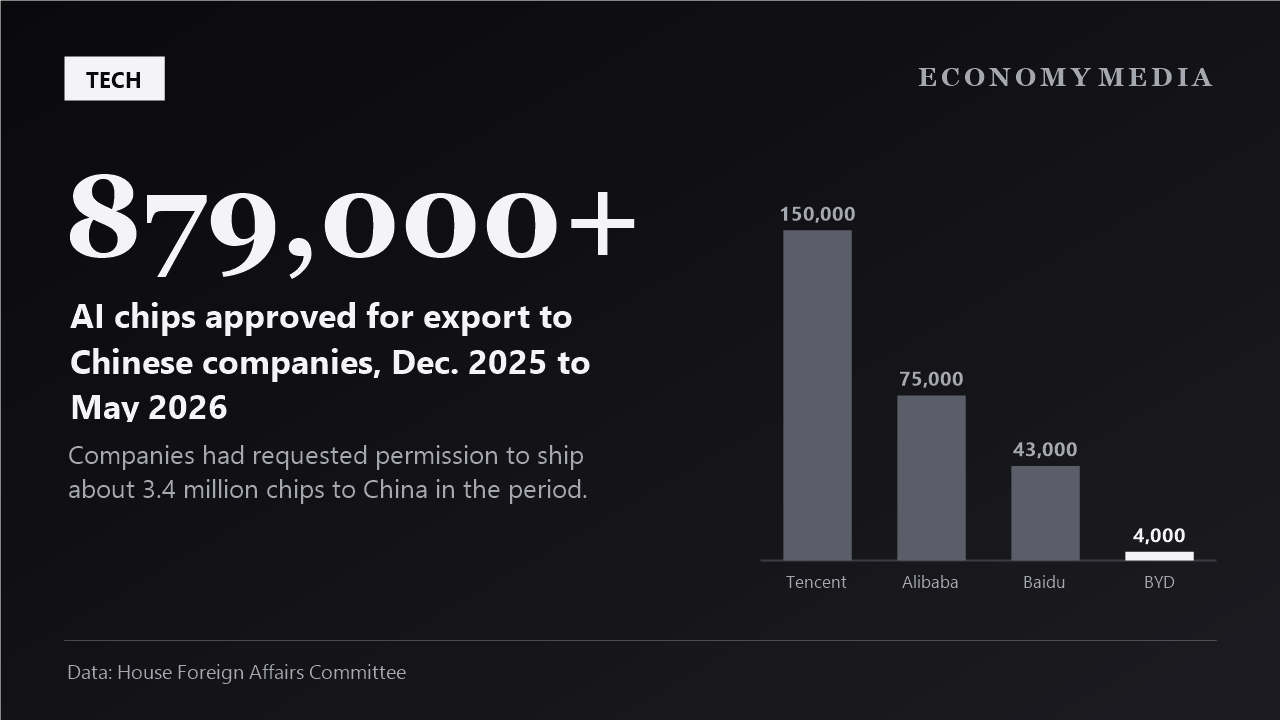
The U.S. Commerce Department approved the export of more than 879,000 advanced artificial intelligence chips made by Nvidia and Advanced Micro Devices (AMD) to Chinese companies between December 2025 and May 2026, according to export license records the House Foreign Affairs Committee made public on Thursday. Companies had asked to ship about 3.4 million chips to China during that period. Among the approved buyers were firms the Pentagon lists as Chinese military companies.
What the records show
The committee said the approvals came from the Bureau of Industry and Security (BIS), the Commerce Department agency that licenses and enforces U.S. export controls. It said Nvidia and AMD had requested permission for roughly 3.4 million chip sales to China. That works out to about one approval for every four chips requested.
Reuters reported that the approvals included about 150,000 chips for Tencent, 75,000 for Alibaba, 43,000 for Baidu and 4,000 for electric vehicle maker BYD. According to the committee, all four companies appear on the Defense Department’s list of companies it says are tied to China’s military. CNBC reported that license requests also named ByteDance, the owner of TikTok, along with Tesla’s Shanghai unit. The licenses covered Nvidia’s H200 processor and AMD’s comparable MI325X.
The approvals do not necessarily mean the chips were delivered. Reuters noted that it was not clear how many of the licenses led to actual shipments. In a statement, Nvidia said the approvals were “subject to strict conditions and limited volumes” and that it has since stopped shipping H200s to China. AMD said it follows U.S. export control laws and keeps rigorous compliance processes in place. The Commerce Department did not immediately respond to requests for comment, according to both Reuters and CNBC.
Concerns over possible smuggling fronts
Rep. Brian Mast, a Florida Republican who chairs the House Foreign Affairs Committee, called the release “the most detailed public disclosure in the history of the Export Control Reform Act,” the committee said in a statement. The Export Control Reform Act is the 2018 law governing U.S. export controls. The committee said the law lets it release such data when withholding it would be against the national interest.
According to the committee, the documents include requests in which Nvidia relied on possible chip-smuggling fronts to complete sales. At a committee meeting on Thursday, Mast pointed to two firms named in Nvidia’s license applications, Maginfra and New Matrix. “Both are fake companies,” he said, according to CNBC, adding that BIS approval of chip sales to them would be of “tremendous concern.” CNBC noted that The New York Times had earlier reported that both firms had empty offices and links to companies under U.S. national security sanctions. Neither company immediately responded to requests for comment.
Rep. Gregory Meeks of New York, the committee’s top Democrat, said the administration’s handling of chip export controls had “put our national security and technology edge at risk” and argued that BIS had not enforced the rules. “The public has the right to know how these decisions were made,” he said, as quoted by CNBC.
Chris McGuire, a former U.S. official who studies the U.S.-China technology contest, told Reuters it was “astonishing” that more than 30% of the chips went to companies the Pentagon has designated as Chinese military companies.
Background: a shifting policy and a scandal
The administration of President Joe Biden barred Chinese buyers from these chips. President Donald Trump reversed course in December 2025 and allowed Nvidia to sell its H200 in China. In July, Jeffrey Kessler, a senior Commerce official, told the committee that shipments had begun but that there had been “very few,” Reuters reported.
The release adds to growing scrutiny of Nvidia. Jensen Huang, Nvidia’s co-founder, resigned as chief executive after reports of several extramarital affairs, including one with a person suspected of spying for China. CNBC reported that those reports raised fears that Nvidia chips could be diverted to China. Commerce Secretary Howard Lutnick has faced criticism over his ties to Huang and over his handling of Megaspeed, a Singapore-based company that U.S. investigators suspect of diverting Nvidia chips to China. No court has ruled on these matters.
What comes next
Huang is scheduled to sit for a closed-door transcribed interview with the Foreign Affairs panel and two other House committees on Dec. 1, and Tim Teter, Nvidia’s general counsel, is set to appear on Dec. 2, CNBC reported. Sen. Tim Scott, the South Carolina Republican who chairs the Senate Banking Committee, said this week that Huang and Lutnick had agreed to testify.
Separately, Commerce on Monday issued an interim rule to close a loophole that let Chinese companies rent Nvidia computing power from data centers in other countries. Lawmakers from both parties are also pushing for laws that would tighten export controls on advanced AI chips bound for China.