US Private Employers Add 86,000 Jobs in October, Edging Past Forecasts
Private employers added 86,000 jobs in October, ADP said, slightly above forecasts, as pay growth for job-changers picked up.
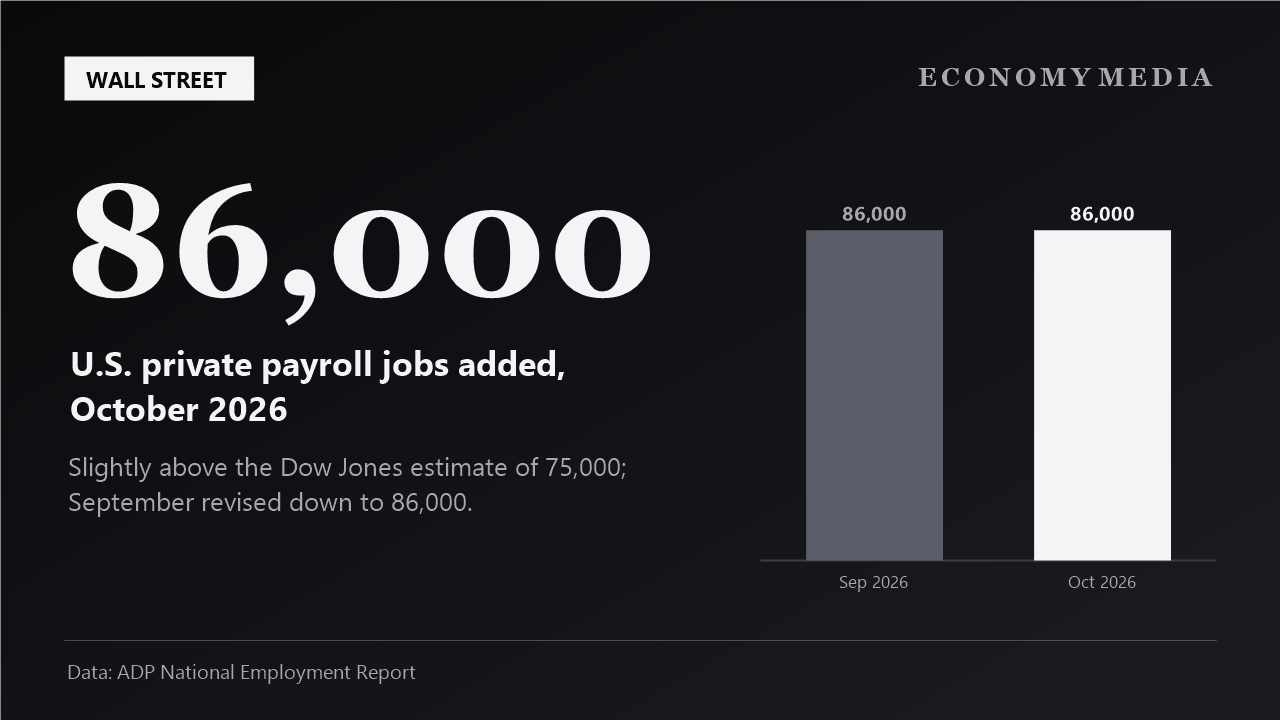
U.S. private employers added 86,000 jobs in October, according to the ADP National Employment Report released Wednesday, Nov. 4. The gain came in slightly above economists’ expectations and matched September’s downwardly revised total. The monthly report from ADP, the payroll processing company, arrives two days before the government’s official jobs count and points to a labor market that is holding steady rather than speeding up.
What the report showed
CNBC reported that the total was a little better than the 75,000 increase forecast by economists polled by Dow Jones. ADP also revised September’s figure to 86,000 from the 90,000 it first reported, so private hiring ran at the same pace for two straight months.
Service-providing businesses accounted for nearly all of the growth, adding 82,000 positions, while goods producers added 4,000, ADP said. Trade, transportation and utilities led with 39,000 new jobs, followed by education and health services with 28,000 and leisure and hospitality with 19,000. Financial activities added 15,000, construction 13,000 and other services 10,000.
Several sectors lost jobs. Professional and business services shed 27,000, its third straight monthly decline, according to ADP. Natural resources and mining cut 8,000, information 2,000 and manufacturing 1,000. CNBC noted that information services is a sector that could be affected by the artificial intelligence buildout.
Hiring was spread across companies of different sizes. Medium-sized establishments, those with 50 to 499 workers, added 33,000 jobs. Small businesses with fewer than 50 employees added 28,000, and large employers with 500 or more workers added 24,000, ADP said. By region, the South led with 47,000 jobs, followed by the West with 28,000, the Midwest with 9,000 and the Northeast with 3,000.
“Employers of all sizes were hiring last month,” Nela Richardson, ADP’s chief economist, said in the release.
Pay gains favor job-switchers
ADP’s pay data showed a growing gap between workers who stayed with their employers and those who moved. The company reported these year-over-year changes in median pay for October:
- Base pay for all workers: up 3.2%
- Base pay for job-stayers: up 3.0%
- Base pay for job-changers: up 4.8%
- Gross pay, which includes extras such as bonuses and overtime, for all workers: up 4.7%
- Gross pay for job-changers: up 7.6%
Richardson said job-changers were drawn by a combination of bonuses, overtime, more hours and higher base pay. Taken together, she said, earnings growth for those workers “hit its fastest pace since March 2024.”
Why it matters
The ADP report is based on anonymized payroll data from the company’s clients and is produced in collaboration with the Stanford Digital Economy Lab, a research group at Stanford University. Investors and economists watch it as an early read on hiring ahead of the Bureau of Labor Statistics (BLS) nonfarm payrolls report, the government’s main monthly jobs measure. The two often differ because they use different methods, and the government count also includes public-sector jobs.
Other recent readings have pointed in different directions. ADP’s weekly preliminary estimate, known as NER Pulse, showed private employers added an average of 16,750 jobs a week in the four weeks ended Oct. 10, down from 26,000 a week in the four weeks ended Sept. 26. ADP said at the time that hiring had slowed for a second week and cautioned that the weekly numbers are preliminary and may change.
At the same time, CNBC noted that a BLS report released Tuesday showed the number of workers quitting their jobs rose to its highest level since March 2025. Quits are often read as a sign that workers feel confident about finding new positions, which fits with ADP’s finding of faster pay growth for job-changers.
What comes next
The BLS is scheduled to publish its October employment report on Friday, Nov. 6. Economists surveyed by Dow Jones expect it to show an increase of 59,000 nonfarm payroll jobs, after a gain of 29,000 in September, CNBC reported. Federal Reserve officials closely watch hiring and wage figures when they set interest rates, so Friday’s data will be studied for signs of whether the labor market is steadying or cooling further.
ADP said its next monthly National Employment Report, covering November, is due Dec. 2.