10-Year Treasury Yield Hits 5% as Hot Inflation Fuels Fed Hike Bets
The benchmark 10-year Treasury yield climbed to about 5% on Nov. 10 after October inflation beat forecasts and a Fed governor backed a December hike.
The yield on the 10-year U.S. Treasury note climbed to around 5% on Tuesday, Nov. 10, 2026. Hotter-than-expected October inflation data, along with hawkish remarks from a senior Federal Reserve official, led investors to bet that the central bank will raise interest rates again next month. Shorter-dated yields jumped even more sharply, and stocks fell as higher borrowing costs weighed on technology shares.
What happened
The Labor Department’s Bureau of Labor Statistics said its consumer price index, the main U.S. gauge of what households pay for goods and services, rose 0.4% in October from September. That beat the 0.3% economists had expected but was slower than September’s 0.6% gain. Core prices, which leave out volatile food and energy costs, rose 0.3%, against a forecast of 0.2%. CNBC reported that both readings came in 0.1 percentage point above the Dow Jones consensus.
Bonds sold off right after the 8:30 a.m. ET release. Different outlets captured the move at different moments, so the reported levels vary. Yahoo Finance’s live blog said the 10-year yield rose 7 basis points to 4.93% shortly after the data, while its market ticker later showed the yield at 5.01%. An intraday quote table published by the financial news site Beinsure put the 10-year at 4.988%, up 12.6 basis points. The Wall Street Journal reported that the benchmark had moved above 5%. (A basis point is one-hundredth of a percentage point. Bond yields rise as bond prices fall.)
The biggest moves came in shorter maturities, which track Fed policy expectations most closely. Beinsure’s table showed the two-year yield up 18.9 basis points at 4.736% and the one-year yield up 18.5 basis points. Yahoo Finance, in a story republished by AOL, put the two-year at 4.69%, up 14 basis points. The 30-year yield rose to roughly 5.3%.
The Fed factor
Before the inflation report came out, Christopher Waller, a member of the Federal Reserve Board of Governors, told an audience in London that he was “leaning toward” a quarter-point rate increase at the Fed’s December meeting, CNBC reported. He said he would consider a half-point move if inflation came in above forecasts. “Hiking only 25 basis points would put our credibility at risk,” Waller said, according to CNBC.
The Fed’s rate-setting body, the Federal Open Market Committee, raised rates by a quarter point in September. It held them steady in October, according to CNBC. Beinsure said the October decision kept the benchmark federal funds rate at 3.75% to 4.00%. Other officials have also leaned hawkish. Lorie Logan, president of the Federal Reserve Bank of Dallas, expects two more quarter-point increases before a pause, and Austan Goolsbee, president of the Chicago Fed, has warned against letting the economy overheat, CNBC reported.
Traders moved quickly to price in tighter policy, though estimates differed slightly. Citing the CME Group’s FedWatch tool, which derives odds from futures prices, Yahoo Finance reported an 89% chance of a December hike. In an earlier update, it put the odds of a quarter-point increase at 84% and of a half-point move at 15%, up from zero the day before. CNBC said traders had fully priced in a quarter-point hike and assigned 12.5% odds to a half-point increase.
Why it matters
The 10-year Treasury yield is a key reference point for borrowing costs across the economy, including mortgages and corporate debt. Higher yields also raise the discount rates investors use to value future corporate profits, Beinsure noted. That tends to hit fast-growing technology stocks hardest.
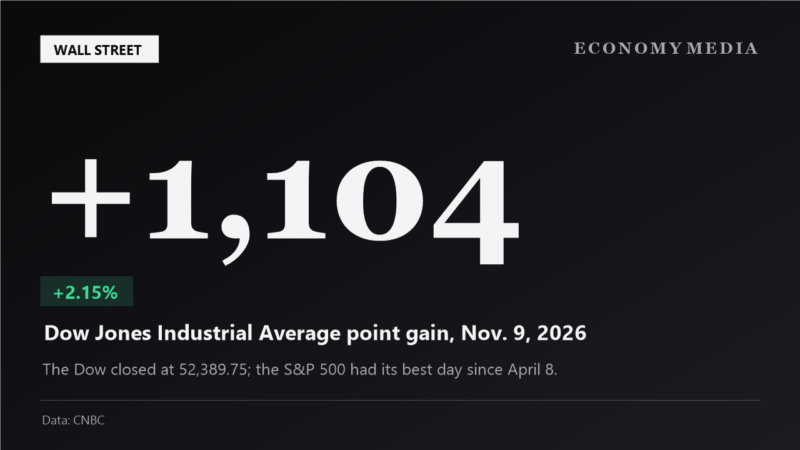
Stocks fell on Tuesday. Yahoo Finance reported that the Dow Jones Industrial Average was down about 0.6% during the session, the S&P 500 roughly 0.8% to 0.9%, and the Nasdaq Composite about 1.4%. Chipmaker Nvidia extended Monday’s losses. Several pressures were in play:
- Higher Treasury yields across maturities, led by the two-year note
- Rising odds of a December Fed rate increase
- Continued weakness in semiconductor shares
Lower energy prices partly offset the pressure. Brent crude, the global oil benchmark, fell about 3% to below $90 a barrel, according to Yahoo Finance and Beinsure.
What comes next
The government did not publish an annual inflation rate for October. Beinsure said the 2025 federal shutdown prevented the bureau from collecting the comparison data. The annual rate was 3.7% in September, and some economists estimate it picked up slightly in October. Investors will watch further data and comments from Fed officials before the December meeting. The labor market is part of that picture: employers added 165,000 jobs in October, well above forecasts.