AI Tops List of Threats to US Financial System in Fed Survey
Eighty-seven percent of market contacts surveyed by the Federal Reserve named AI as a key risk to the financial system, up from 50% in the spring.
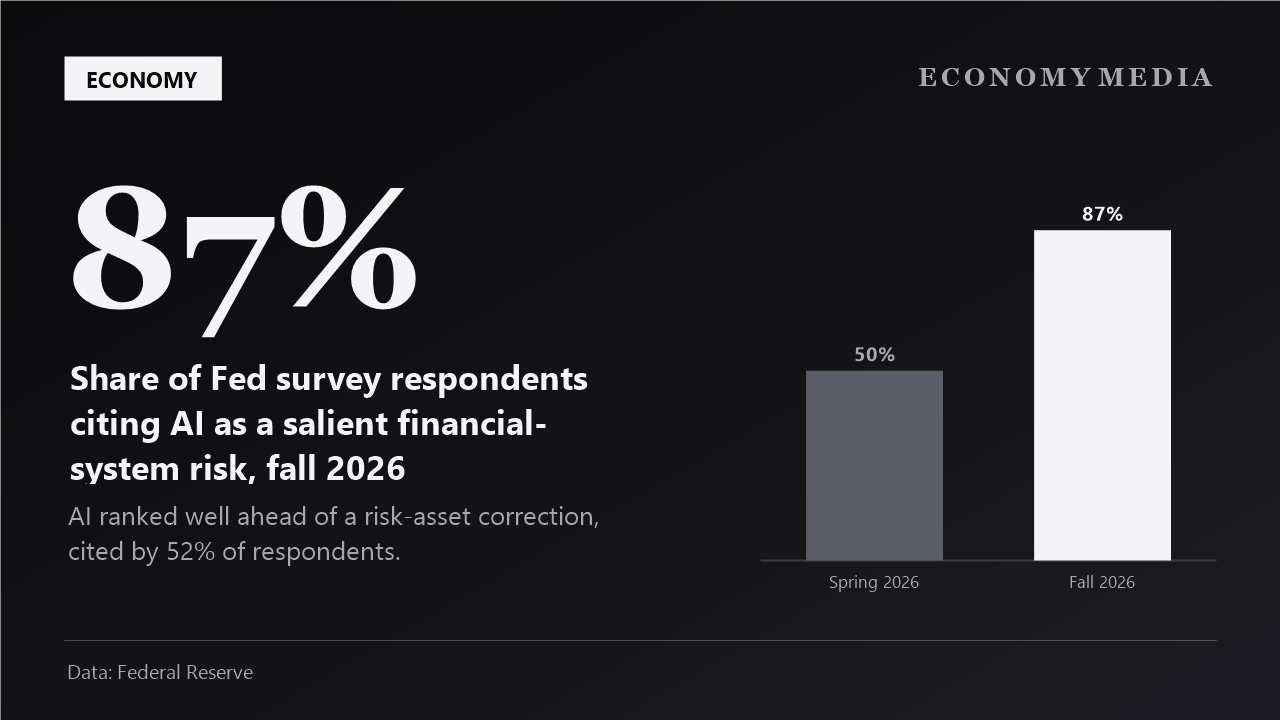
Artificial intelligence has become the leading worry about the stability of the U.S. financial system, according to a Federal Reserve survey published Friday. In the central bank’s twice-yearly Financial Stability Report, 87% of the market participants and analysts it surveyed named AI as a salient risk. That was up from 50% in the spring survey and well ahead of every other concern.
The report, which the Fed uses to assess weak points in the financial system, also warned that borrowing to build data centers and other AI infrastructure is growing quickly. It said the deals tying together tech giants, lenders and investors deserve close watching.
What the survey found
The Fed collects views from a mix of market participants, economists, analysts and institutional contacts. Reuters reported that this round was conducted in September and October, and CNBC said it covered the period through Oct. 28, a few days before this month’s midterm elections.
After AI, the most-cited risks were:
- A broad correction in prices of riskier assets such as stocks: 52%
- Higher long-term interest rates: 48%
- Cyberattacks: 43%
- The sustainability of government debt: 43%
According to the report, respondents’ AI concerns fell into three areas. The first is stock prices: valuations are high, and earnings from AI could fall short of expectations, which could set off a market sell-off. The second is cybersecurity, whether from sophisticated attacks by foreign governments or from damage caused by the most advanced AI models themselves. The third is what the Fed called complex forms of AI-related financing.
A borrowing boom behind the AI build-out
The report put numbers on that financing concern. Reuters reported that debt issued for advanced computing reached $680 billion by October, about five times the total for all of 2023. Such debt now makes up nearly a third of investment-grade bond sales by nonfinancial companies, up from less than 6% three years earlier.
Counting debt, guarantees and leases that have been signed but have not yet started, obligations tied to AI infrastructure could top $3 trillion, the Fed estimated. It compared the spending wave to the late-1990s build-out of telecom and broadband networks and said the current cycle may soon be bigger.
Much of that money moves through arrangements that link companies to one another. Large cloud providers, often called hyperscalers, and chipmakers sign long-term contracts, leases and guarantees that let smaller builders raise money for projects. They also take equity stakes in those builders. The Fed said this kind of circular financing could help the biggest firms absorb losses in a downturn. But it also warned that their exposure could be “substantially larger” than their balance sheets show, Reuters reported. The report said the links among data center developers, bond markets, private lenders and special-purpose financing vehicles “create vulnerabilities that necessitate close monitoring.”
Why it matters for households
AI investment has been a major engine of U.S. economic growth this year, the Fed noted. That is why the report treats a surprise drop in AI earnings as a risk to the wider economy, not just to tech investors. In the Fed’s scenario, a downturn could push markets lower, tighten credit and cut investment. For households, that could show up as smaller retirement balances, tougher lending standards and slower hiring.
The worries also extend beyond Wall Street. CNBC noted that communities have grown wary of the rapid spread of data centers. It also cited exit polling showing 56% of voters in this month’s midterm elections said data centers were of crucial or major importance to their choices.
The broader picture
The Fed did not sound an alarm about the system as a whole; CNBC reported that the Fed found it fairly stable. It said valuations across many asset classes remain high, driven in part by enthusiasm for AI. It also flagged hedge fund leverage, which is borrowing used to amplify bets. Leverage is at its highest since the Fed began collecting the data in 2013 and is concentrated among a relatively small number of the largest funds.
Other pressures remain in the background. CNBC pointed out that U.S. government debt exceeds $40 trillion and the annual budget deficit is close to $2 trillion, which helps explain why 43% of respondents flagged fiscal sustainability.
Because the survey closed in late October, it does not reflect this week’s turmoil around Nvidia, the chipmaker whose chief executive, Jensen Huang, stepped down on Thursday, Reuters noted. Nvidia has been among the most important companies in the AI investment wave. The Fed’s next survey, due in the spring, will show whether those concerns have grown or eased.