US Wholesale Inflation Hits 6.5%, Highest Annual Rate Since 2022
Producer prices rose 0.3% in October, lifting the annual rate to 6.5%, the fastest since November 2022, as the Fed weighs a December rate hike.
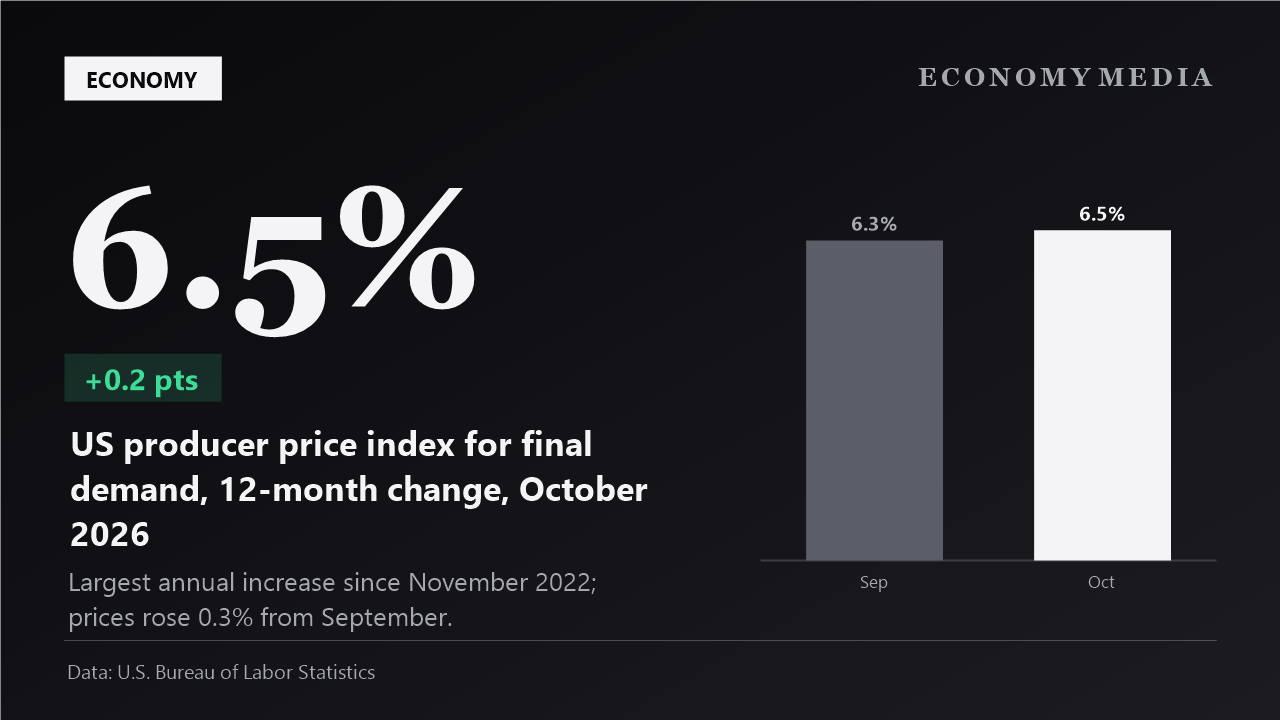
Prices that American businesses receive for their goods and services rose 6.5% in the year through October, the fastest annual pace in nearly four years, the U.S. Bureau of Labor Statistics (BLS) said Friday. The report adds to signs that inflation is spreading through the economy just weeks before the Federal Reserve meets on interest rates.
The producer price index (PPI) for final demand measures what domestic producers charge for their output, and it is often read as an early signal of the prices consumers will later pay. It rose a seasonally adjusted 0.3% from September. That was slightly below the 0.4% gain economists had forecast in surveys by Dow Jones and Reuters. Even so, the 12-month increase climbed from 6.3% in September to the highest level since November 2022, when the index was rising 7.4% a year.
What happened
According to the BLS release, goods prices at the wholesale level rose 0.5% in October after jumping 2.5% in September. Over the past year, goods prices are up 10.2%, which Reuters described as the largest 12-month gain in four years. Food prices rose 1.3% in the month. Reuters reported that fresh and dry vegetables, chicken, turkey and roasted coffee led that increase. Energy prices slipped 0.1%. Diesel fuel fell 7.9% for the month, though Reuters noted that it remains 115.2% more expensive than a year ago.
Goods other than food and energy rose 0.5%, with basic organic chemicals up 3.9%. Reuters reported that this category accounted for more than 60% of the overall goods increase.
Prices for services rose 0.2%, the fifth monthly advance in a row. Transportation and warehousing costs jumped 2.0%, and truck freight alone climbed 3.9%. Reuters said transportation accounted for about three-quarters of the services increase. Hotel and motel prices rose 2.5%, while airfares fell 1.2%.
A narrower gauge that strips out food, energy and trade services rose 0.5% for a second straight month and is up 4.9% from a year earlier. The BLS also revised its data for June through September. September’s monthly gain now stands at 1.4%, up from the 1.3% first reported, Reuters said.
Why it matters
Wholesale prices feed into what households pay for groceries, travel and other everyday purchases. Several PPI components are also used to calculate the personal consumption expenditures (PCE) price index, the inflation measure the Fed prefers. Reuters reported that economists estimate core PCE, which excludes food and energy, rose 0.3% in October. That would lift its annual rate to 3.2% from 3.1%, still well above the Fed’s 2% target.
Economists who spoke to Reuters were blunt. “There is no silver lining in the report,” said Christopher Rupkey, chief economist at FWDBONDS. Ben Ayers, senior economist at the insurer Nationwide, said he expects the PCE price indexes to come in hotter as well. He warned that the effects of the earlier spike in fuel prices could last into 2027, which he said would warrant further tightening by the Fed.
Chris Zaccarelli, chief investment officer at Northlight Asset Management, told CNBC that the report showed some improvement but that inflation was still too high. He said the data was “unlikely to change the Fed’s approach in December.”
Background
The PPI release came days after the consumer price index showed October prices rising 0.4% overall and 0.3% excluding food and energy, both slightly above forecasts, CNBC reported. CNBC noted that the BLS did not publish a 12-month consumer inflation figure because of data gaps from the October 2025 government shutdown.
According to CNBC, policymakers are increasingly concerned that price pressures from the war with Iran, higher fuel costs and President Donald Trump’s tariffs are spreading more broadly through the economy. Austan Goolsbee, president of the Federal Reserve Bank of Chicago, told the network that inflation has “proved far more persistent than we predicted” and that price increases are no longer confined to oil- or tariff-affected categories.
What comes next
The Fed held its benchmark overnight rate in a range of 3.75% to 4% at its meeting last month, and its next policy meeting is scheduled for Dec. 8-9. Outlets differ on what markets expect. CNBC reported that futures fully price in a quarter-point rate increase, with slight odds of a half-point move. Reuters described traders as split between those two options and said they also anticipate another hike in January.
Market reaction to Friday’s report was muted. CNBC and Reuters reported that stocks opened higher, and Treasury yields were mixed to lower. The BLS is scheduled to publish November producer prices on Dec. 15, after the Fed’s decision.