Bank of England: 430,000 UK Homeowners Face £500-Plus Mortgage Jumps
The Bank of England says about 6.5 million UK mortgage holders face higher payments by 2029, with 430,000 facing rises of £500 or more a month.

About 430,000 households in the United Kingdom could see their monthly mortgage payments rise by £500 or more over the next three years, the Bank of England warned on Thursday, as higher interest rates and an energy shock tied to the conflict in the Middle East squeeze family budgets. The estimate appeared in the central bank’s November 2026 Financial Stability Report, a twice-yearly assessment of risks to the British financial system produced by its Financial Policy Committee, the body charged with spotting threats to the economy’s stability.
What the Bank found
In total, around 6.5 million mortgage borrowers are expected to face higher repayments by the end of 2029 as their existing fixed-rate deals expire, according to coverage of the report by the trade publication Mortgage Strategy and the Leamington Observer. In Britain, most homeowners lock in a rate for two or five years and must then refinance at whatever rates prevail, so increases in borrowing costs reach households gradually.
Mortgage Strategy reported the Bank’s breakdown of how large those increases are likely to be:
- About 3.4 million borrowers are expected to see payments rise by less than £100 a month.
- Around 2.7 million could face increases of between £100 and £500 a month.
- About 430,000 face rises of more than £500 a month, which the Leamington Observer noted is equivalent to at least £6,000 a year.
For borrowers who will pay more, the typical increase is now about £100 a month. That is roughly double the Bank’s earlier projection, though the two outlets described the comparison differently: the Leamington Observer said the figure had doubled from July, while Mortgage Strategy compared it with a forecast published at the start of the year that had six million borrowers facing an average rise of £50. The Bank’s July report, as covered by the Press Association at the time, had projected an average increase of £45 a month for borrowers refinancing over the following two years.
The pressure is sharpest for people who locked in very cheap deals. Just over one million borrowers with fixed rates below 3% are due to refinance before the end of 2027, and their monthly payments are forecast to rise by almost £200 on average, Mortgage Strategy reported. The Leamington Observer said around half a million more borrowers are now expected to see higher repayments than the Bank predicted over the summer.
Why it matters for households
The warning lands as British families absorb several cost shocks at once. The Leamington Observer reported that the Bank of England raised its benchmark rate from 3.75% to 4% earlier this month, its first increase in three years, citing inflation pressure linked to the Middle East conflict, and that markets expect further increases. Average two-year fixed mortgage rates stood at 5.62% and five-year deals at 5.59%, according to figures from the data provider Moneyfacts cited by Mortgage Strategy. In July, the Bank had put the average two-year fixed rate on a mortgage covering 75% of a home’s value at 4.92%.
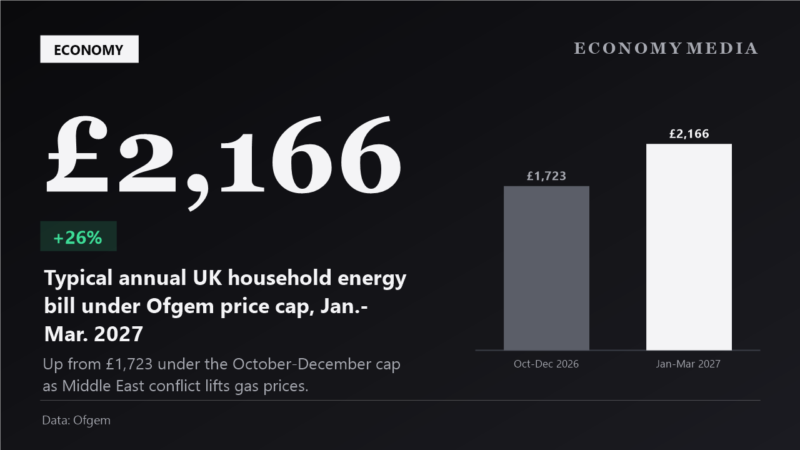
Energy costs are climbing too. Ofgem, the British energy regulator, announced on Wednesday that its price cap will rise 26% from Jan. 1, lifting a typical annual bill for direct debit customers from £1,723 to £2,166, the Leamington Observer reported.
According to Mortgage Strategy, the Bank warned that household debt repayments as a share of income could reach their highest level since the 2008 financial crisis by the end of 2029 if the conflict continues. Almost three in 10 consumers reported experiencing financial pressure, with lower-income families most exposed. The Bank also flagged a rise in mortgage lending at high multiples of income, including to groups more vulnerable to shocks, and cautioned that households cutting back on spending could deepen any downturn, especially if unemployment rises.
The broader stability picture
Despite the strain on individual borrowers, the Bank said in the report that “UK household and corporate balance sheets remain strong in aggregate,” while adding that financial headroom “is being eroded across borrowers.” It said the banking system remains well capitalized with high liquidity and low impairments, and the committee kept the countercyclical capital buffer, an extra cushion banks must hold in good times, at its neutral setting of 2%.
The report also highlighted risks beyond housing. It noted that Brent crude had risen to $92 a barrel from $75 at the time of the July report and that government bond yields had reached near two-decade highs in several advanced economies. It described the financing of artificial intelligence investment as increasingly “complex, circular and opaque,” pointed out that equity valuations remain stretched on some measures despite recent falls, and warned that advances in AI are making cyber and operational risks a more prominent threat to financial stability.
What comes next
Because fixed-rate deals roll off gradually, the full effect of higher borrowing costs will reach households over several years rather than all at once. How large the final hit turns out to be will depend on where interest rates settle, how long the Middle East conflict keeps energy prices elevated and whether the labor market holds up, all of which the Bank flagged as sources of uncertainty.