Bath & Body Works Beats Q3 Forecasts but Sees Softer Holiday Quarter
Bath & Body Works topped third-quarter estimates and raised its sales outlook, but its holiday-quarter forecast points to another decline.
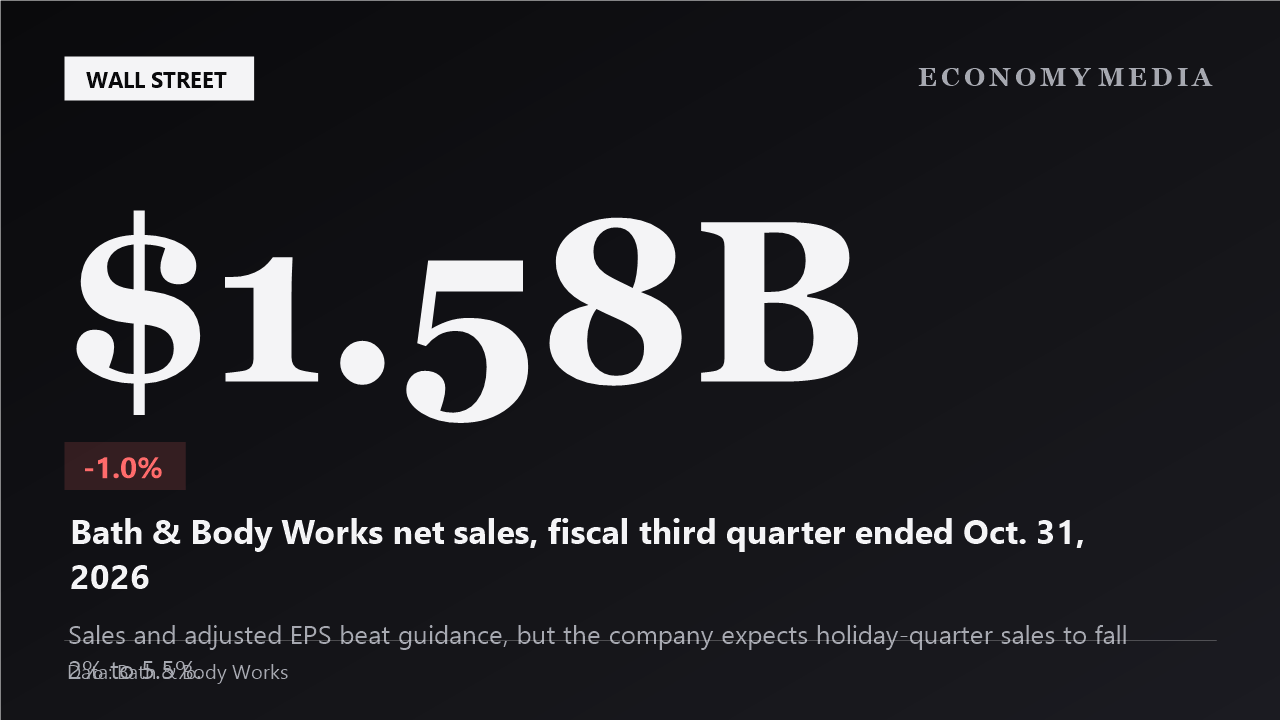
Bath & Body Works, the Columbus, Ohio-based seller of candles, body care and home fragrance products, reported third-quarter results on Thursday, Nov. 19, 2026, that beat Wall Street expectations and its own guidance. It also nudged up its full-year sales outlook and approved a new $500 million share buyback. Even so, the company’s forecast for the holiday quarter calls for sales to fall again, and Seeking Alpha said that outlook came in below analysts’ expectations.
What happened
Net sales for the quarter ended Oct. 31 were $1.577 billion, down 1.0% from $1.594 billion a year earlier, according to the company’s earnings release. Reported earnings fell to 19 cents a diluted share from 37 cents, and net income dropped to $38 million from $77 million. Operating income slipped to $108 million from $161 million.
Excluding one-time items, adjusted earnings were 26 cents a share, compared with 35 cents a year earlier. The adjustments removed about $13 million in pretax business transformation costs and a $5 million pretax loss on paying down debt early.
Both headline numbers came in ahead of forecasts. The Associated Press reported that the average estimate of nine analysts surveyed by Zacks Investment Research was 12 cents a share, and that seven analysts had expected revenue of $1.54 billion.
The company’s sales channels moved in different directions during the quarter:
- Stores (U.S. and Canada): $1.169 billion, down 4.3%
- Direct, or online (U.S. and Canada): $307 million, up 2.6%
- International and other: $101 million, up 39.3%. This category includes international sales, franchise royalties and domestic wholesale sales through partners such as Ulta Beauty and Amazon.
The holiday outlook
The weak spot was the fourth quarter, which includes the holiday shopping season and is by far the company’s biggest period. Bath & Body Works said it expects net sales to fall between 2.0% and 5.5% from $2.724 billion a year earlier, with diluted earnings of $1.41 to $1.61 a share. That compares with $1.99 a share on a reported basis, and $2.05 adjusted, in the same quarter of 2025.
For the full fiscal year, the company raised its sales outlook to a decline of 2.1% to 3.4% from last year’s $7.291 billion. It updated its reported earnings forecast to $3.09 to $3.29 a share and kept its adjusted earnings forecast unchanged at $2.60 to $2.80.
Daniel Heaf, the company’s chief executive officer, said in the release that the quarter’s results “exceeded our sales and adjusted earnings per share guidance.” He also cautioned that the company is “one year into a multi-year transformation, and progress will not always be linear.”
Seeking Alpha described the stock as trading defensively after the report. Intraday market data shown by financial news site Stock Titan put the shares at $18.29 on Thursday, down about 2% from the previous close, after swinging between $16.86 and $19.45. According to the AP, the stock was already down 7% for the year before the report and 12% over the past 12 months.
Background: a turnaround in progress
The results come one year after a much rougher report. In November 2025, the company missed third-quarter estimates and cut its annual forecast, saying cash-strapped shoppers were choosing cheaper alternatives, Reuters reported at the time. The shares fell nearly 14% in premarket trading that day and were down 46% for 2025, according to the Reuters report carried by BNN Bloomberg.
At that point the company also laid out a turnaround plan called the “Consumer First Formula,” which included $250 million in cost savings over two years, with more than half expected in 2026. This quarter’s release pointed to signs of progress: online sales grew for a second straight quarter, and the company said its wholesale business with Ulta and Amazon “continues to gain momentum.”
Physical stores, which still produce nearly three-quarters of sales, remain the main drag. The company ended the quarter with 1,959 company-operated stores in the U.S. and Canada and 623 partner-operated stores abroad.
What comes next
The new $500 million buyback can begin once the company finishes the repurchase program its board approved in January 2025. Investors will now watch whether holiday demand holds up within the guided range. The company is cutting costs while consumer spending on nonessential goods stays uneven, and the fourth quarter will show whether growth in online, wholesale and international sales can make up for weaker store traffic.