Berkshire’s Pacific Power Seeks 57% Rate Hike in Northern California
Pacific Power, owned by Berkshire Hathaway Energy, wants a 57% increase that could add about $120 a month to typical bills in far northern California.
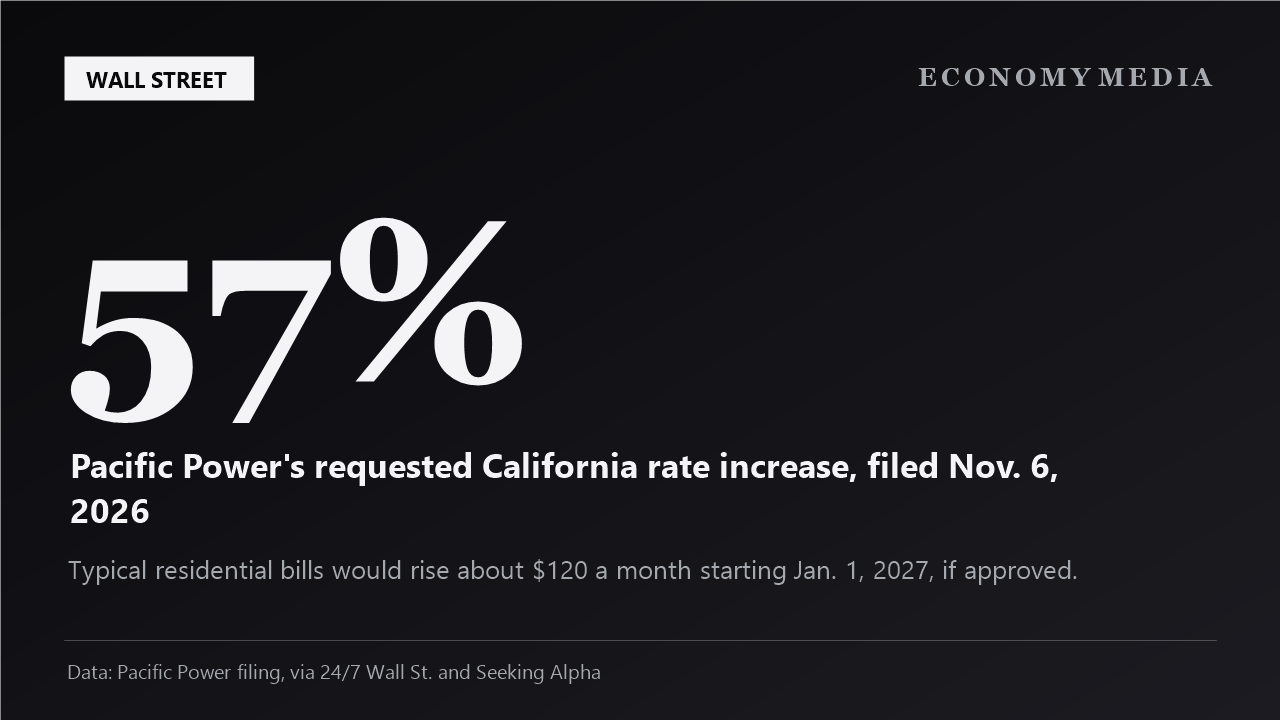
Pacific Power, the electric utility owned by Warren Buffett’s Berkshire Hathaway through its Berkshire Hathaway Energy unit, has asked California regulators to approve a 57% rate increase that would lift the typical residential power bill by roughly $120 a month, citing the rising cost of protecting its grid against wildfires. The request, filed on Nov. 6 with the California Public Utilities Commission (CPUC), the state agency that sets utility rates, would take effect on Jan. 1, 2027, if approved.
What the utility is asking for
According to a detailed review of the filing by financial news site 24/7 Wall St., PacifiCorp, which does business as Pacific Power, is seeking an additional $103.4 million a year. The net increase works out to 57%, with residential customers facing 56.9% and other customer classes between 55.6% and 58.0%. The base revenue requirement alone would rise by $82.8 million, or 56.8%.
A company pricing director testified that the average residential bill would climb by $121.15 a month, while customers enrolled in CARE, California’s discount program for low-income households, would see an average increase of $90.24, 24/7 Wall St. reported. Seeking Alpha and other outlets rounded the residential figure to about $120.
The filing notes that a separate 14% rate decrease scheduled for Jan. 1 will partly offset the increase. 24/7 Wall St. said it was not clear whether the bill estimates already take that reduction into account. The CPUC had not yet assigned a case number, and its review could take several months.
The change would hit a small but spread-out customer base. Pacific Power serves about 46,000 customers across more than 11,292 square miles of far northern California, including Siskiyou, Modoc, Shasta and Del Norte counties, Seeking Alpha reported, or roughly four customers per square mile. The company serves about 630,000 customers in neighboring Oregon.
Why costs are rising
PacifiCorp points to three main drivers: spending on wildfire prevention, higher insurance costs tied to wildfire risk, and inflation. It also says its California customers have not had a general rate increase since 2023, so the request covers several years of investment.
Since 2022, the utility says it has added more than 300 miles of covered power lines and replaced more than 7,000 wooden poles with steel or fiberglass ones. Ryan Flynn, president of Pacific Power, told The Wall Street Journal that the company is swapping out wooden poles and replacing hundreds of miles of bare wire with insulated, fire-resistant conductor, according to Seeking Alpha.
The filing also seeks to recover wildfire-related costs deferred through the end of 2026, including $93.8 million in a wildfire mitigation account and $11.1 million in liability insurance premiums, spread over six years at about $19.7 million a year, 24/7 Wall St. reported.
The request is more than double the size of the company’s last California ask. In May 2022, Pacific Power sought a 25.7% increase worth about $28 million; regulators approved 17.5% in late 2023.
Wildfires and financial strain
The utility’s equipment has allegedly been linked to two deadly California blazes: the 2020 Slater Fire, which killed two people, and the 2022 McKinney Fire, which burned about 60,000 acres and killed four, Seeking Alpha reported. Pacific Power faces about $637 million in liability claims and legal expenses from those fires and is asking regulators to let it recover $340.5 million of that from customers.
Wildfire litigation has weighed heavily on PacifiCorp’s finances. Between June 2023 and early 2026, its credit rating was cut several times, leaving its issuer rating one notch above junk, according to 24/7 Wall St. Under current rates, the company says its California return on equity is negative 2.636%, compared with an authorized 10%. It is asking for a 10.5% return on equity in the new case.
Berkshire and PacifiCorp have taken several steps to shore up the utility, including suspending dividends to the parent company, cutting near-term capital spending and proposing to sell PacifiCorp’s Washington service territory to an affiliate of Portland General Electric. On the same day as the California filing, Pacific Power announced a 7.9% rate decrease for its Washington customers.
What comes next
The CPUC will review the request in a process that typically includes public comment and hearings, and regulators have previously approved less than the utility sought. For Berkshire, the California business is small: the territory generated $153.6 million in operating revenue in 2025, according to 24/7 Wall St. But the case is a test of whether regulators will let utilities pass the soaring costs of wildfire risk on to customers in thinly populated, fire-prone regions.
Berkshire’s Class B shares last traded at $571.06 in the session before the company’s third-quarter results, down 0.22%, a move 24/7 Wall St. said was not tied to the filing.