China’s Slowdown Deepens as October Sales, Output and Investment Miss
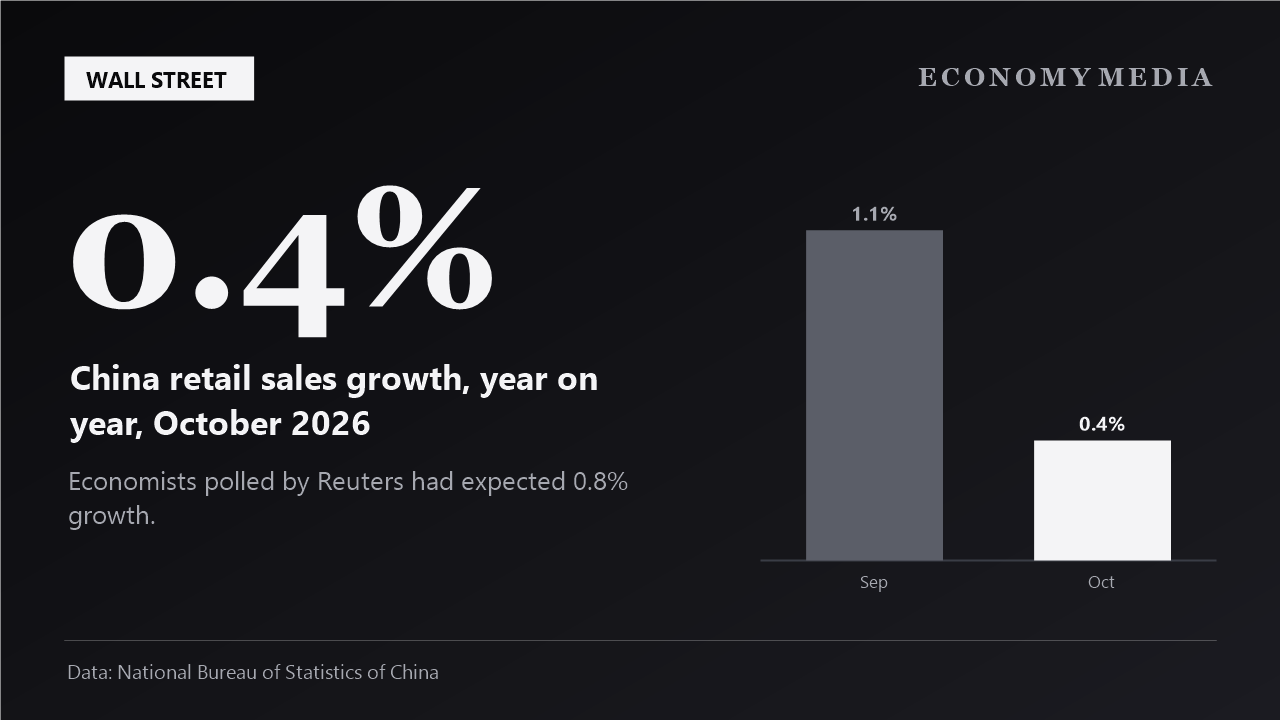
China's retail sales rose just 0.4% in October and fixed-asset investment fell 8.1% through October, with every major gauge missing forecasts.
China’s economy lost more momentum in October. Retail sales, factory output and investment all grew more slowly than economists expected, according to official data released Monday, Nov. 16. The figures show the world’s second-largest economy leaning harder on exports while spending and investment at home weaken.
Retail sales, the main gauge of consumer spending, rose 0.4% from a year earlier, down from 1.1% in September. Industrial output grew 4.8%, compared with 5.5% the month before. Fixed-asset investment, which covers spending on factories, infrastructure and property, fell 8.1% in the first 10 months of the year, Reuters reported, citing China’s National Bureau of Statistics.
What the data showed
All three headline numbers came in below consensus. Economists polled by Reuters had expected retail sales growth of 0.8%, industrial output growth of 5.3% and a 7.0% drop in fixed-asset investment. The January-to-September investment decline was 7.2%, so October’s reading was a wider contraction than both the forecast and the previous month.
CNBC described the slide in fixed-asset investment as unprecedented outside the Covid-19 period. A breakdown by Lynn Song, chief economist for Greater China at Dutch bank ING, showed real estate investment down 21.6% so far this year, infrastructure down 5.1% and manufacturing down 2.9%. Private-sector investment fell 11.4%.
The retail figures showed weakness in big-ticket purchases. According to ING, October sales of autos fell 21.4% from a year earlier, gold and jewelry dropped 28.7%, and building and decoration materials slid 11.2%. Song argued that China’s consumer trade-in program, which subsidizes replacing old cars and appliances, has turned from a tailwind into a headwind as last year’s subsidized purchases set a high comparison base. Song wrote that 2026 “will likely mark the worst for consumption since the pandemic.”
There were some brighter spots. The urban unemployment rate eased to 5.1% in October, CNBC reported. High-tech manufacturing output rose 17.6%, ING said.
Why it matters
The figures add to evidence that China’s growth depends more and more on overseas demand, much of it tied to the global boom in artificial intelligence. Exports rose 35.2% in October, beating forecasts, CNBC reported, and China’s trade surplus passed $1 trillion by October, the fastest it has ever reached that mark. That leaves the economy more exposed to shocks abroad as domestic momentum fades, analysts told CNBC.
Zhiwei Zhang, president and chief economist at Pinpoint Asset Management, told CNBC that markets were already worried about a slowdown in AI capital spending. Zhang said the scandal at Nvidia over restricted chips reaching China had made that risk “even more serious.” Analysts at Citi Research said further European Union trade measures aimed at China looked plausible, which could add to tensions with trading partners that have pressed Beijing to lean less on exports.
The property slump also remains a drag. Home prices have fallen for 41 straight months, though the monthly declines have narrowed this year, according to ING. In October, new home prices slipped 0.15% from September and resale prices dropped 0.24%. Song said a broader property recovery needs firmer prices and a clear reduction in unsold housing before construction investment can pick up.
What comes next
The economy grew 4.5% in the third quarter, CNBC reported. Goldman Sachs expects growth of 4.6% for 2026, down from 5% in 2025, and 4.5% in 2027. The bank also forecasts consumer inflation of 0.8% this year, citing soft domestic demand and ample supply. Consumer prices rose 0.7% in October.
ING said the weak data strengthen the case for more government support. Song pointed to weak consumer confidence as the main obstacle and suggested that steadier asset prices and stronger wage growth would help restore it. Neither Reuters nor CNBC reported any new stimulus measures alongside Monday’s release.