Fed’s Schmid Says Inflation Is ‘Moving in the Wrong Direction’
Kansas City Fed President Jeff Schmid said the Fed has work to do on inflation, as futures fully price a December rate hike.
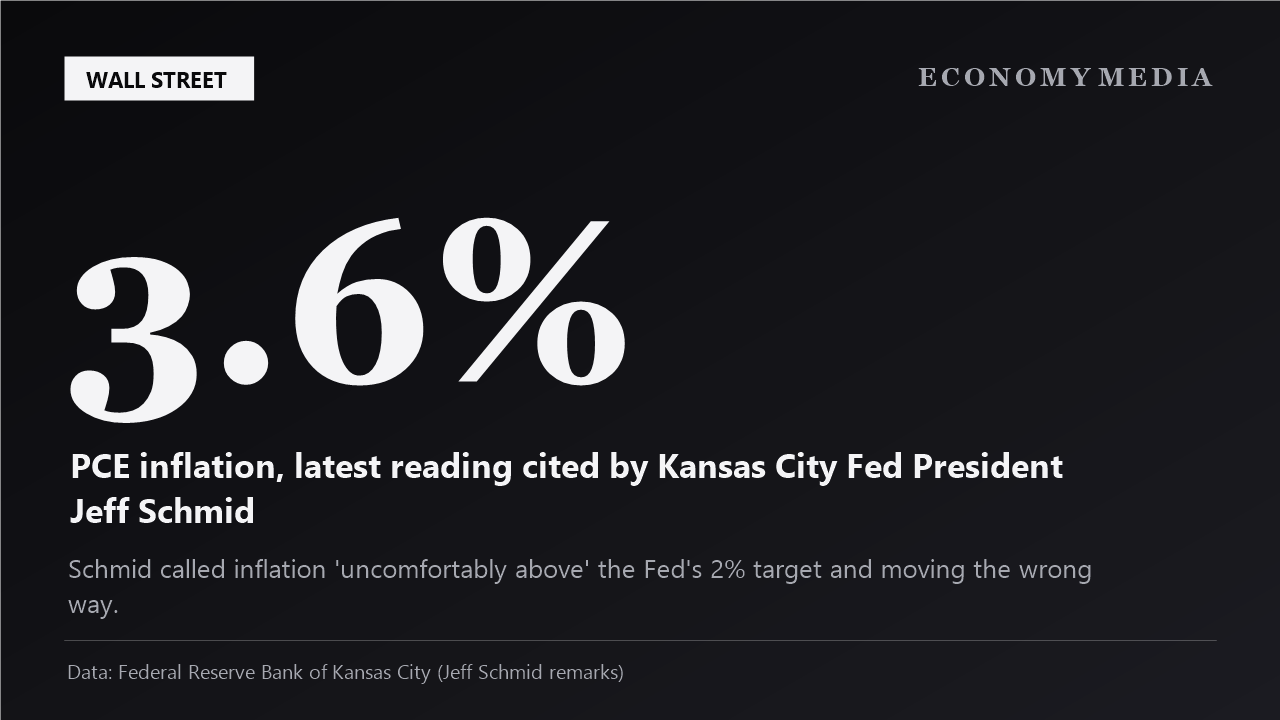
Jeff Schmid, president of the Federal Reserve Bank of Kansas City, said on Sunday, Nov. 15, that the U.S. central bank “has some work to do on inflation,” arguing that price pressures are running too hot and that the Fed has both the tools and the responsibility to bring them down. Speaking at a credit union conference in Hawaii, Schmid described inflation as “uncomfortably above” the Fed’s 2% target and “moving in the wrong direction,” according to Reuters and CNBC. He stopped short of explicitly calling for another interest rate increase.
What Schmid said
Schmid pointed to the Fed’s preferred inflation gauge, the personal consumption expenditures (PCE) price index, which he said stood at 3.6% in the most recent data, according to a summary of his remarks published by MLQ.ai. He also noted that the consumer price index rose at a 5.7% annualized rate over the previous three months.
The problem, he argued, is not confined to energy, which has been pushed higher by the oil shock tied to the conflict involving Iran. Setting energy aside, inflation would still be running at about 3%, Schmid said, a point also highlighted by the financial news site investingLive.
Much of his speech was a rebuttal of two arguments that he said share a common flaw: the assumption that inflation is beyond the Fed’s control.
- Supply shocks: Schmid rejected the view that today’s inflation mainly reflects a string of supply disruptions. Reuters reported that he framed inflation as an imbalance between supply and demand, and said the Fed can influence the demand side.
- AI-driven demand: He also disputed the idea that spending linked to the artificial intelligence buildout is immune to higher interest rates. He acknowledged that some upward pressure on prices comes from strong AI demand, noting that personal computer prices are up 10%, but said the Fed does not need to target the price of any single good or service to reach its goal.
On jobs, Schmid said the labor market is largely in balance, with wage growth around 3% and roughly one job opening for every unemployed worker, suggesting that pay is not a major source of inflation. He also echoed Kevin Warsh, chair of the Federal Reserve, saying that containing inflation has become harder since Warsh’s speech at the Kansas City Fed’s annual Jackson Hole symposium in August.
Why it matters for markets
Schmid’s comments add to a growing chorus of Fed officials signaling discomfort with the inflation outlook ahead of the central bank’s December policy meeting. The Fed raised its benchmark rate by a quarter percentage point in September, to a range of 3.75% to 4.00%, then held steady at its October meeting.
Following higher-than-expected inflation readings and recent comments from Christopher Waller, a member of the Fed’s Board of Governors, interest rate futures were fully pricing a quarter-point hike in December, with a small probability of a half-point move, Reuters reported.
Schmid is not a voting member of the Federal Open Market Committee, the Fed’s rate-setting body, this year, though he takes part in its deliberations. Regional Fed presidents rotate through voting seats.
A divided chorus
A day earlier, Susan Collins, president of the Federal Reserve Bank of Boston, backed a steady, gradual pace of modest rate increases, CNBC reported. She said inflation has exceeded the 2% target for more than five years and that recent price data and a firmer labor market suggest rates could end up somewhat higher over the next year than she had expected a few months ago. Mary Daly, president of the Federal Reserve Bank of San Francisco, has also leaned toward further increases, according to MLQ.ai.
Not everyone in Washington agrees. Treasury Secretary Scott Bessent has said the Fed should avoid raising rates too aggressively in response to an energy supply shock, a view at odds with Schmid’s argument that the inflation problem runs deeper than oil.
What comes next
Investors will get more signals this week. Warsh is scheduled to deliver opening remarks on Monday, Nov. 16, at a Fed conference on productivity and jobs hosted by the San Francisco Fed. Waller is set to speak on payments on Tuesday in New York, and minutes of the Fed’s Oct. 27-28 meeting are due Wednesday afternoon. Those releases may help clarify how widely Schmid’s view that the Fed has more work to do is shared among policymakers.