IEA Sees First Oil Surplus Since Iran War as Gulf Exports Rebound
The IEA expects global oil supply to exceed demand in the fourth quarter, the first surplus since the Iran war began, as Gulf exports recover.
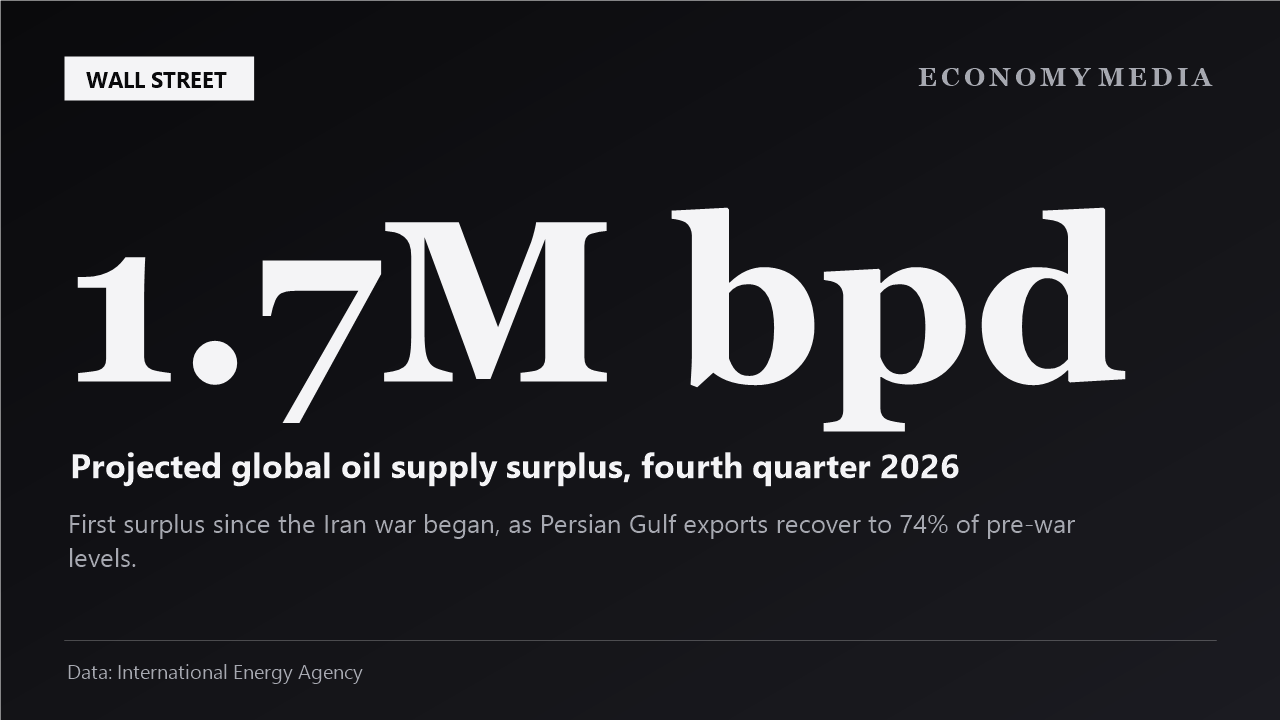
The global oil market is set to move into surplus in the fourth quarter of 2026 for the first time since the Iran war began in late February, the International Energy Agency said on Friday, Nov. 13. Exports from the Persian Gulf have recovered faster than demand, even though tankers in the region are still being attacked. In its monthly Oil Market Report, the Paris-based agency, which advises industrialized countries on energy policy, said the market was “showing tentative signs of rebalancing.”
What the IEA reported
The IEA expects world oil supply to average 105 million barrels per day (bpd) in the fourth quarter, about 1.7 million bpd more than forecast demand, Reuters reported. A month earlier, the agency had predicted a fourth-quarter deficit. Bloomberg, in a report republished by Rigzone, gave a slightly different figure for the gap, describing it as an oversupply of roughly 2 million bpd compared with a deficit of similar size projected in October.
Supply has risen quickly. Global oil output reached 105.4 million bpd in October, up 2.3 million bpd from September, CNBC reported, citing the IEA. The agency called the 5.3 million bpd increase since August “extraordinary.” It also raised its fourth-quarter supply estimate by 3.3 million bpd.
The main reasons, according to the report:
- Gulf exports: Shipments from the Persian Gulf, excluding Oman, reached 18.4 million bpd in October, or 74% of pre-war levels, Bloomberg reported. Saudi Arabia and Iraq led the recovery.
- Producer output: Saudi Arabia raised crude production to 10 million bpd in October, and Iraq’s output hit a seven-year high of 4.6 million bpd, according to Bloomberg.
- Russia: Russian crude production rose by 210,000 bpd to 8.73 million bpd in October, CNBC reported.
- Outside OPEC+: The U.S., Canada, Brazil, Argentina and Guyana are expected to add 1.6 million bpd of supply this year.
Gulf producers have partly restored exports through so-called dark crossings of the Strait of Hormuz, the narrow waterway at the mouth of the Persian Gulf. During these crossings, tankers turn off their tracking signals to avoid attack. Iran itself is under a U.S. blockade that has curbed its oil exports, Reuters noted.
Why it matters for markets
The outlook has changed sharply from the IEA’s October report, which had forecast deficits through the end of the year. The agency now projects a full-year 2026 deficit of 685,000 bpd, down from 1.7 million bpd previously, Bloomberg reported. For 2027 it expects a surplus of about 3.8 million bpd, slightly smaller than the 3.94 million bpd it forecast a month ago, according to Reuters. Global supply is projected to rise by 6.6 million bpd next year to 108.1 million bpd. That supply estimate is 1.1 million bpd lower than last month’s, partly because the IEA lowered its outlook for Iran.
Inventories are starting to rebuild. Observed global stocks rose by 52 million barrels in October, the first increase since June, CNBC reported. Bloomberg noted that the gain came mostly from oil on tankers at sea, and that stockpiles on land remain at their lowest level in a decade.
Prices had already fallen before the report. Benchmark crude was down about 18% so far in November, Bloomberg reported. Rising Middle East supply and signs that President Donald Trump may hold off on new military action in Iran have weighed on prices. After the report came out on Friday, Brent crude, the international benchmark, was down 0.1% at $95.71 a barrel, giving up earlier gains, according to Reuters.
Demand and diesel
High prices have cut into consumption. The IEA expects world oil demand to fall by 2.68 million bpd this year to an average of 102.3 million bpd, and then to recover by about 2 million bpd in 2027. Even after that rebound, demand would stay below 2025 levels. Bloomberg reported that most of the growth is expected in petrochemical feedstocks, while electrification and better fuel efficiency limit gains in vehicle fuels.
Diesel supply is still tight. CNBC reported that refined product exports remain limited because of disruptions in the Middle East and repeated attacks on Russian energy infrastructure. On Oct. 9, Trump reached a deal with Vladimir Putin, the president of Russia, to supply diesel to world markets. The U.S. Treasury’s Office of Foreign Assets Control, which administers sanctions, then issued a general license for some transactions involving Russian-origin diesel, valid through April 7, 2027. The IEA said the diesel outlook had “marginally improved” as high prices reduced consumption.
What comes next
IEA member countries will speed up the release of their remaining emergency stocks, with 71 million barrels, including 15 million barrels of diesel, still to be released through the end of February. Bloomberg reported that European nations agreed to move faster after U.S. criticism that they were acting too slowly. Other forecasts point the same way as the IEA’s. OPEC data released on Wednesday showed OPEC+ crude output at 41.23 million bpd in October, about 97% of pre-war February levels, and JPMorgan had forecast a global surplus of 1.4 million bpd for October, Reuters reported.
The recovery could still be reversed. Continued attacks on tankers in and around the Strait of Hormuz, or renewed U.S. military action against Iran, could disrupt Gulf exports again and change the price outlook.