Leaked Files Show Cisco Worked to Keep Israeli Military Deals in Gaza War
Internal Cisco documents leaked by worker activists show the company scrambling to save a 'critical' Israeli military intelligence account during the Gaza war.
Cisco Systems, the California-based networking giant, sent senior staff to repair a troubled relationship with Israeli military intelligence during the war in Gaza and went on to pursue dozens of new deals with Israeli government clients, according to leaked internal documents reported by the Guardian on Saturday. The files, which were provided by a group of current and former Cisco employees, show the company treating the account as a priority even as some of its own workers protested its role in the conflict.
What the documents show
According to the Guardian, a confidential Cisco memo described a run of outages on networks used by Israel’s military intelligence community during the war. The memo said the repeated failures had severely affected critical operations and badly damaged the customer’s view of the company.
In response, Cisco mobilized senior staff to save what the documents called a “critical” account, the Guardian reported. Employees were sent to meet on site with Sapir, a secretive Israeli military unit, with the stated goals of restoring “customer confidence” and reversing “negative sentiment.” Cisco later presented the effort internally as a customer success story.
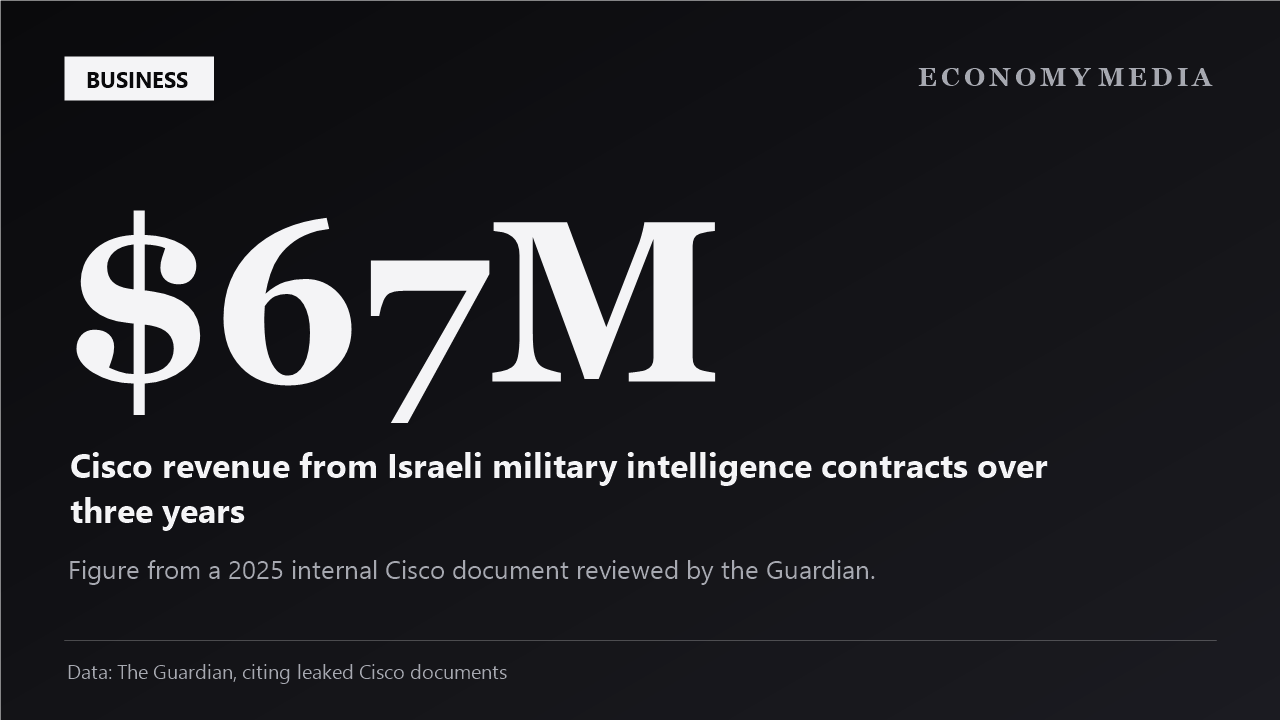
The newspaper said a 2025 company document put the value of Cisco’s contracts with Israeli military intelligence at about $67 million over three years. Other files describe dozens of deals planned for 2026 with Israeli government customers, including the intelligence community, the air force and the navy, many of them labeled as artificial intelligence projects. Earlier this year, the Guardian reported, Splunk, a data analytics company Cisco acquired in 2024, proposed joining Project Nimbus, the Israeli government’s cloud computing contract with Google and Amazon.
The leaked material came from Bridge to Humanity, a group of current and former Cisco workers. The group described the company’s work with Israeli intelligence as a “shocking and complete contradiction of values” and accused Cisco of becoming “an instrument of genocide.” Israel has rejected genocide accusations over its conduct in Gaza.
Earlier leaks and the business at stake
The Guardian’s report follows a separate investigation published in May by Drop Site News, an independent investigative outlet, which also drew on internal Cisco documents supplied by whistleblowers. That reporting said Israel’s Ministry of Defense drove much of Cisco Israel’s growth after the Hamas-led attack of Oct. 7, 2023. According to Drop Site, the Israeli unit’s revenue rose from $109 million in the first half of 2023 to $150 million a year later, with defense ministry sales nearly doubling from $52 million to $98 million, before falling back in the first half of 2025.
Drop Site said one internal presentation carried the slide title “Never let a good crisis go to waste,” and that a 2021 company report described the defense ministry account as making up about half of Cisco Israel’s revenue. The outlet also reported plans for a $50 million AI computing agreement with the ministry. Muslim Network TV, which summarized the Drop Site findings, noted that the documents described Cisco as the “dominant ICT partner” to the ministry.
Those sums are small for a company that Drop Site said reported $56.7 billion in revenue in 2025, but the documents suggest executives saw the military relationship as strategically important. Cisco did not respond to Drop Site’s request for comment, and the summaries of the Guardian report reviewed for this article do not include a company response to the new documents.
Pressure from workers and investors
The leak adds to pressure that Cisco already faces on several fronts:
- Workplace complaints: Earlier this year the US Equal Employment Opportunity Commission, the federal agency that enforces anti-discrimination law, found reasonable cause to believe Cisco had allowed a hostile work environment for Palestinian, Arab and Muslim employees, the Guardian reported. Cisco told the newspaper it disagreed with those findings.
- Limits on internal debate: Drop Site reported that a Cisco executive told staff in March 2025 that the Middle East conflict could not be discussed or debated in company-wide meetings.
- Shareholder vote: A group of investors is asking Cisco to commission an independent human rights assessment of its Israeli military business, and shareholders are expected to vote on the proposal at the company’s annual meeting later this month.
What comes next
The upcoming shareholder vote will be the most immediate test of whether the disclosures change anything at Cisco. Big technology companies have faced similar scrutiny over Israeli military contracts: Drop Site noted that Microsoft recently fired the head of its Israeli subsidiary and other senior staff after an internal review of how the defense ministry used its Azure cloud services. Activist employees at Cisco have said they will keep pushing the company to cut its military ties, while the company has so far given no public sign that it plans to change course.