Ford Beats Profit Forecasts, Sees 2027 Earnings Flat as Costs Climb
Ford topped third-quarter profit estimates and lifted the floor of its 2026 forecast, but warned that rising commodity costs will keep 2027 earnings flat.
Ford Motor Co. beat Wall Street’s profit estimates for the third quarter and raised the low end of its full-year earnings forecast on Wednesday. The Detroit automaker also warned that rising costs for metals, memory chips and shipping will keep its profit in 2027 roughly level with this year’s. It reported adjusted earnings of 49 cents a share, well above the 41 cents analysts expected, even as revenue slipped 2% to $49.5 billion and its electric-vehicle unit lost more than $1 billion again.
What happened
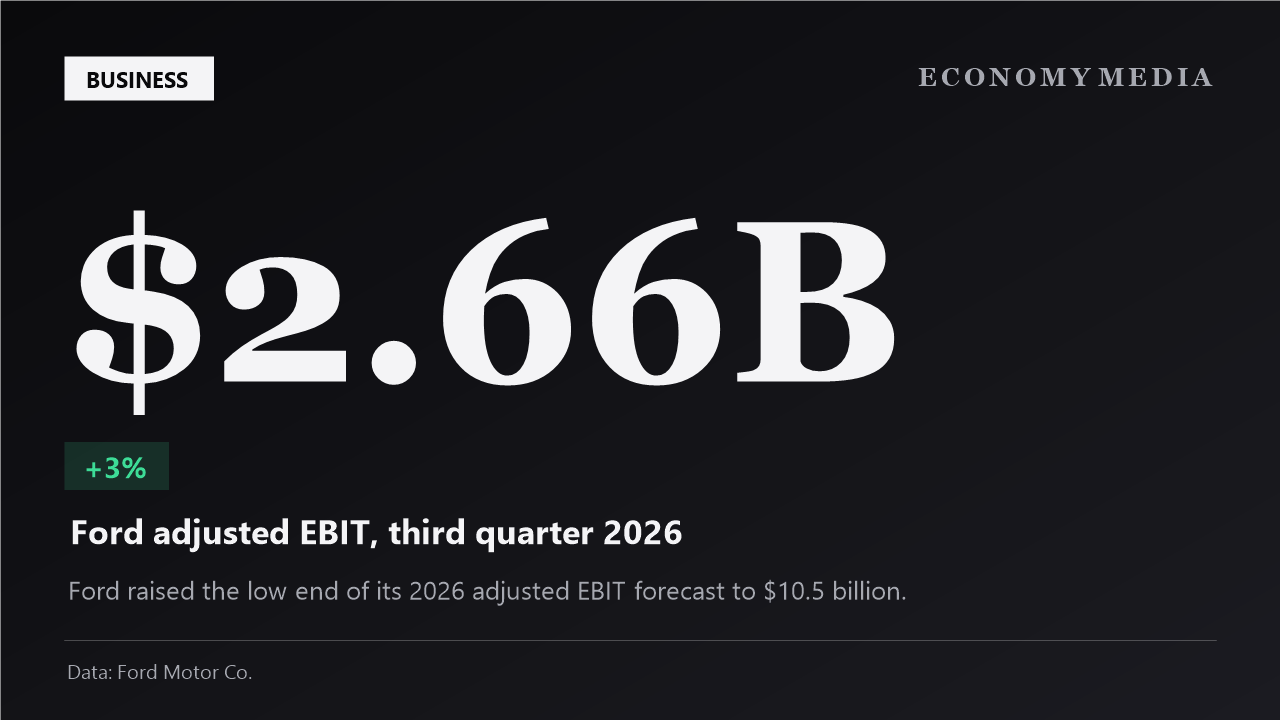
According to Ford’s earnings release, filed with the Securities and Exchange Commission, net income fell to $2.0 billion, or 50 cents a share, from $2.4 billion a year earlier. Adjusted earnings before interest and taxes (EBIT), the company’s preferred measure of operating profit, rose about 3% to $2.66 billion. Its adjusted EBIT margin improved to 5.4% from 5.1%. Adjusted free cash flow came in at $4.7 billion, and Ford ended the quarter with $25.3 billion in cash.
Whether revenue beat or missed depends on the measure. Investing.com said total revenue of $49.5 billion topped the roughly $48.9 billion analysts expected. Yahoo Finance reported that automotive revenue of $46.1 billion fell just short of the $46.2 billion Bloomberg consensus. CNBC described the results as mixed, saying Ford beat on earnings but slightly missed on revenue.
Ford raised the bottom of its 2026 adjusted EBIT forecast, which now runs from $10.5 billion to $11 billion instead of $10 billion to $11 billion. It kept its forecast of $6 billion to $7 billion in adjusted free cash flow. The company said the outlook does not account for a significant escalation of the conflict in the Middle East or a material downturn in the U.S. economy.
Inside the business units
Ford reports its results in four main segments. Both of its profitable vehicle businesses earned less than a year earlier, while the EV unit narrowed its loss:
- Ford Blue, the gas and hybrid vehicle business, earned $1.39 billion, down 10%. Ford cited lower volumes from discontinued models, effects of the Middle East conflict and higher commodity costs.
- Ford Pro, the commercial vehicle and fleet services unit, earned $1.67 billion, down 16%. Higher commodity costs and temporary launch costs for the Super Duty pickup at its Oakville, Ontario, plant outweighed a smaller tariff bill.
- Model e, the electric vehicle unit, lost $1.06 billion on revenue of $1.2 billion. The loss was about 25% smaller than a year ago, but revenue fell 31%.
- Ford Credit, the lending arm, posted pre-tax earnings of $803 million, up 27%.
Yahoo Finance noted that Ford’s U.S. sales fell 6.6% in the quarter to 509,764 vehicles. The company blamed planned phase-outs of the Escape and the Lincoln Corsair. Ford’s U.S. electric-vehicle sales plunged 80%, according to the report, and the comparison is with a quarter that ended just as the federal EV tax credit expired. Ford still expects Model e to lose about $4 billion this year.
Why 2027 looks flat
The bigger news for investors may be Ford’s early view of next year. Sherry House, Ford’s chief financial officer, said on the company’s earnings call that she sees 2027 profit coming in roughly in line with 2026. “We are still expecting significant commodity cost increases going into 2027,” House said, according to Yahoo Finance. She pointed to rising steel and copper prices.
Ford now expects commodity costs to be about $2.5 billion higher this year than last, up from a $2 billion estimate a quarter ago. According to a call transcript published by Investing.com, management estimated that commodities, memory chips and logistics will add roughly $2 billion in costs again in 2027. The company says it will try to offset that with better quality, pricing and cost cuts. House added that progress “isn’t going to be linear” and that Ford now expects higher expenses in 2027.
Jim Farley, Ford’s president and chief executive, described 2027 as a foundational year for the company’s goal of an 8% adjusted EBIT margin by 2029. By then, he said, Ford will have refreshed about 70% of its global lineup by volume.
What comes next
Much of Ford’s EV strategy now rests on the Fathom, the first vehicle built on its lower-cost Universal EV platform. The electric pickup will start at $28,350. Executives said on the call that pre-orders open in the first quarter of 2027 and that it launches in the fourth quarter of 2027. Ford still aims for Model e to break even in 2029.
Ford’s stock had closed up about 2% at $11.95 before the report and dipped about 1.4% in after-hours trading, Investing.com reported. The shares remain near the bottom of their 52-week range. Rival General Motors recently narrowed its own 2026 profit forecast, Yahoo Finance noted.