Poppi Founders Take On PepsiCo’s Gatorade With Hydration Startup Jetty
Allison and Stephen Ellsworth, who sold Poppi to PepsiCo for $1.95 billion, are launching Jetty, an everyday electrolyte drink brand, at Whole Foods.
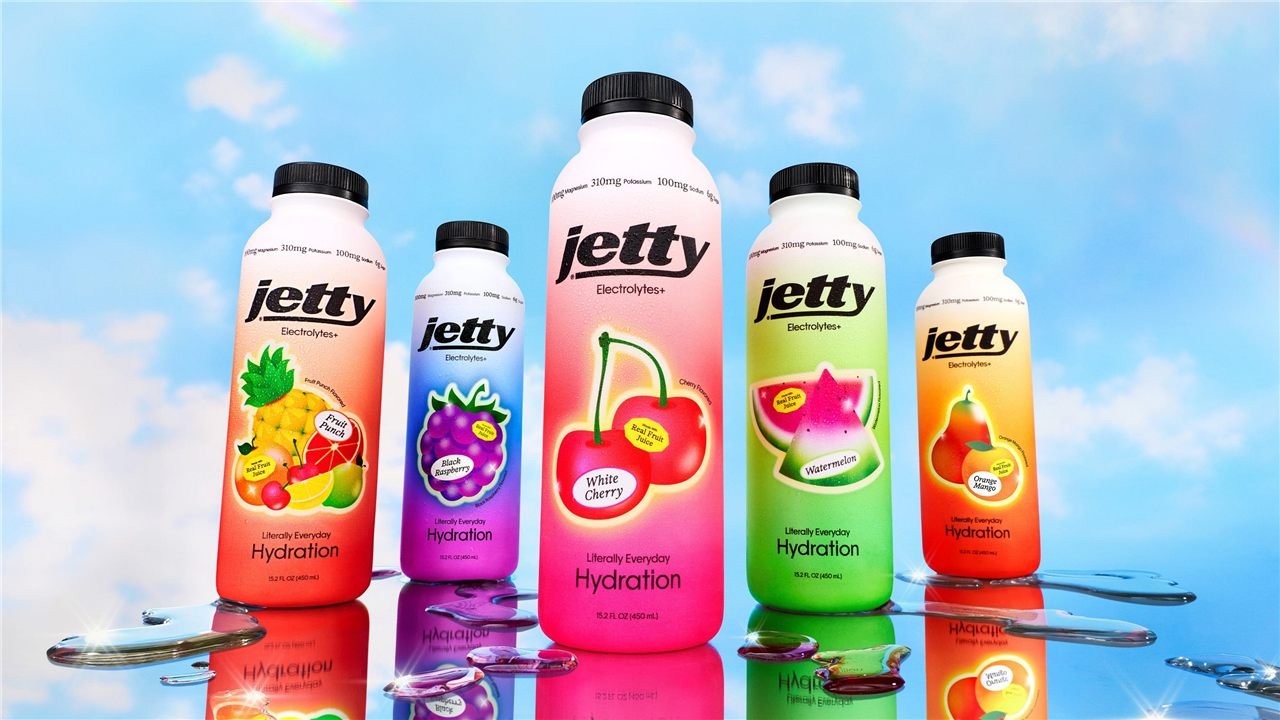
The couple who built the prebiotic soda brand Poppi and sold it to PepsiCo for $1.95 billion are back in the beverage business, this time going up against one of PepsiCo’s biggest brands. Allison and Stephen Ellsworth are launching Jetty, a hydration brand that sells bottled electrolyte drinks and single-serve powder packets. It goes on sale Monday in Whole Foods Market stores and online through Target and Amazon, CNBC reported.
What happened
The startup pitches Jetty as an everyday drink rather than a sports drink. Allison Ellsworth, Jetty’s chief brand officer, said its main customers will be millennial moms and Gen Z consumers, according to CNBC. Stephen Ellsworth, who ran Poppi as chief executive, is Jetty’s CEO. The couple split the same roles at Poppi.
According to CNBC, Jetty is launching in five flavors: watermelon, orange mango, fruit punch, black raspberry and white cherry. A lemon-lime version, Gatorade’s original flavor, is planned for later. An October preview from Stack3d, a site that covers the supplement industry, listed only four of those flavors and left out white cherry. Each bottle (15.2 ounces) or 15-gram packet has 100 milligrams of sodium, 310 milligrams of potassium and 100 milligrams of magnesium. It also has B vitamins, 3 grams of fiber and 6 grams of sugar. The founders say the drinks contain no artificial sweeteners or dyes. CNBC compared that with a 20-ounce Gatorade Thirst Quencher, which has about 270 milligrams of sodium, 80 milligrams of potassium and 34 grams of sugar.
Stack3d reported that the label carries the line “Not for a marathon. Not for the gym. For real life, every day.” Speaking to CNBC Make It, the network’s personal finance and careers site, Allison Ellsworth called the product “a solution to boring water.”
So far the company is paying its own way. CNBC reported that the founders put in $2.5 million and will probably seek outside money in 2027. Allison Ellsworth said she would prefer investors who open doors in the industry, such as celebrity connections, over traditional venture capital firms.
Why it matters
Jetty is entering a crowded market where demand is still growing. Dollar sales of hydration and electrolyte products rose 20% to $2.6 billion in the 52 weeks ended Oct. 4, according to market research firm SPINS, as cited by CNBC. SPINS also counted 41% more new hydration products with at least $10,000 in yearly sales over the past two years. NielsenIQ data cited by CNBC Make It shows a larger picture. Drinks with hydration claims brought in $10.5 billion over the past year, about 6% of all U.S. beverage sales, and roughly half of that came from sports drinks.
Traditional sports drinks, however, are losing ground. Unit sales fell 9.1% from 2022 to 2026, according to retail analytics firm Numerator, which estimates that Gatorade holds about 60% of the U.S. sports drink market. Coca-Cola has written down the value of BodyArmor by more than $1.7 billion. It bought control of the sports drink brand for $5.6 billion in late 2021. Much of the growth is in powder sticks such as Unilever’s Liquid I.V. and LMNT. Allison Ellsworth said powders are a $1 billion category on Amazon alone.
The big beverage companies are responding. Here is what some of them have done, according to CNBC:
- PepsiCo relaunched Gatorade in April, marketing it for moments like a morning start or an afternoon walk. It is also phasing out artificial colors and pushing lower-sugar versions.
- Kraft Heinz introduced Capri Sun pouches and Kool-Aid packets with added electrolytes this spring.
- Keurig Dr Pepper reported 40% retail sales growth in its third quarter for Electrolit, a Mexican-made hydration drink.
Allison Ellsworth criticized her former buyer’s approach. She told CNBC that PepsiCo “doesn’t get it” if it believes cutting dyes or sugar will win the market, and called that “very big corporate thinking.” PepsiCo’s response, if any, was not included in the reports.
Background
PepsiCo bought Poppi in 2025, attracted by its low-sugar sodas and its marketing aimed at younger shoppers. Allison Ellsworth stayed on as an adviser but no longer works on the brand day to day. CNBC reported that Poppi has reportedly underperformed under its new owner. In an October regulatory filing, PepsiCo valued possible performance-based payments to Poppi’s former owners at $12 million. When the deal was announced, it had offered up to $300 million more if Poppi hit certain targets by the third quarter of 2027. The Ellsworths declined to comment on the filing.
Poppi also settled a class-action lawsuit over its “gut healthy” marketing claims. CNBC’s main report put the settlement at $8.9 million, while the CNBC Make It article gave it as $9.8 million. With that history in mind, the founders say three separate claims lawyers checked Jetty’s packaging. CNBC Make It noted that the brand avoids the word “healthy.”
What comes next
Allison Ellsworth told CNBC that the idea for Jetty came from her own experience. She started a GLP-1 weight-loss medication and lost 60 pounds, and her husband noticed she was not drinking enough. Drugs such as Ozempic and Mounjaro can reduce thirst. In a survey of more than 3,600 current or former GLP-1 users by consulting firm EY-Parthenon, about 44% said they drink more functional beverages.
Jetty is not the first company to sell electrolytes to people who are not athletes. CNBC Make It pointed to Nuun, which already markets electrolyte tablets for everyday use. It also cited the Cleveland Clinic’s guidance that most people get enough electrolytes from a healthy diet. The founders are betting that their Poppi-style marketing can win shoppers in a category that established brands and newcomers are all chasing.