El-Sayed Beats Rogers in Michigan, Becoming First Muslim US Senator
Democrat Abdul El-Sayed defeated Republican Mike Rogers in Michigan's open Senate race, keeping the seat blue and making history as the first Muslim senator.
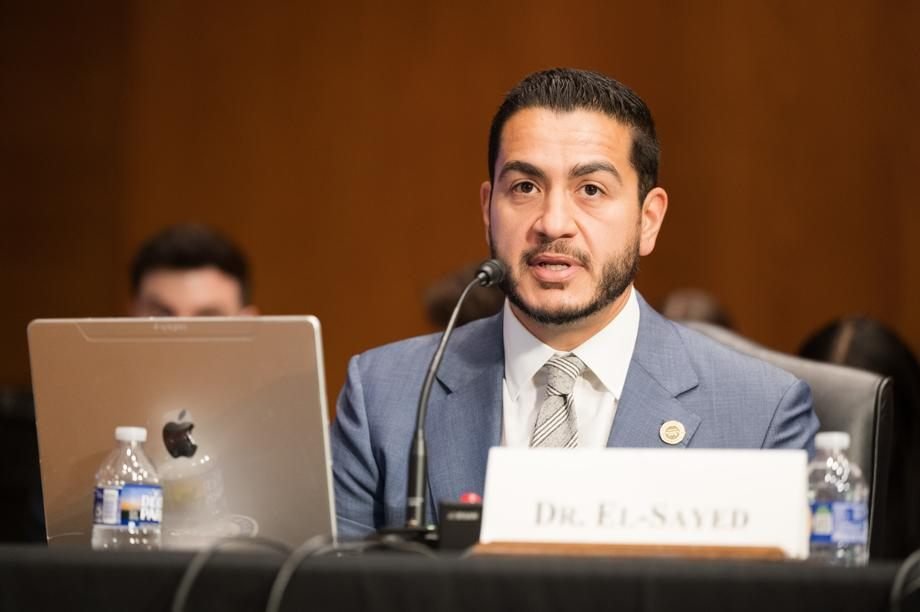
Abdul El-Sayed, a progressive Democrat and former public health official who has never held elected office, defeated Republican former Rep. Mike Rogers in Michigan’s open US Senate race, according to projections by the Associated Press. The win keeps the seat in Democratic hands and makes El-Sayed the first Muslim elected to the Senate in US history, a milestone noted by PBS NewsHour, Time and Al Jazeera.
El-Sayed declared victory before supporters in Detroit early Wednesday, after a campaign that both sides described as unusually bitter. “You took a chance on the unlikeliest of candidates,” he told the crowd, according to the AP report carried by PBS.
What happened
The seat opened when Gary Peters, a two-term Democratic senator from Michigan, decided not to seek reelection. El-Sayed, 42, narrowly won the August 4 Democratic primary over Rep. Haley Stevens, a moderate congresswoman from the Detroit suburbs, and then faced Rogers, 63, a former chairman of the House Intelligence Committee who lost the state’s 2024 Senate race to Democrat Elissa Slotkin by a small margin.
The general election was shaped by rising fuel and consumer prices, which the AP linked to the US war with Iran and to tariff-driven economic turmoil. Rogers, who had aligned more closely with President Donald Trump in recent years, sought some distance from the administration late in the race. Time reported that he broke with Trump on tariffs against Canada, and he wrote on social media in September that “the war with Iran needs to end, and end quickly.”
The result came as part of a broader Democratic sweep in Tuesday’s midterm elections that gave the party control of both chambers of Congress.
A campaign marked by attacks and defections
Trump and other Republicans repeatedly linked El-Sayed to extremist and terrorist groups, claims that the AP, Time and Al Jazeera all described as lacking evidence. Time reported that at a rally nine days before the vote, Trump called El-Sayed a member of the Muslim Brotherhood, and that Rogers also raised allegations about the candidate’s family ties to the group. El-Sayed has denied those allegations. Al Jazeera reported that Trump also called him a “jihadist” and said Black or Jewish voters who supported him were “crazy.”
In his victory speech, El-Sayed addressed Rogers directly. “You chose hate and Michigan chose hope,” he said, according to the AP.
The Democratic side was divided as well. Two days before the election, Stevens appeared with Rogers at a Detroit church and endorsed him, saying El-Sayed had not done enough to address the concerns of some communities. Time called the move an “extraordinary act of defection.”
El-Sayed also faced heavy spending from pro-Israel groups. Reports differ on the amount: the AP said the American Israel Public Affairs Committee (AIPAC), the leading pro-Israel lobbying group in Washington, spent nearly $30 million against him in the primary, its largest investment in a single race, while Al Jazeera put the figure at more than $30 million. Time reported that El-Sayed himself cited $42 million in his speech.
He drew criticism during the campaign for saying “hurt people hurt people” after a March attack on Temple Israel, a synagogue in West Bloomfield, Michigan, remarks for which he later apologized, and for appearing with Hasan Piker, a political streamer whose comments about Israel, Jews and the Sept. 11 attacks have drawn objections, the AP reported.
Who is Abdul El-Sayed
El-Sayed is the son of Egyptian immigrants and grew up in suburban Detroit. According to Time, he graduated from the University of Michigan, studied at Oxford as a Rhodes Scholar and earned a medical degree from Columbia University, though he did not practice medicine. He taught epidemiology at Columbia and later held public health leadership roles in Detroit and Wayne County. He lost the 2018 Democratic primary for Michigan governor by a double-digit margin.
Backed by Sen. Bernie Sanders of Vermont and Rep. Alexandria Ocasio-Cortez of New York, he ran on a platform that included:
- Medicare for All, a single government-run health insurance program covering every American;
- higher taxes on the wealthy and limits on corporate and outside money in politics;
- redirecting spending on foreign wars toward domestic needs and affordability.
He has called Israel’s war in Gaza a genocide and opposes US military aid to Israel, according to Time.
Why it matters and what comes next
Al Jazeera reported strong turnout in Dearborn, a Detroit suburb with a large Arab American population, and early results showing El-Sayed performing well among Black voters in Detroit, a group some Democrats had worried about after Stevens carried Wayne County in the primary. Former President Barack Obama and former Vice President Kamala Harris campaigned with El-Sayed in Detroit in an effort to boost turnout.
Maya Berry, executive director of the Arab American Institute, an advocacy group, told Al Jazeera that the electorate rejecting what she called bigotry was “tremendous.”
The AP said the victory could strengthen the hand of progressives inside the Democratic Party ahead of the 2028 presidential race. El-Sayed is scheduled to be sworn in on January 3, when the new Congress convenes.