IEA Says Data Center Power Use Could Double by 2030 as Grids Strain
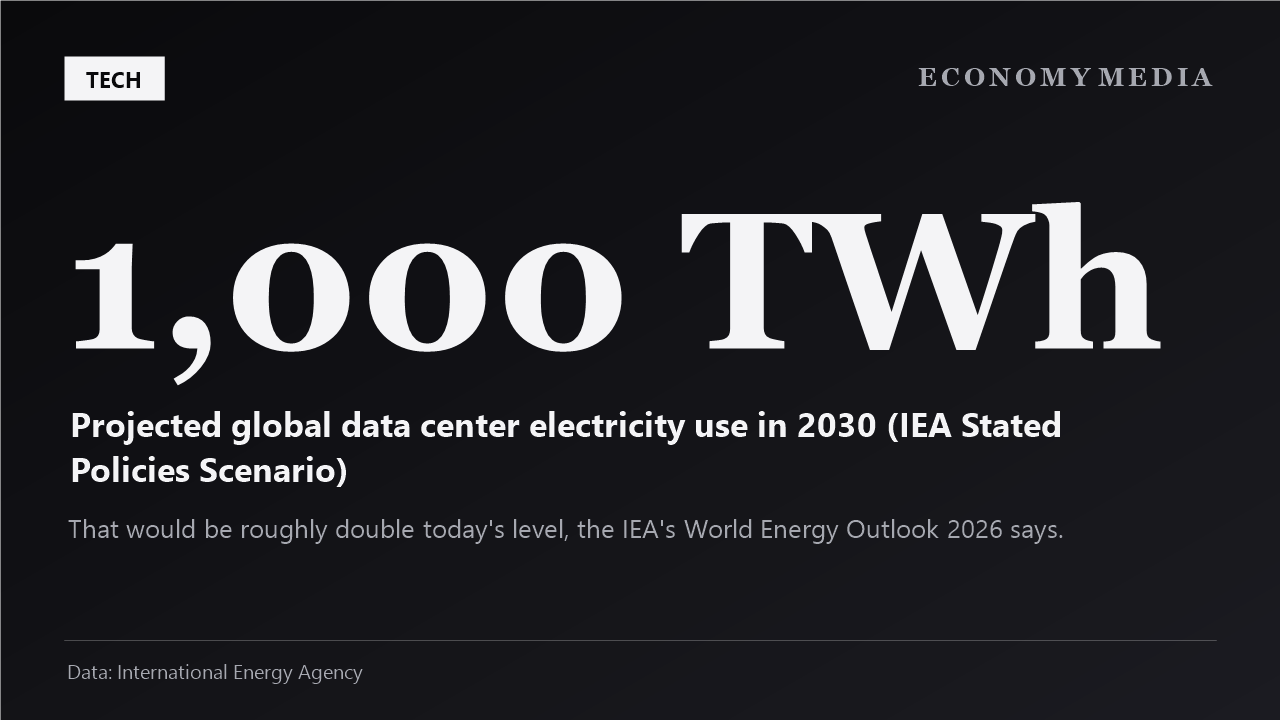
The IEA's World Energy Outlook 2026 says data centers could use about 1,000 TWh a year by 2030 and warns that power grids must expand fast to keep up.
Electricity use by the world’s data centers could double by 2030 as the artificial intelligence boom adds to strain on power grids, the International Energy Agency said on Thursday. In its flagship World Energy Outlook 2026, the Paris-based agency also warned that grid construction has to speed up sharply over the next decade.
CNBC reported that, under one of the report’s main scenarios, data centers could consume about 1,000 terawatt-hours (TWh) of electricity a year by the end of the decade. A terawatt-hour is a billion kilowatt-hours. The agency’s executive summary says that “surging demand from data centres is amplifying strains in some markets and supply chains.”
What the IEA found
The International Energy Agency (IEA) advises governments on energy policy, mostly in industrialized countries. Its annual outlook sets out several scenarios, and the agency says none of them is a forecast. The data center estimate comes from the Stated Policies Scenario, which assumes that governments carry out measures they have announced but not yet put into law, CNBC said. A second scenario, the Current Policies Scenario, includes only rules already in force.
According to CNBC, the agency pointed to large lists of planned data center projects in Texas, Virginia, Finland and the United Kingdom. In several regions, the demand from data centers waiting to connect to the grid already exceeds those regions’ current peak demand. Tight supply chains, limited grid capacity and local opposition could slow construction, the report said.
Data centers are one driver among several. The IEA said global electricity demand has grown 3.3% a year since 2019, faster than the world economy and more than twice as fast as total energy demand. Electric motors in industry, air conditioners, electric vehicles and heat pumps are also pushing demand up. The agency added that cooling needs are overtaking heating needs for the first time in history.
Why the grid matters
The report presents power networks as the main bottleneck. Without upgrades, the IEA said, grids could become more congested and less reliable, new projects could wait longer to connect, and power plants could be forced to cut output when lines cannot carry their electricity, CNBC reported.
The scale of the work the agency describes is large:
- At least 25 million kilometers of new power lines are needed over the next 10 years, and about 15 million kilometers of existing lines need replacing or upgrading, according to the IEA’s executive summary. CNBC, citing the Stated Policies Scenario, put the figures at 26 million and 16 million kilometers.
- Grid spending rises 75% over the next decade under the Current Policies Scenario, CNBC said.
- Peak electricity demand could rise by 40% to 50% by 2035, according to CNBC’s account of the report.
The IEA said supplies of copper, cables, transformers and other electrical equipment needed for this buildout are already tight. CNBC said the agency described power networks as “one of the biggest energy investment stories of the next decade.”
The energy crisis backdrop
The outlook comes during what the IEA calls the largest energy supply shock on record, caused by the conflict in the Middle East and disrupted shipping through the Strait of Hormuz, the narrow waterway between Iran and the Arabian Peninsula. CNBC noted that about 20 million barrels a day of crude oil and oil products moved through the strait in 2025, roughly a quarter of global seaborne oil trade.
“The Hormuz crisis has delivered a huge shock to the system,” Fatih Birol, the IEA’s executive director, said in a statement. He added that he does not see “any credible pathway” for the energy world to return to the way it was before.
The agency argued that the crisis is pushing countries toward electricity produced at home. Electricity made up around 23% of final energy consumption in 2025, and that share approaches 30% by 2035 in the agency’s main scenarios. Renewables, led by solar panels, now supply about a third of the world’s electricity and reach 45% to 50% by 2035 in those scenarios, the IEA said.
What comes next
Electrification cuts countries’ reliance on imported fuels, but it makes a reliable grid more important, CNBC noted. The report also points to cyber risks: the IEA said cyberattacks on energy utilities topped 2,000 a week in 2025.
The agency put data centers in perspective. Efficiency gains in household lighting, TVs, refrigerators and other appliances over the past decade saved about 600 TWh, which the IEA said is more than data centers worldwide use in a year.
“The pressures of the current crisis must not obscure the choices that will shape energy security, sustainability and prosperity for the decades to come,” Birol said.