Lucid Misses Third-Quarter Forecasts, Gets $1.75 Billion More From PIF
Lucid's quarterly revenue and loss fell short of estimates, but Saudi Arabia's wealth fund expanded a loan that the EV maker says funds it into late 2027.
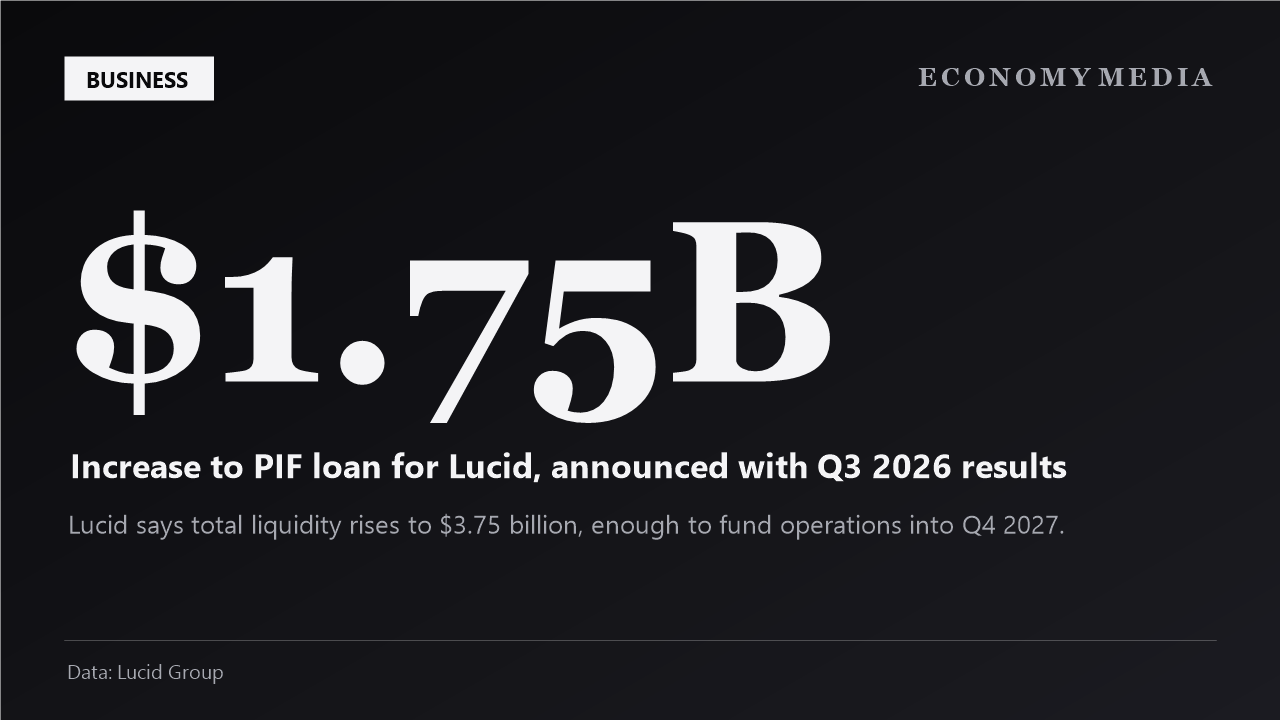
Lucid Group, the California-based maker of luxury electric vehicles, reported third-quarter results on Monday that fell short of Wall Street’s expectations, while announcing that its largest shareholder, Saudi Arabia’s Public Investment Fund (PIF), had agreed to add $1.75 billion to an existing loan. The company says the extra money should keep it running into the fourth quarter of 2027 and pay for the start of production of a long-awaited midsize vehicle.
What happened
Lucid posted revenue of $350 million for the quarter, CNBC reported, below the roughly $407 million analysts had expected according to LSEG. The company lost $2.74 per share, wider than the $2.28 loss analysts had forecast. Revenue rose about 4% from the $336.6 million Lucid reported a year earlier.
Net loss narrowed to $830.9 million from $978.4 million in the same quarter of 2025, according to CNBC. Adjusted EBITDA, a measure of earnings before interest, taxes, depreciation and amortization that strips out some costs, was a loss of about $726 million, slightly larger than a year earlier.
Measures differ between data providers. StockStory, a financial research site, put Lucid’s adjusted loss at $2.30 per share against a consensus of $2.21, and revenue consensus at about $396 million, but it also described the quarter as a miss.
A bigger lifeline from Saudi Arabia
The PIF increased a delayed draw term loan, a credit line that a borrower can tap in stages, by $1.75 billion. Lucid said the move lifts its total liquidity to $3.75 billion from $2 billion at the end of the quarter, according to CNBC.
The runway matters. Investment research site TIKR calculated that at its previous rate of spending, Lucid’s $2 billion would have lasted about two quarters; with the new money, the company says it can operate into late 2027. TIKR also noted that the new debt ranks ahead of common shareholders, and that a further delay to the midsize vehicle would likely force Lucid to seek more funding.
Lucid has leaned heavily on the Saudi fund for years, and the PIF has repeatedly stepped in with new capital as the company works toward profitability.
Turnaround under a new CEO
The quarter was the first full report since Silvio Napoli, who took over as chief executive in June, unveiled a restructuring plan. “Our transformation is beginning to show progress,” Napoli said, as quoted by CNBC.
Several signs of that progress were cited by the sources:
- Cash burn fell about 30% from the second quarter to roughly $1.04 billion, TIKR reported, the first improvement after three straight quarters of heavier spending.
- Napoli said on the earnings call that Lucid is on track for its $1.4 billion cash-flow improvement target for 2026, with about $800 million already realized, according to StockStory.
- Lucid deliberately trimmed output to work down inventory, building 2,954 vehicles in the quarter, fewer than it delivered.
- Warranty claims fell 70% from a year earlier, StockStory reported.
Investor reaction was mixed. CNBC reported shares slipped about 5% in after-hours trading Monday, while TIKR reported the stock later rose about 12% as investors focused on the new financing.
What comes next
Lucid has pushed the start of production for its midsize vehicle, a lower-priced model meant to broaden its customer base, from the end of this year to the second half of 2027, CNBC reported. Management told analysts it expects the platform to expand the company’s addressable market eightfold.
The company is also building a factory in Saudi Arabia, where it expects full production in 2027, and is developing a robotaxi with ride-hailing giant Uber and autonomous-driving firm Nuro. Uber has invested $500 million in Lucid and committed to buy at least 35,000 vehicles, mostly midsize robotaxis, according to TIKR. StockStory reported that Lucid also signed a new agreement with European ride-hailing company Bolt and that the robotaxi program is preparing for driverless testing ahead of a planned early 2027 launch.
Lucid suspended its guidance and many targets in May. It plans to share a medium-term plan and new targets early next year, alongside its year-end results.