Meta Launches Muse Ember, a Low-Cost AI Model Built for Agents
Meta's new Muse Ember costs 10 cents per million input tokens and is designed to handle the repetitive work of AI agents at scale.
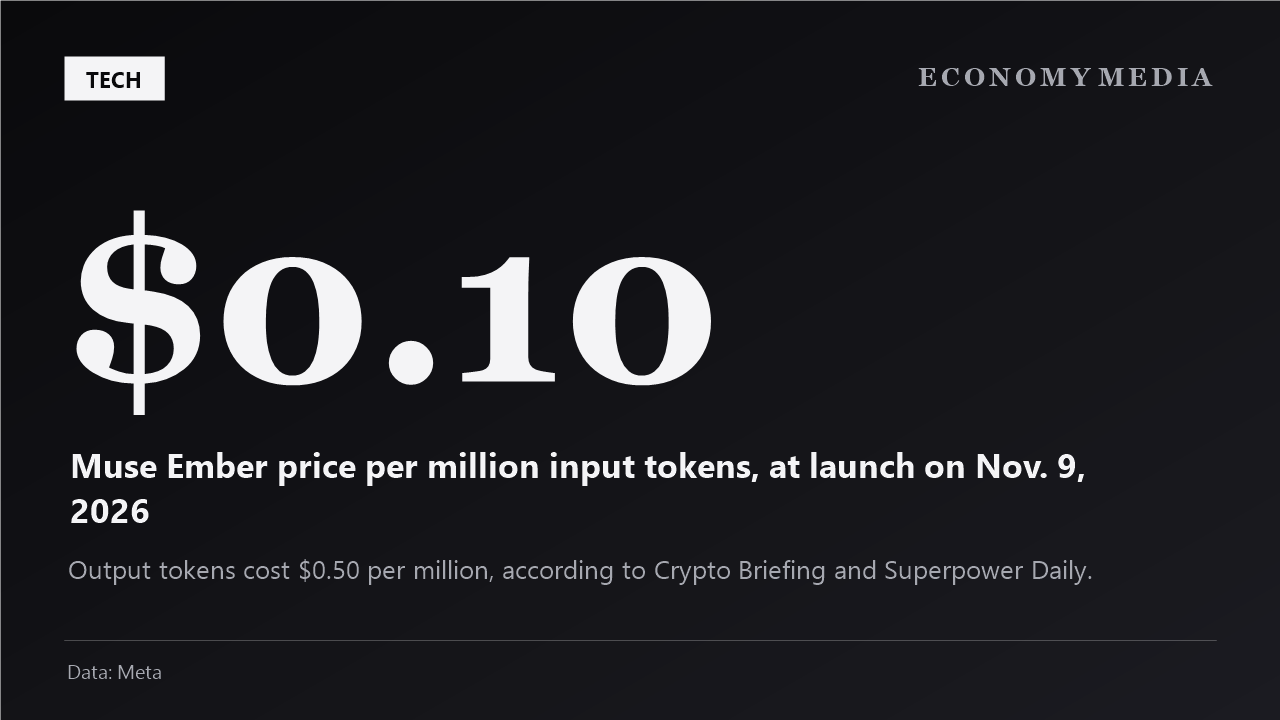
Meta on Monday released Muse Ember, the smallest and cheapest artificial intelligence model yet from its Meta Superintelligence Labs unit. The company is pitching it as a workhorse for AI agents, the software systems that carry out multistep tasks for users, and is pricing it below small models from Anthropic and OpenAI. Ember costs 10 cents per million input tokens, TechCrunch reported. Tokens are the small chunks of text and data that AI models process and that developers pay for.
What Meta released
Meta says Ember is built for what it calls the work agents repeat all day: tool calls, coding subtasks, routing requests, pulling information out of documents and parsing long files. According to TechCrunch, the company has framed the launch around cost per task rather than raw capability. It says Ember beats Anthropic’s Haiku and OpenAI’s Luna, both lightweight models aimed at the same market, on a composite score from Artificial Analysis, an independent firm that benchmarks AI models.
The model is meant to run alongside Muse Wonder, the frontier model Meta released in October. In that setup the larger model plans and sets the rules, and Ember applies them at volume. TechCrunch described a customer-support agent as an example: a heavier model works out how a type of problem should be handled, and Ember then applies that approach across tens of thousands of cases. Meta summed up the split as “Muse Wonder plans, Muse Ember handles the volume.”
Ember was trained on text, images and audio. Meta says agents built on it can read screenshots, charts and scanned documents and work from voice memos, meeting recordings and video without needing a separate model.
Price and performance claims
Crypto Briefing and the AI newsletter Superpower Daily both reported that Ember costs $0.50 per million output tokens on top of the 10-cent input price. Superpower Daily, citing Meta’s launch post, said cached input, meaning text the model has already seen and stored, costs $0.004 per million tokens. It also reported a context window of 1 million tokens, which is the amount of material the model can consider at once. Developers can reach Ember through Meta’s Model API and its Muse Code coding tool under the identifier muse-ember-1.0.
Crypto Briefing compared Ember with Meta’s own mid-weight Muse Spark 1.3. It said Spark costs about $1.25 per million input tokens and $4.25 per million output tokens, roughly 12.5 times Ember’s input price. TechCrunch said Ember is also priced in line with low-cost open-source rivals such as DeepSeek V4.1 Flash and GLM 5.3 Flash.
Meta’s benchmark table, as reported by Superpower Daily, shows Ember well ahead on a business-workflow test and slightly ahead on one coding test. It trails Anthropic’s model on a second coding test that judges whether code changes would be accepted in real projects:
Superpower Daily also reported that, on Meta’s cost chart, one Ember setting scored 35.8 on the Artificial Analysis intelligence index at an estimated $0.136 per task. Haiku’s top displayed score was 36.2 at $0.411 per task. The publication noted that Ember’s per-task figures are estimates derived from its list price.
Caveats
The performance numbers come from Meta itself. Crypto Briefing reported that no independent benchmarks or full technical specifications had been published at launch, so it is not yet clear how Ember holds up outside Meta’s own testing. Other points to watch:
- Crypto Briefing noted that Ember’s rates closely match Meta’s discounted “Contributor” tier, which requires developers to let Meta use their interaction data to train future models.
- Meta said it tested Ember for chemical, biological, cybersecurity and loss-of-control risks under its internal Meta Superintelligence Scaling Framework and found it stayed below the framework’s high-risk thresholds, according to Superpower Daily. That is the company’s own assessment.
- Meta also said it checked behaviors such as resisting hidden instructions and asking for human input before high-impact actions, but it published no figures from those tests.
Background
Ember is the fourth model under the Muse brand, which Meta built after reorganizing its AI efforts around Meta Superintelligence Labs. The line began with Muse Spark, a mid-weight model, in April. Meta followed with Glimmer, an open-source counterpart to Spark, in August, and Wonder in October. Meta also launched Muse Agent, its main consumer AI product, in September. TechCrunch said that product has seen unexpected success and added features including video chat this month.
The launch comes as AI developers compete on price as well as capability. Companies building agents can run up millions of model calls, so the cost of each routine step matters. With Ember, Meta is betting that a cheap model handling the bulk of that work, steered by a more powerful one, will draw developers away from rival platforms.