New York Forces T-Mobile to Drop Data Caps on Low-Income Internet Plans
T-Mobile agreed to remove data caps and widen access to its $15 low-income home internet plan after a New York attorney general investigation.
T-Mobile has agreed to remove data caps from the discounted home internet plans it sells to low-income New Yorkers, after state investigators found the company was slowing those customers to a crawl after just a few days of typical use. New York Attorney General Letitia James and Governor Kathy Hochul announced the agreement on Nov. 9, saying T-Mobile’s offerings had failed to meet the requirements of the state’s Affordable Broadband Act.
Under the deal, T-Mobile will also offer the low-cost plans everywhere it sells home internet in the state and stop hiding information about them from search engines, according to statements from the attorney general’s office and the governor’s office.
What investigators found
The Affordable Broadband Act, or ABA, is a New York law that requires large internet providers to offer income-eligible households service of at least 25 megabits per second (Mbps) for no more than $15 a month, or at least 200 Mbps for no more than $20 a month, with taxes and equipment fees included in those prices. Providers must also make reasonable efforts to promote and advertise the plans.
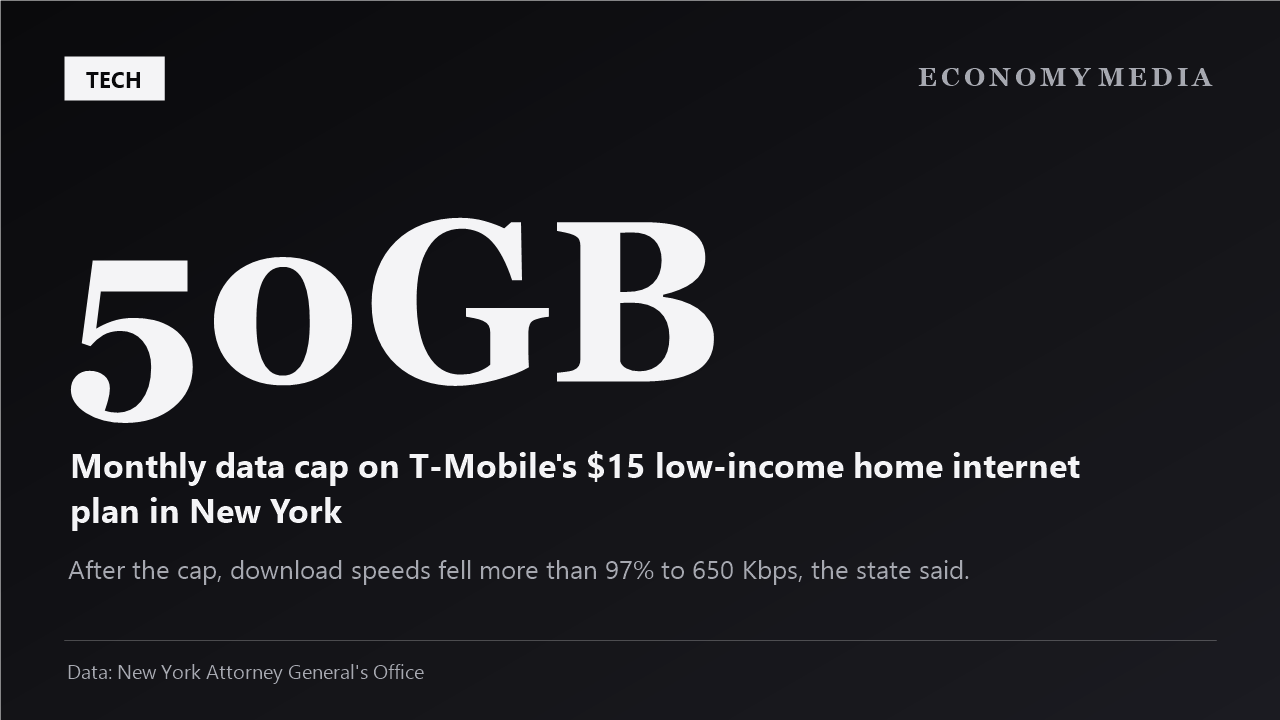
T-Mobile delivers its home internet through fixed wireless technology, meaning service runs over its mobile network rather than through cables to the home. The company advertised an ABA plan offering 25 Mbps downloads for $15 a month. In practice, the attorney general’s office said, a data cap kicked in once a customer used 50 gigabytes in a month, cutting download speeds by more than 97 percent, to 650 kilobits per second. State officials said a typical customer could reach that limit in about four days.
Investigators identified two other problems:
- T-Mobile offered ABA plans only in areas where it had built out 5G service, even though it sold full-price 25 Mbps plans in areas covered only by its older 4G network.
- The company coded its website so that pages describing the ABA plans did not show up in search engine results.
“T-Mobile flouted the law designed to help vulnerable New Yorkers access it,” James said, as quoted by Engadget. In the official release, she added that reliable and affordable internet service “is a basic need for all New Yorkers.”
Hochul said in the statement that “no New Yorker should struggle to access reliable and affordable internet,” pointing to the role of internet access in work, school and emergency services.
The case began when the state Department of Public Service, which together with the Public Service Commission oversees compliance with the law, raised concerns and referred the matter to the attorney general’s office. Neither the attorney general’s release nor the governor’s announcement mentions a financial penalty, and Engadget’s report did not include a response from T-Mobile.
What changes for customers
Under the agreement, T-Mobile will remove the data caps on its ABA plans and deliver 25 Mbps download speeds to all subscribers on those plans, with exceptions only for temporary slowdowns caused by network congestion. It will make the plans available in every part of New York where it provides home internet, not only in 5G areas, and make its ABA webpage visible to search engines.
A household qualifies for an ABA plan if at least one member currently receives Medicaid, SNAP food assistance, home energy assistance (known as HEAP) or a utility affordability benefit, free or reduced-price school lunch, or one of New York City’s rent-freeze programs for seniors and people with disabilities, known as SCRIE and DRIE. Households that do not receive those benefits may still qualify based on income, according to the governor’s office. The discounted plans cover home broadband only; mobile phone and dial-up services are excluded, and available plans, speeds and providers vary by location.
Why it matters
New York’s law, enacted in 2021, took effect in January 2025 after years of legal challenges from the broadband industry, according to the Benton Institute for Broadband & Society, a nonprofit that researches internet access policy. Benton described it as the first state law of its kind and noted that other states are considering or have passed similar measures.
The law applies to providers with more than 20,000 subscribers. Measuring how well it is working has been difficult. In an analysis published in April, Benton researcher Caroline Stratton wrote that 16 providers filed 2025 compliance reports with the Public Service Commission, the first public data on how the law is being carried out, but that providers’ differing use of confidentiality protections limits what can be learned from them.
The T-Mobile case shows that enforcement depends on more than price. A plan can meet the $15 price on paper while its speeds, coverage or visibility keep it out of reach for the people it was meant to serve. Fixed wireless providers such as T-Mobile have grown quickly in home broadband, which makes how they handle subsidized plans increasingly relevant to state regulators.
The bigger picture in New York
The settlement is part of a wider state effort to close the digital divide. Through its ConnectALL initiative, New York says it is investing $1 billion in broadband infrastructure, competition and access, including a $100 million program to bring service to affordable and public housing and $50 million for digital literacy and devices. Rory Christian, chair of the Public Service Commission, and Hope Knight, president of the state economic development agency Empire State Development, also praised the agreement in the governor’s announcement.
State officials directed residents who want to check their eligibility to the state’s broadband consumer resources website, broadband.ny.gov.