Tesla Invites Select Buyers to Order Cybercab for Personal Use
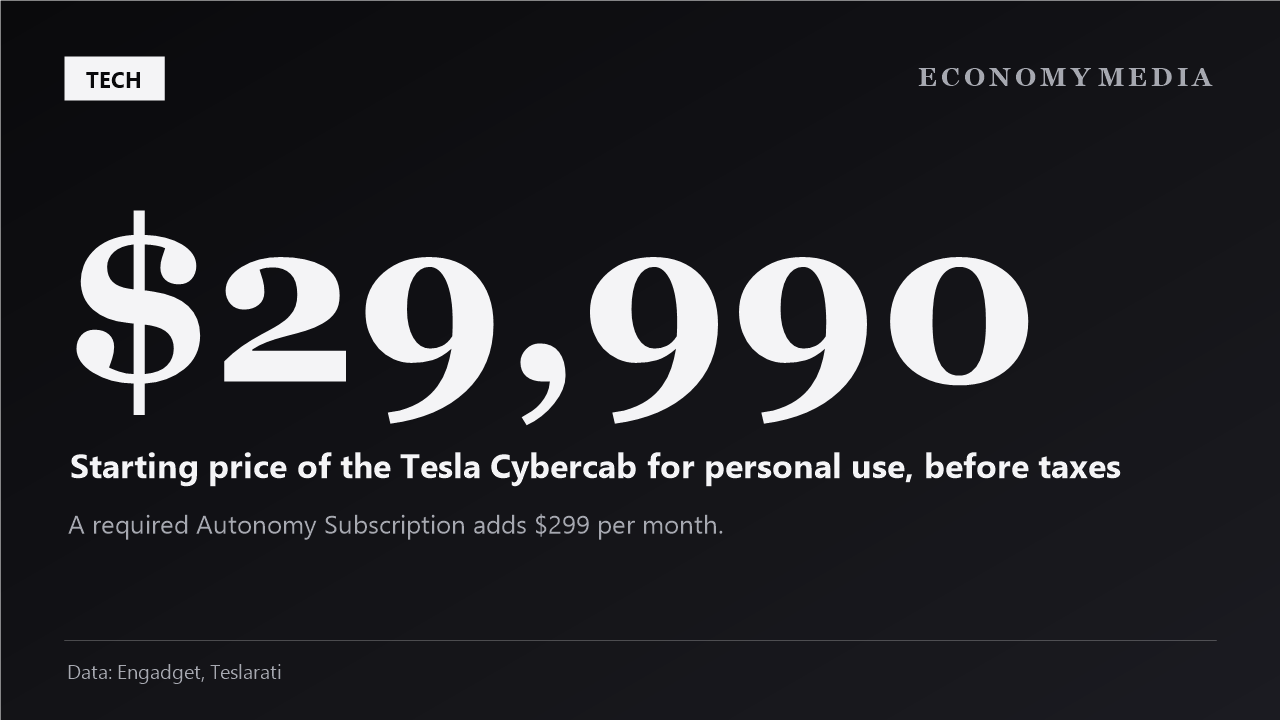
Tesla is offering the steering-wheel-free Cybercab to chosen customers at $29,990, but it requires a $299 monthly subscription and works only in approved zones.
Tesla has begun inviting select customers to buy its Cybercab, a two-seat robotaxi with no steering wheel or pedals, for personal use. Engadget, Electrek and Teslarati all reported the offer on Nov. 13 and 14, 2026. It is a shift for a vehicle Tesla had said would first go mainly to companies buying fleets.
What Tesla is offering
The Cybercab is priced at $29,990 before taxes, according to Engadget and Teslarati. Teslarati reported that buyers must put down a $1,000 non-refundable order deposit. Every buyer must also pay for what Tesla calls an Autonomy Subscription, which costs $299 a month. Teslarati said the first month is included in the purchase price.
The subscription is not optional. Electrek, which reviewed the agreement, quoted it as saying: “Your Cybercab will not operate without an active Autonomy Subscription.” Electrek calculated that the car plus 59 further months of the subscription would cost about $47,631 over five years, before insurance, registration, charging and taxes. It also reported that Tesla can change the subscription price with one month’s notice.
Teslarati said sales are limited to invited customers. There is no open public order page. Teslarati said Tesla’s ordering page estimates delivery in December and lists Austin, Texas.
Where it can drive
The car is tied to the zones where Tesla runs its robotaxi service. Ashok Elluswamy, Tesla’s head of AI, said, according to Engadget, that personal Cybercabs will work “unsupervised inside all the same geo locations as Robotaxi, just serving the owners’ needs.”
The sources differ on where those zones are. Engadget listed Miami, Orlando and Tampa in Florida, and Austin, Dallas, Fort Worth, Houston and San Antonio in Texas. Teslarati said initial deliveries are expected only in the Austin area, where unsupervised service already operates. Electrek said Tesla may “expand, reduce, relocate, or otherwise modify the operating area at any time” and that driving outside the zones is prohibited and can be blocked technically.
Electrek said its own tests found actual robotaxi coverage was between 59% and 78% of the areas on Tesla’s advertised maps.
The fine print
According to Electrek’s reading of the agreement, Tesla can remotely locate, restrict or control the vehicle and put it in a “safe state.” Three or more strikes for improper or unsafe use trigger a one-week suspension of autonomous driving, with no prorated refund. The car collects “Autonomy Data,” including cabin camera images, which are kept for 30 days by default. Use on Tesla’s own Robotaxi network, on Uber, on delivery apps or on rental platforms requires Tesla’s written permission.
Electrek was sharply critical. It called the arrangement exploitative and quoted a user on X, Mark Valorian, who described it as “an endless variable-rate lease with a ridiculous down payment.” Electrek did not include a direct Tesla response to the criticism. Tesla’s stated position, as Electrek reported it, is that the Cybercab and its Model Y robotaxis share hardware and software.
Regulatory scrutiny and what comes next
Engadget noted that the National Highway Traffic Safety Administration, the main U.S. auto safety regulator, opened an inquiry into how Tesla self-certified the Cybercab, given that it has no conventional manual controls. The agency is examining the technical data Tesla relied on. Electrek did not mention that review, and the outcome is not known.
Engadget said it is unclear whether personal-use orders will actually reach buyers. On Tesla’s third-quarter earnings call, executives said, according to Teslarati, that most Cybercabs will stay Tesla-owned for ride-hailing, with some sold to customers by year-end. Electrek said Elluswamy suggested customer-owned cars might join Tesla’s network around the second quarter of 2027.
Not yet confirmed is how many invitations Tesla has sent, which cities will receive the first deliveries, and whether the terms will change before cars ship. Reports on the exact cities and the deposit differ between outlets, and Electrek did not describe a separate deposit.