UK Debt Tops £3 Trillion as Interest Bill Hits September Record
Britain borrowed £24.5 billion in September as debt interest hit a record for the month, piling pressure on the chancellor a week before the budget.
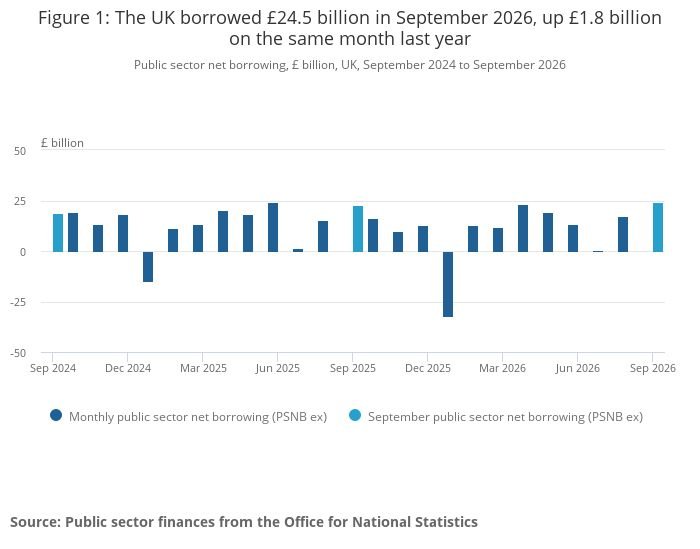
The British government borrowed £24.5 billion in September, more than forecast, as the cost of servicing its debt climbed to the highest level ever recorded for that month and total public debt passed £3 trillion (about $4 trillion) for the first time, according to figures published Wednesday, Oct. 21, by the Office for National Statistics (ONS), the UK’s official statistics agency.
The data land one week before John Healey, the chancellor of the exchequer, Britain’s finance minister, presents his first budget on Oct. 28, and they narrow the room he has to cut taxes or raise spending.
What the numbers show
September’s deficit, the gap between what the public sector spends and what it collects, was £1.8 billion, or 7.7%, larger than a year earlier, the ONS said. It was also £1.9 billion above the projection made by the Office for Budget Responsibility (OBR), the independent body that produces the government’s official economic and fiscal forecasts. The statistics agency described it as the second-highest September on record, behind only 2020, when pandemic spending sent borrowing soaring.
Economists had expected a slightly smaller number, though reports differ on how much smaller. BM Magazine said analysts had forecast £23.9 billion, while the news site Brit Brief put the consensus at £24.1 billion.
The biggest single pressure was interest. Central government paid £10.9 billion in debt interest in September, up £1.6 billion from a year earlier and £2.0 billion more than the OBR had expected. The ONS said that was the highest September figure since monthly records began in 1997. Of that total, £4.0 billion reflected the inflation adjustment on index-linked gilts, government bonds whose repayments rise with the retail prices index, a measure of inflation.
Debt crosses a symbolic line
Public sector net debt was provisionally estimated at £3,005.0 billion at the end of September, £91.7 billion more than a year earlier and the first time it has exceeded £3 trillion, the ONS said, cautioning that the figure may be revised. Measured against the size of the economy, however, debt edged down to 94.0% of gross domestic product, 0.7 percentage points lower than a year before.
Grant Fitzner, chief economist at the ONS, said borrowing in the first six months of the fiscal year “remained below the same period last year,” and that debt as a share of the economy “remains at levels last seen in the early 1960s,” according to Brit Brief. From April through September, the government borrowed £97.8 billion, £4.4 billion less than in the same period of 2025 but £6.0 billion above the OBR’s forecast.
Why it matters for households
Higher interest costs are tied closely to inflation. Separate ONS data released the same morning showed consumer prices rising 3.5% in the year to September, driven largely by fuel costs that reports linked to conflict in the Middle East. Because part of Britain’s debt is indexed to inflation, rising prices feed directly into the government’s interest bill, money that cannot go to public services or tax relief.
Greg Thwaites, interim chief economist at the Resolution Foundation, a think tank focused on living standards, said rising inflation and record debt “illustrate the double dilemma facing the Chancellor,” Brit Brief reported.
For borrowers more broadly, the pressure shows up in bond markets. BM Magazine reported the yield on 10-year UK government bonds at 5.41%, and noted that economists expect the Bank of England, the UK central bank, to consider raising interest rates as inflation climbs.
What comes next
The OBR will publish updated forecasts alongside the budget on Oct. 28. BM Magazine reported that the watchdog is widely expected to project annual debt interest above £100 billion into the 2030s, and that some economists believe Healey may need to find around £10 billion in tax increases or spending cuts.
- Matt Swannell, chief economic adviser to the EY Item Club, a forecasting group, estimated the chancellor’s headroom against his main fiscal rule at £10 billion to £15 billion, according to Brit Brief.
- Swannell said any giveaways in the budget are “likely to be modest and temporary.”
- Brit Brief reported that Healey is expected to raise taxes on banks.
The Treasury had not detailed its budget plans as of Wednesday. Whatever Healey announces, the September figures suggest that the rising cost of past borrowing will remain one of the largest constraints on what the government can afford.