US Job Openings Jump to 7.52 Million in September as Quits Rise
US job openings rose by 333,000 to 7.52 million in September, beating forecasts, while quits hit their highest level since March 2025.
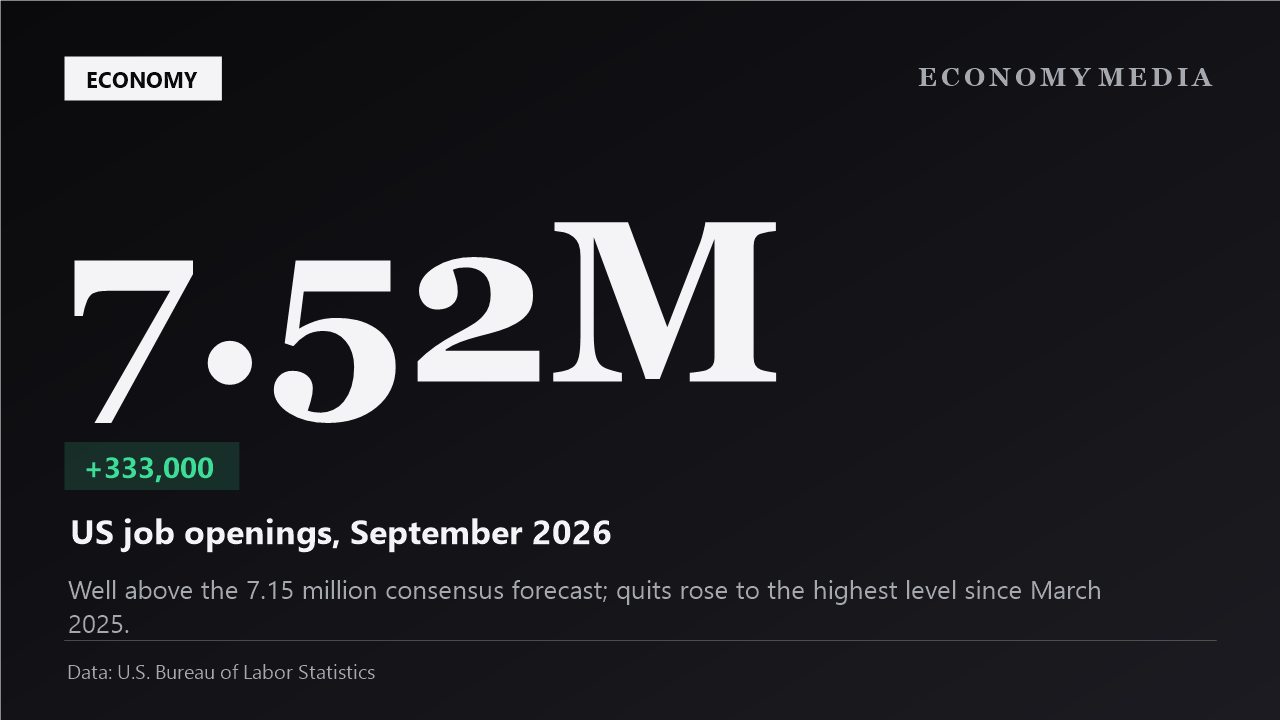
US employers posted far more open positions in September than economists expected, and more workers quit their jobs, according to government data released Tuesday. The figures suggest the labor market may be steadier than recent weak payroll reports had implied. Job openings rose to 7.52 million, up 333,000 from August, the Bureau of Labor Statistics (BLS) said in its monthly Job Openings and Labor Turnover Survey, known as JOLTS. CNBC reported that the figure was well above the Dow Jones consensus forecast of 7.15 million.
What the numbers show
The openings rate, which measures vacancies as a share of total jobs plus openings, rose 0.2 percentage point to 4.5%, CNBC reported. The BLS called the overall level of openings “little changed” in statistical terms, partly because it revised August’s figure up by 111,000, to about 7.2 million.
The increase was broad. According to CNBC, state and local government added about 108,000 openings, professional and business services about 106,000, and manufacturing about 54,000. The BLS said openings in state and local government outside education rose by 104,000.
Other key figures for September:
- Quits: 3.36 million, up 321,000 from August and the highest since March 2025, CNBC reported. The quits rate rose to 2.1%, according to the BLS.
- Hires: up 131,000 to 5.4 million, a hiring rate of 3.4%.
- Layoffs and discharges: down 127,000 to 1.64 million, the lowest since March 2025, CNBC said. The layoff rate held at 1.0%.
Much of the jump in quits came from one industry. The BLS said quits in accommodation and food services, which covers restaurants and hotels, rose by 197,000. That sector also led hiring, with an increase of 158,000. Layoffs fell most in health care and social assistance, down 70,000. Over the past year, total quits are up 375,000, the agency said.
Why it matters
Economists watch quits closely because people tend to leave jobs when they are confident they can find another one, often for higher pay. A rise in quits can point to stronger worker bargaining power, which matters for households whose wages have struggled to keep up with prices.
The data also show that there are again more openings than unemployed people. CNBC calculated that September had about 414,000 more vacancies than job seekers, or roughly 1.05 openings for each unemployed worker. “There are more job openings than unemployed people in the United States right now,” Heather Long, chief economist at Navy Federal Credit Union, told CNBC. She said that despite high gas and diesel prices and ongoing inflation, companies appear to be “slowly increasing their hiring.”
A more cautious reading
Not everyone sees a turning point. Cory Stahle, writing for Indeed Hiring Lab, the research arm of the job site Indeed, described the report as “eerily quiet.” He noted that the quits rate topped 2% for the first time since June 2025, but called the signal faint. Hiring remains at its slowest pace since 2013, and quitting is still near its slowest since 2015, he wrote, while the layoff rate has stayed within a narrow range since mid-2024.
Stahle argued that a stable job market is not necessarily a healthy one. Workers enjoy strong job security, he wrote, but have little leverage to switch jobs or win raises at a time when the Federal Reserve raised interest rates in September and paychecks are trailing inflation. Indeed’s own job postings data showed a year-over-year gain for the first time in more than four years, he added.
What comes next
The JOLTS data lag the government’s main jobs report by a month. The October nonfarm payrolls report, due Friday, will give a more current picture. Economists expect employers to have added 59,000 jobs in October, after a gain of just 29,000 in September, with the unemployment rate holding at 4.2%, CNBC reported.
Separate data released Tuesday showed factory orders for manufactured goods rose 1.8% in September, above the 1.3% estimate, after a 0.3% gain in August, according to CNBC.