UK Economy Grows 0.7% in Third Quarter as AI Boosts Services
Britain's GDP rose 0.7% from July to September, its fastest pace in about two and a half years, as AI and cloud computing work lifted services output.
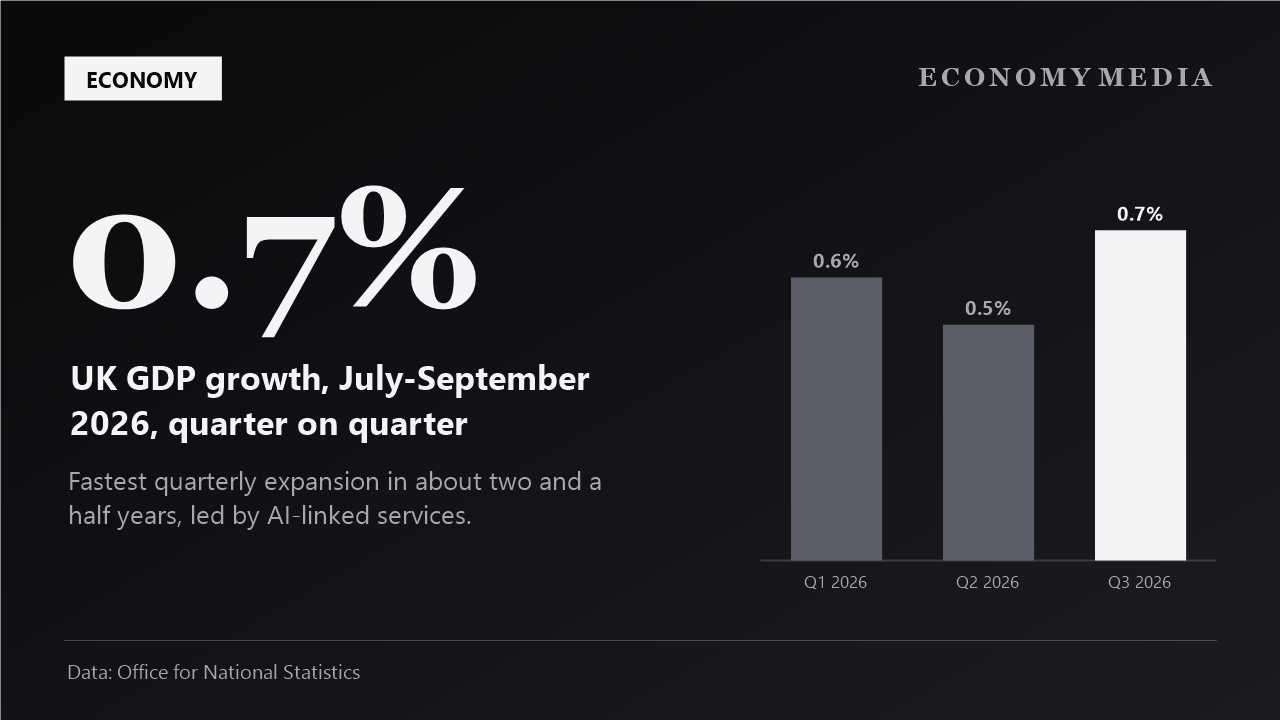
The British economy grew 0.7% in the three months to September, its strongest quarterly expansion in roughly two and a half years, as demand linked to artificial intelligence helped power the services sector, official figures released Thursday showed. The Office for National Statistics (ONS), the U.K.’s official statistics agency, said output was 1.9% higher than a year earlier. Both figures matched economists’ forecasts, according to CNBC and Investing.com, and growth picked up from a revised 0.5% in the second quarter.
The result comes as the world’s fifth-largest economy deals with higher energy costs tied to the U.S.-Iran war and the wider Middle East conflict, rising inflation and the first interest rate increase from the Bank of England in about three years.
What happened
Services, which make up the largest part of the British economy, rose 0.9% over the quarter and did most of the work. Within services, the information and communication sector grew 2.1%, helped by a 4.4% jump in computer programming, consultancy and related activities, Euronews and Investing.com reported. Administrative and support services rose 4.1%.
The ONS said information and communication has been the largest driver of growth across 2026. It added that many of the businesses reporting the largest increases in turnover work in AI and cloud computing, though the agency said it was hard to measure their exact impact.
Not every part of the economy expanded. Construction output fell 0.7%, dragged down by a 4.7% drop in new private housing work, according to Investing.com. Accommodation and food services shrank 0.5%. Production edged up only 0.1%, even as manufacturing grew 0.9%, led by a 4.6% rise in computer, electronic and optical products, Euronews reported.
Monthly data showed the economy grew 0.2% in September, beating expectations for no growth, after a flat August that was revised down from an initial 0.1% gain. July growth stood at 0.4%. On the spending side, household consumption rose 0.6% in the quarter and fixed investment climbed 1.7%, according to Investing.com.
Why it matters
For households, the figures suggest the economy has so far absorbed the shock of higher fuel and energy prices better than many forecasters expected. But stronger growth also complicates the picture on interest rates and borrowing costs.
John Healey, the chancellor of the exchequer and Britain’s finance minister, said in comments reported by Euronews that the Middle East conflict had hurt growth worldwide, “yet Britain is showing stand-out resilience.” CNBC reported that Healey also said the economy was growing at its fastest rate in almost a decade outside the pandemic period. Prime Minister Andy Burnham said the growth was “bringing hope for the future,” according to CNBC.
Analysts largely agreed the quarter was solid while flagging risks. Suren Thiru, chief economist at the ICAEW, a professional body for accountants, called it “a strikingly strong third quarter” and said AI had acted as “an extra engine of growth,” CNBC reported. Sarah Coles, head of personal finance at investment platform AJ Bell, said AI did “a significant portion of the heavy lifting,” according to Euronews. Kit Rees, investment strategist at wealth manager Quilter, described growth as “robust, if unspectacular by historic standards.”
Inflation and the Bank of England
Annual inflation in the U.K. rose to 3.5% in September, partly because of higher household energy bills and motor fuel prices. Last week, the Bank of England raised its benchmark interest rate by a quarter of a percentage point to 4%, its first increase since August 2023, and warned that further hikes could follow if the war is not resolved. In its November Monetary Policy Report, the central bank said growth had been “more resilient than expected” and lifted its growth forecasts to 1.6% for 2026 and 1.3% for 2027, but it projected a slowdown in the fourth quarter and into next year.
Thiru said the latest data keep a December rate rise firmly on the table. Markets were pricing a 73% chance of a hike at the bank’s December meeting, according to LSEG data cited by CNBC. The pound slipped 0.2% against the U.S. dollar on Thursday morning, while U.K. government bond yields were little changed.
What comes next
Economists warned that momentum may fade. Scott Gardner, investment strategist at J.P. Morgan Personal Investing, called the figures a “decent set of results” but said nerves ahead of the government’s Autumn Budget and uncertainty in the Middle East could weigh on confidence, CNBC reported. Rees said rising employment costs, higher energy prices and pressure on household budgets were likely to weigh on the economy into 2027. Coles noted that some investors also worry that heavy spending on AI may not produce lasting profits.