US Home Sales Drop to Lowest Level Since 2010 as Mortgage Rates Climb
Sales of previously owned US homes fell 5.5% in October to a 3.75 million annual pace, the weakest since August 2010, as mortgage rates topped 7%.
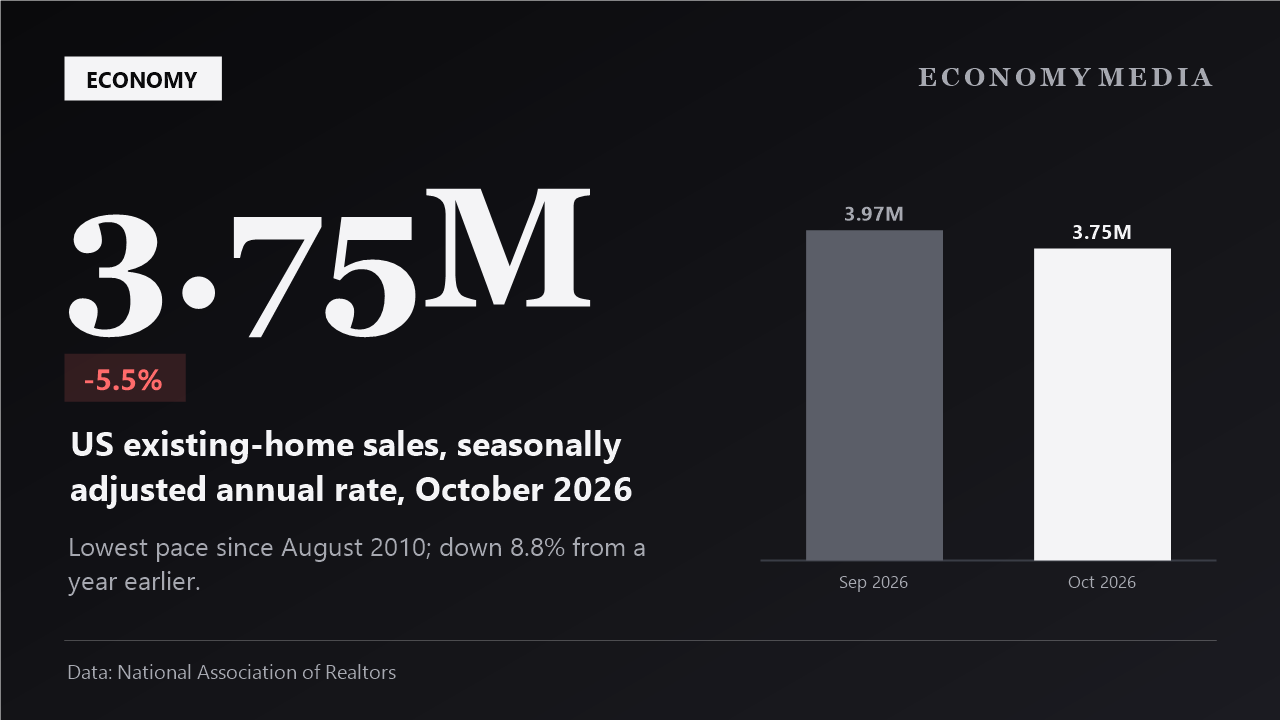
Sales of previously owned homes in the United States fell to their slowest pace in more than 16 years in October, as mortgage rates above 7% and stubbornly high prices kept many would-be buyers out of the market. Existing-home sales dropped 5.5% from September to a seasonally adjusted annual rate of 3.75 million, the National Association of Realtors (NAR), the country’s largest real estate trade group, reported on Thursday. That was the lowest reading since August 2010 and 8.8% below the pace of a year earlier.
What happened
The decline was steeper than forecasters expected. Economists polled by Reuters had projected a rate of 3.85 million, Reuters reported, while a summary of the release by financial news site TFTC cited a consensus of 3.86 million. September’s figure was revised slightly lower, to 3.97 million from an initially reported 3.99 million, according to TFTC.
Lawrence Yun, chief economist of the NAR, tied the slump directly to borrowing costs. “Home buying is difficult when mortgage rates have climbed to their highest levels since 2000,” he said, adding that sales had consequently fallen to their lowest level since August 2010. According to Reuters, Yun also pointed to the possibility of considerable pent-up demand should rates come down.
Sales fell in the South, Midwest and West, and were flat in the Northeast compared with September, Reuters reported. Single-family home sales dropped 5.8% to a 3.41 million annual rate, TFTC said.
Why it matters for households
Because existing-home sales are recorded when deals close, October’s numbers largely capture contracts signed in August and September, Reuters noted. That was the stretch when borrowing costs jumped. According to mortgage finance company Freddie Mac, the average 30-year fixed mortgage rate rose above 7% in late August and hit 7.40% by mid-September. That was 142 basis points higher than before the United States and Israel attacked Iran at the end of February, an escalation that has pushed up energy prices and inflation worries.
Rates have eased only a little since then. Freddie Mac’s weekly average stood at 7.18% last week, down from 7.24% the week before, Reuters reported.
High rates combined with high prices make homes much less affordable. Reuters put the October median existing-home price at $421,900, the highest on record for that month and 0.4% above a year earlier. TFTC’s summary of the NAR data gave a median of $416,700, also up 0.4% from a year ago, and said it was the 40th straight month of annual price gains. The two reports do not agree on the exact dollar figure.
The squeeze shows up in who is buying:
- First-time buyers made up 29% of sales, down from 31% in September and 32% a year earlier. The NAR says a 40% share is needed for a healthy market, according to Reuters.
- All-cash purchases rose to 29% from 27% in September, the same share as a year ago.
- Individual investors and second-home buyers accounted for 20% of transactions, up from 16% a year earlier.
- Distressed sales, including foreclosures, stayed at 2%.
Inventory builds as homes sit longer
As fewer buyers came forward, homes for sale piled up. Inventory rose 1.3% from September to 1.59 million units, 4.6% more than a year earlier, Reuters reported. At October’s sales pace, that supply would take 5.1 months to sell. That is the longest since November 2015, up from 4.7 months in September and 4.4 months a year earlier. Homes also stayed on the market longer, with a median of 35 days compared with 33 in September and 34 a year ago.
A larger stock of unsold homes could eventually give buyers more negotiating room, but so far it has done little to bring prices down, as the record October median suggests.
What comes next
The near-term outlook depends heavily on mortgage rates, which in turn track inflation expectations and the path of interest rates set by the Federal Reserve. The modest dip in Freddie Mac’s weekly average in recent weeks has not yet been large enough to bring back many buyers, and sales recorded in November will mostly reflect contracts signed while rates were still near their highs.
Yun’s comments point to a market that could rebound if borrowing costs ease meaningfully. Until that happens, the data suggest first-time buyers will remain the most squeezed, while cash buyers and investors take a larger share of a shrinking market.