AI Memory Crunch Leaves Holiday Shoppers Facing Pricier Gadgets
A global memory-chip shortage driven by AI data centers has pushed up prices of laptops, tablets and game consoles as the holiday shopping season begins.
Holiday shoppers hunting for laptops, tablets and game consoles this year are running into a problem decades in the making: for the first time in a generation, consumer electronics are getting more expensive, not cheaper. The cause is a worldwide shortage of memory chips, as the companies that make them steer production toward the artificial intelligence data centers built by the largest technology firms. The latest industry data suggest the squeeze is easing slightly heading into the end of the year, but it is far from over.
What happened
The price increases have been building through 2026. Apple and Microsoft both announced in late June that they were raising prices on core products, CBS News reported, citing iPads, certain MacBook models and Xbox consoles. According to Scripps News, Apple’s entry-level iPad rose from $349 to $449 and its 13-inch MacBook Air from $1,099 to $1,299, while Microsoft said new Xbox consoles would cost $100 to $150 more than the models they replace. Both companies pointed to rising memory and storage costs.
David Katzmaier, editor-in-chief of the technology site CNET, told Scripps News that Apple raised prices on “pretty much all of its iPads, its MacBooks,” as well as some home devices such as the Apple TV and HomePod. Tim Cook, Apple’s chief executive, told The Wall Street Journal that price increases were “unavoidable,” Scripps reported.
Windows laptops have followed the same path. Gulf News, citing industry analysts and market reports, said laptops from Dell, HP and Lenovo had risen between 15% and 30% this year. Memory now makes up about 35% of a laptop’s manufacturing cost, up from a historical range of 16% to 20%, the newspaper reported.
Why it matters
The shift reverses a long trend. Computer and electronics prices have generally fallen since the 1980s, CBS noted, making gadgets one of the few corners of household budgets where shoppers could count on getting more for less. Government inflation data cited by CBS showed prices for computer software and accessories up more than 14% over the past year.
The root of the problem is a reallocation of factory capacity. Micron Technology, Samsung Electronics and SK Hynix, the three dominant producers of DRAM and NAND memory, have been shifting resources toward high-bandwidth memory, or HBM, a specialized and more profitable type of chip used in AI servers, according to CBS. The buyers are so-called hyperscalers such as Alphabet, Amazon, Meta and Oracle. TrendForce, a Taiwan-based market research firm, estimated that AI-focused systems would consume 70% of global memory production this year, Gulf News reported.
Analysts describe a market with little slack. Dan Ives, an analyst at Wedbush Securities, estimated there are 15 times as many memory chip orders from tech companies as there are available chips, CBS reported. “You can’t just snap your fingers and release more memory chips,” he told the network. Francisco Jeronimo, vice president for data and analytics at research firm IDC, told CBS that every memory chip device makers buy now costs “100% to 200% more than six or 12 months ago.”
The pain is spread unevenly. Analysts expect high-end gaming laptops and workstations with large amounts of memory to become substantially more expensive, according to Gulf News. Ranjit Atwal, a senior director analyst at Gartner, said the cost increases were making low-margin entry-level laptops unviable and that the sub-$500 PC segment would disappear by 2028, the newspaper reported.
Signs of a slowdown
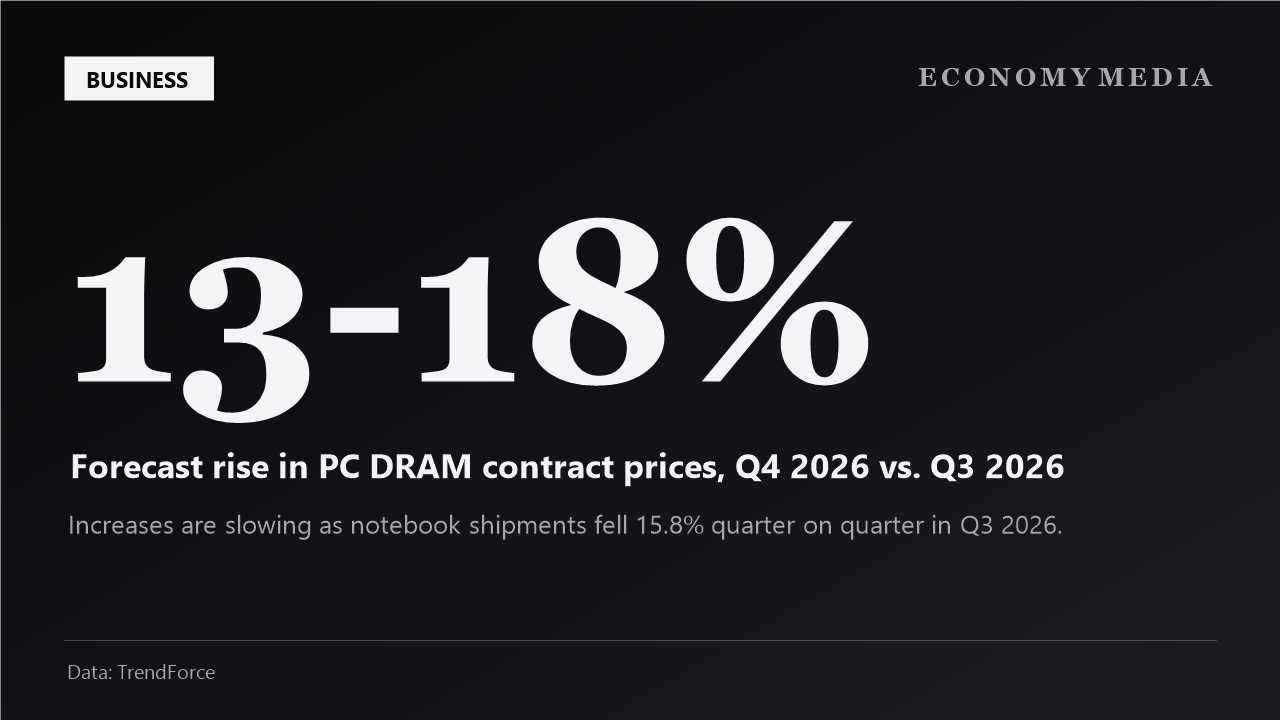
The most recent figures point to some cooling, driven less by new supply than by buyers pulling back. In a report published Nov. 11, TrendForce said notebook shipments fell 15.8% from the previous quarter in the third quarter of 2026, with a further single-digit decline possible in the fourth quarter. PC makers had pulled purchases forward into the first half of the year and are now sitting on rising memory inventories, prompting some to scale back orders for late 2026 and early 2027.
As a result, TrendForce expects price increases to moderate rather than stop:
- PC DRAM contract prices are forecast to rise 13% to 18% from the previous quarter in the fourth quarter of 2026, a slower pace than the prior quarter.
- Contract prices for client solid-state drives are expected to rise less than 5% in the same period.
- Memory manufacturers have tentatively planned cuts to PC DRAM supply in 2027.
What comes next
Forecasts for how long the shortage will last vary. Tech analysts and economists told CBS it would persist at least through 2027 and perhaps later, while Gulf News reported that SK Hynix executives expect tight conditions through 2030. Building a new chip plant can cost $10 billion and take up to five years, according to CBS, which limits how quickly supply can respond.
Other price-sensitive products could be next. Biju Nair, an executive vice president at device-protection company Assurant, told Scripps News that the memory in an iPhone 17 Pro cost about $39, while memory for the iPhone 18 is forecast at about $145. Nair said Apple may hold steady or even raise prices on older iPhone models instead of cutting them by the customary $100. Nabila Popal, an analyst at IDC, told CBS: “I think the days of $50 price increases are over.”
Retail holiday discounts may soften the blow for some shoppers this season, but analysts broadly expect suppliers to keep passing higher component costs through to consumers well into next year.