Burberry Swings Back to Profit as US and China Sales Lift Turnaround
Burberry posted a £19 million first-half pre-tax profit, reversing a year-ago loss, as strong US and Chinese demand powered a fifth straight quarter of growth.
Burberry, the British luxury fashion house best known for its trench coats, returned to profit in the first half of its financial year, as rising sales in the Americas and China gave fresh momentum to a turnaround plan launched less than two years ago. The London-based company reported a pre-tax profit of £19 million for the 26 weeks ended Sept. 26, compared with a £48 million loss a year earlier, while revenue rose 6% to about £1.1 billion (roughly $1.46 billion), according to figures reported by FashionUnited and TheBusinessDesk.com.
What happened
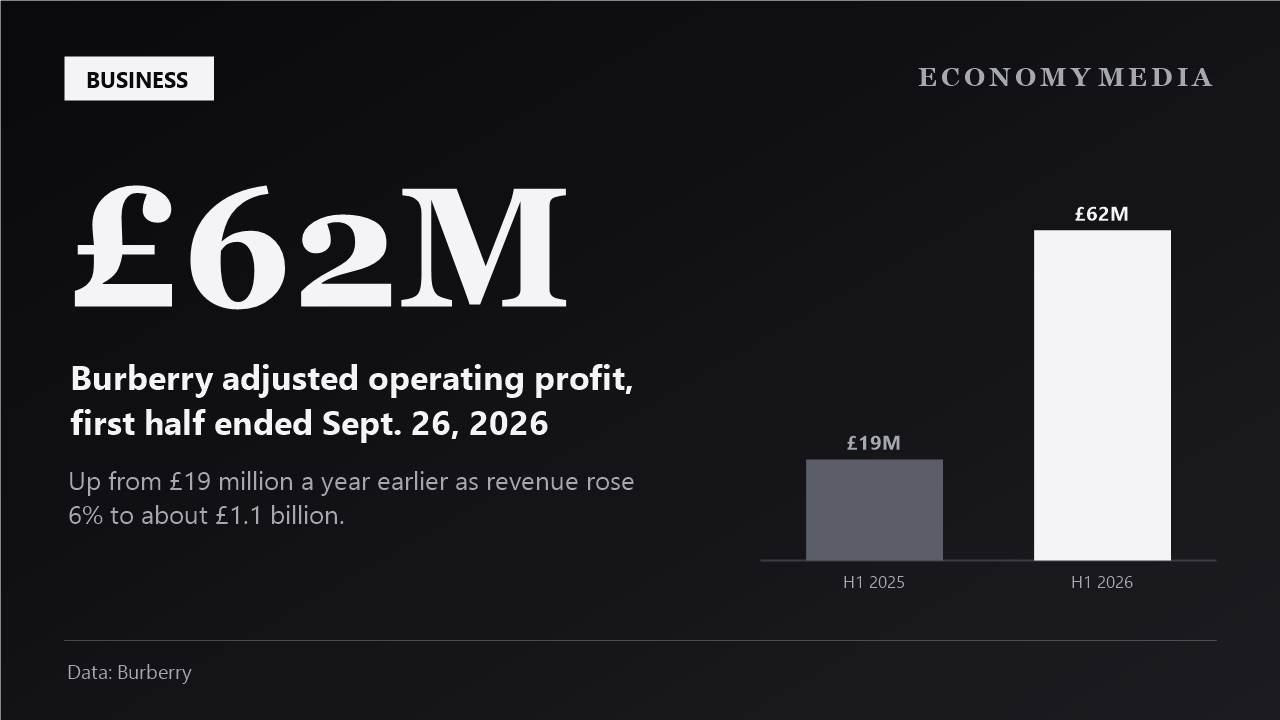
The results, published Thursday, showed improvement across most of the business. Adjusted operating profit, a measure that strips out one-off items, more than tripled to £62 million from £19 million, FashionUnited reported. On a reported basis, Burberry swung to an operating profit of £54 million from an operating loss of £18 million. Profit after tax came in at £6 million, reversing a net loss of £27 million.
Comparable retail sales, which track stores open for at least a year along with online sales, rose 4% both in the second quarter and across the half. That marked the fifth consecutive quarter of growth for the company after a long period of decline.
“Five consecutive quarters of growth and improved quality of sales demonstrate that our strategy is working,” said Joshua Schulman, Burberry’s chief executive, according to FashionUnited.
Shares rose about 8% in early London trading after the announcement, the PA news agency reported, as cited by the publication Martin Cid Magazine.
Where the growth came from
The gains were uneven across regions. The Americas led the way, with comparable sales up 12%, driven by local shoppers and better conversion of store visits into purchases. Greater China rose 7%, helped by domestic spending and travel within Asia. The broader Asia Pacific region grew 3%, with South Korea strong and Japan weaker as fewer visitors from mainland China arrived.
The weak spot was EMEIA, the company’s region covering Europe, the Middle East, India and Africa, where comparable sales fell 2%. Burberry blamed lower tourist activity and softer traffic at outlet stores.
Wholesale revenue, which comes from sales through department stores and other retail partners, jumped 17% at constant exchange rates to £174 million. Outerwear, the company’s signature category, posted double-digit growth, and leather goods sales picked up in the second quarter.
Why it matters
The results suggest Burberry may be regaining its footing after a long stretch of falling sales. Under the turnaround strategy Schulman launched in late 2024, the company has leaned on its signature outerwear while using lower-priced items such as scarves and socks to draw in shoppers who may later trade up to costlier products, Martin Cid Magazine reported.
That approach is a contrast with rivals that have leaned on repeated price hikes. Schulman said wealthy shoppers are showing “some fatigue with exorbitant pricing,” and that Burberry’s value for money had resonated with Chinese customers, according to Martin Cid Magazine. He also cautioned that “nobody has a crystal ball” on when luxury spending will fully recover, describing the industry as highly cyclical.
There were caveats. Part of the improvement in gross margin, which rose to 68.3%, came from a one-off supply chain rebate. Free cash outflow widened to £147 million from £50 million, as the company built inventory ahead of the holiday season, and net debt stood at £988 million at the end of the period, FashionUnited reported.
What comes next
Burberry said it expects revenue growth and a wider operating margin for the full financial year. Its guidance includes:
- Wholesale revenue growth of 10% to 12% at constant exchange rates
- Annualized operating cost savings of about £100 million
- Capital spending of about £100 million, with retail space broadly stable
The company is due to report holiday-quarter trading on Jan. 21, 2027, and plans to hold a capital markets day for investors in London in March. Burberry also has a new chair: William Jackson succeeded Gerry Murphy, who retired from the role, on Nov. 12, according to Martin Cid Magazine.