Tesla to End Cybertruck Production in Texas as Sales Fall Short
Tesla will wind down Cybertruck output at its Austin plant around mid-2027, citing Cybercab plans, after sales fell far below Elon Musk's early forecasts.
Tesla plans to stop building the Cybertruck at its Texas factory around the middle of 2027, Elon Musk, the electric carmaker’s chief executive, said in a post on X, ending a run of about three and a half years for a pickup that never came close to the sales Tesla once predicted for it. Musk said the move would make room for more production of the Cybercab, Tesla’s two-seat driverless robotaxi. Some industry observers doubt that explanation and point to weak demand instead.
What happened
In the post, which Fox Business reported went up late on Thursday, Nov. 5, Musk wrote that Tesla would be “winding down production of the Cybertruck at Gigafactory Texas around the middle of next year.” Gigafactory Texas is the company’s large assembly plant in Austin. Musk called the angular, stainless-steel truck the “best vehicle Tesla has ever made” and described the decision as the “end of an era,” according to Fox Business, which drew on reporting from Reuters.
Tesla has not said whether the Cybertruck will move to another plant or be dropped entirely. The Austin factory is the only Tesla site known to have the equipment for the truck’s specialized parts, Fox Business noted. Electrek, an outlet that covers electric vehicles, reported that the company also has not said how long it will keep selling trucks from inventory or how it will handle parts and service for current owners. Musk did say the Cybertruck fleet “will be around for a long time.”
Wes Morrill, the Cybertruck’s lead engineer, wrote on X that the truck “lives on through Cybercab,” calling it a technology development platform for the robotaxi. Gizmodo said Tesla did not immediately respond to a request for comment.
Why sales matter
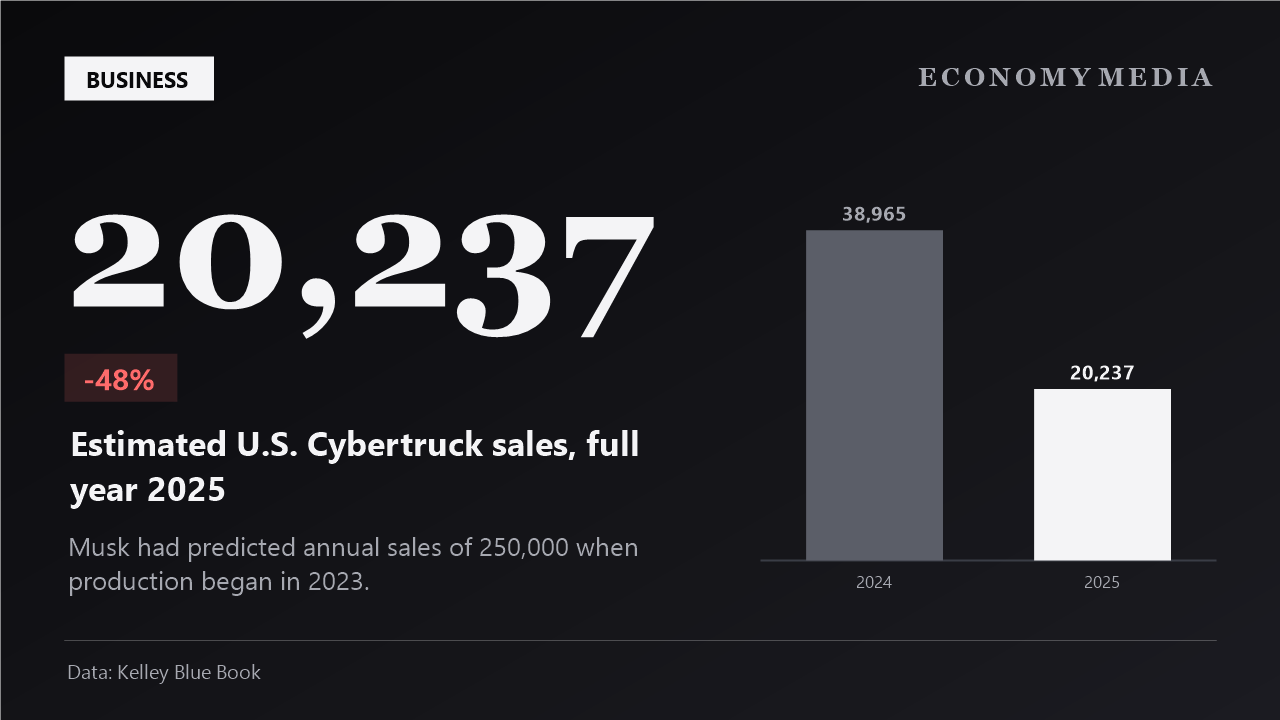
When production started in 2023, Musk predicted annual sales of 250,000 Cybertrucks. Actual sales have been a small fraction of that. Kelley Blue Book, a car-pricing and research firm, estimates Tesla sold 20,237 Cybertrucks in the U.S. in 2025, down 48% from 38,965 in 2024, Fox Business reported.
The decline has continued this year. Gizmodo, citing Cox Automotive, an automotive data company, reported estimated U.S. sales of 4,323 Cybertrucks in the third quarter and 11,586 in the first nine months of 2026. Tesla does not break out Cybertruck deliveries. It reports them in an “Other Models” category, which came to 8,295 vehicles in the third quarter, down 48% from a year earlier. Electrek estimated that 7,000 to 8,000 of those were Cybertrucks, a pace of about 30,000 a year.
The truck has had other problems. Federal safety regulators at the National Highway Traffic Safety Administration (NHTSA) have logged 11 Cybertruck recalls since its 2023 debut, Fox Business reported, covering issues that Gizmodo said included wheels, windshield wipers and a gluing defect. Tesla also changed prices and trims several times. According to Electrek, it launched and then dropped a cheaper rear-wheel-drive version in 2025 and raised prices by $5,000 in August 2026, with the dual-motor model now starting at $74,990. Electrek also reported that Tesla canceled Cybertruck sales in Australia and New Zealand shortly before the announcement.
Questions about the Cybercab rationale
Some coverage questioned whether the Austin plant really needs the space. Fred Lambert of Electrek pointed out that Tesla says the factory has more than 10 million square feet of floor space. He also noted that the Cybertruck line runs at roughly a quarter of its stated installed capacity of more than 125,000 units a year. He argued that low demand and the cost of supporting a low-volume, one-of-a-kind vehicle were the more likely reasons for the decision. Gizmodo likewise said it was not clear why Tesla could not build both vehicles at the sprawling site.
The Cybercab, which has no steering wheel or pedals, began offering paid rides in Austin in September. The service is still small, and the sources give different counts. Fox Business, citing the Texas Department of Motor Vehicles, said about 570 of the more than 1,200 Tesla robotaxis registered in Texas are Cybercabs. Electrek put the number of registered Cybercabs at 463 as of late October. NHTSA is reviewing whether Tesla properly certified that the Cybercab meets federal safety standards without traditional controls. Gizmodo reported that the agency is also looking into allegations that Tesla robotaxis sped through active school zones.
What comes next
The Cybertruck decision follows Tesla’s move earlier this year to end production of its Model S sedan and Model X SUV. Electrek reported that the change freed space at the company’s Fremont, California, plant for Optimus, its humanoid robot. Taken together, the moves leave Tesla’s car business more dependent on the Model 3 and Model Y while Musk shifts the company toward autonomy and robotics. Key open questions include whether Tesla will try another, more conventional pickup and how it will support existing Cybertruck owners after production ends.