China Factory Prices Jump 5.7%, Fastest Since 2022, as CPI Cools
China's producer prices rose 5.7% in October, a four-year high driven by energy costs, while consumer inflation slowed to 0.7%.
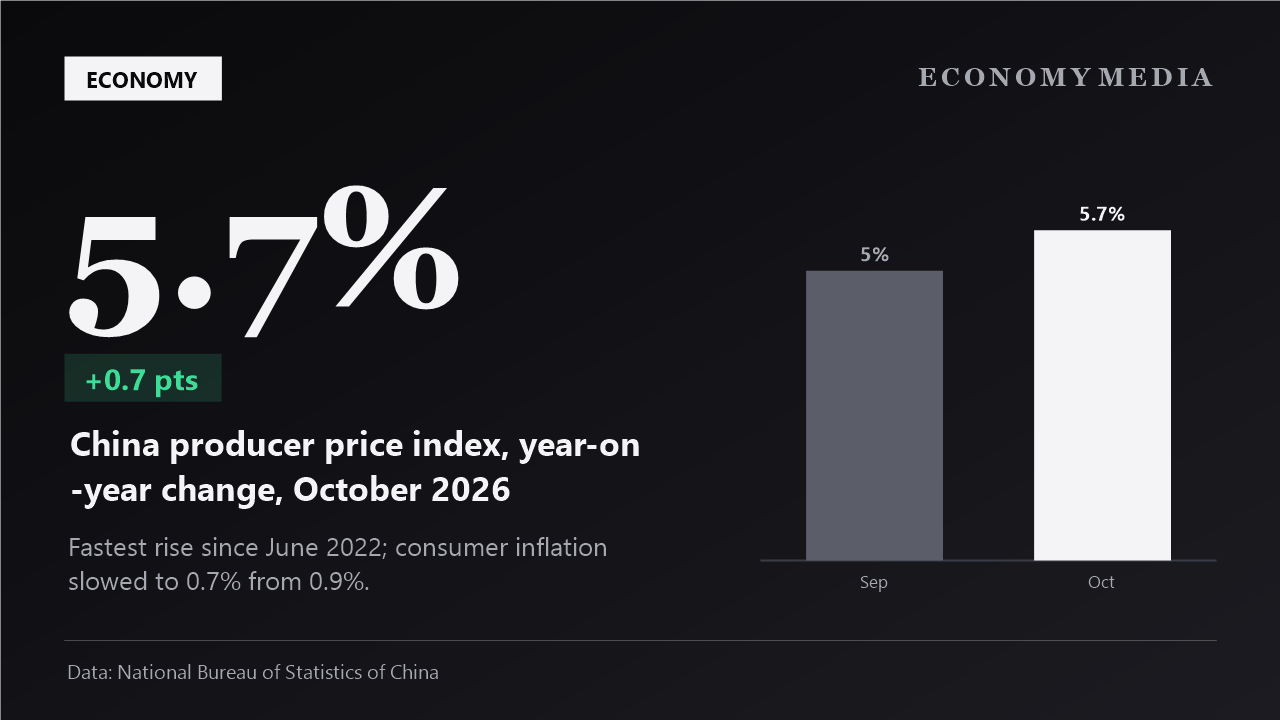
Prices charged by Chinese factories rose at their fastest pace in more than four years in October, even as inflation for shoppers cooled. That gap shows China’s economy is being pulled two ways: global energy costs are pushing prices up, while demand at home stays weak. The producer price index (PPI), which tracks what factories charge for goods as they leave the plant, rose 5.7% from a year earlier, the National Bureau of Statistics (NBS), China’s official data agency, said on Monday. The consumer price index (CPI) slowed to 0.7%.
What the numbers show
The PPI figure was the strongest since June 2022 and beat economists’ forecasts. CNBC reported that a Reuters poll had expected 5.3%. Ireland’s RTÉ cited a Bloomberg survey with the same 5.3% estimate. Caixin Global, a Beijing-based financial news outlet, put the consensus slightly higher, at 5.4%. Caixin said factory-gate inflation sped up by 0.7 percentage points from September, which puts the prior month’s rate at about 5.0%. According to CNBC, October was the third month in a row that producer inflation accelerated.
Consumer prices went the other way. The CPI’s 0.7% annual gain was down from 0.9% in September. CNBC said it was the first slowdown after two months of increases, and it fell short of the 0.8% economists expected. Core CPI, which leaves out volatile food and energy prices, slowed to 0.8% from 1%, CNBC reported. That suggests underlying price pressure in the consumer economy is fading, not building.
Why factory prices are climbing
The analysts quoted in these reports mostly blamed costs from abroad, not a rebound in spending at home. RTÉ reported that producer prices have risen steadily since the Iran war began at the end of February. That ended more than three years in which China’s factory-gate prices kept falling. Caixin said energy-related industries accounted for more than 80% of the month-on-month rise in producer prices.
Nguyen Hoang Nam, an economist at Capital Economics, a London-based research firm, said higher global energy prices and higher prices for AI-related electronics continued “to be the main drivers,” RTÉ reported. CNBC said sharp price gains in mining and raw materials led the October increase. Zhang Zhiwei, president and chief economist at Pinpoint Asset Management, a Hong Kong investment firm, pointed to very strong demand from overseas, the network reported.
Little of that cost pressure has reached consumers. Dong Lijuan, chief statistician of the NBS urban department, said gasoline added the most to consumer prices, but food prices fell more than expected and offset it, according to CNBC. Caixin noted that rising factory costs were only partly being passed on to the prices of consumer goods.
Why it matters
China’s consumer inflation remains well below the government’s official target of about 2%, RTÉ noted. Household spending has been sluggish for years, and the property sector is still stuck in a debt crisis. Zhang told CNBC that weak domestic demand, driven by the property market, is a key reason consumer inflation is not picking up. He said there was “no clear sign of stabilization” in housing yet, which weighs on household confidence and on local government revenue.
For businesses and consumers outside China, the factory data is worth watching. China is the world’s largest exporter of manufactured goods. Higher factory-gate prices there can, over time, raise costs for importers in the United States and elsewhere, though how much gets passed on depends on exchange rates, tariffs and companies’ profit margins. RTÉ said China’s exports have boomed, helped by strong global demand for AI-related products.
What comes next
The rest of the economy has shown some strength. China’s gross domestic product grew 4.5% in the third quarter, up from 4.3% in the previous three months, according to RTÉ. Beijing is targeting growth of 4.5% to 5% in 2026, its lowest goal in decades. CNBC said September retail sales came in well above forecasts. China’s benchmark CSI 300 stock index rose 0.56% after the inflation data came out.
Still, forecasters expect the burst of factory inflation to be temporary. Capital Economics expects the energy-driven price shock to last for several more months and then fade next year, when it sees producer prices falling back into deflation, RTÉ reported. Zhang described overall economic momentum as weak, with no clear sign of recovery yet.