S&P 500 Profits Top Forecasts by the Slimmest Margin Since 2022
Most S&P 500 companies beat third-quarter profit forecasts, but by an average of just 2.7%, the smallest cushion since late 2022, FactSet data show.
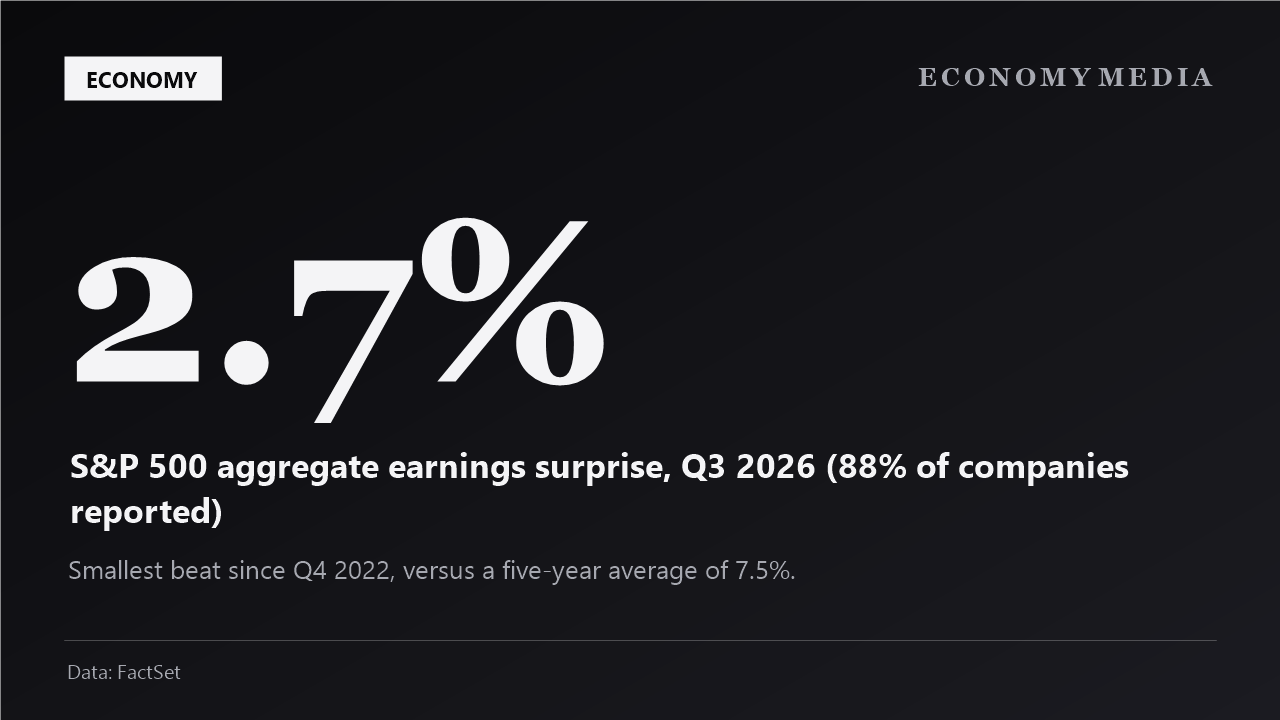
Most of America’s largest companies are still reporting third-quarter profits above Wall Street’s forecasts, but they are clearing the bar by the narrowest margin in about four years. With 88% of S&P 500 companies having reported, actual earnings are running just 2.7% above analysts’ estimates in aggregate, according to FactSet, the financial data provider. That is far below the five-year average surprise of 7.5% and the 10-year average of 8.0%.
If the figure holds once the remaining companies report, it would be the smallest aggregate earnings beat since the fourth quarter of 2022, when results topped estimates by only 1.3%, John Butters, vice president and senior earnings analyst at FactSet, wrote in a Nov. 6 update.
What the numbers show
The slimmer cushion does not mean profits are weak. By most measures, the season has been strong. FactSet’s data show:
- 84% of reporting companies beat earnings-per-share estimates, above the five-year average of 78% and the 10-year average of 77%.
- Blended earnings growth for the quarter, which combines actual results with estimates for companies yet to report, stands at 31.4% from a year earlier, up from 29.1% on Sept. 30.
- 74% of companies beat revenue estimates, and revenue is running 2.1% above forecasts, slightly better than the five-year average of 1.8%.
- Blended revenue growth is 14.3%, which would mark a third straight quarter of double-digit sales gains.
All 11 sectors of the index are reporting higher earnings than a year ago, and seven are growing at double-digit rates, led by energy, information technology and materials, FactSet said. Butters summarized the picture as mixed: more companies are beating estimates than usual, but “the magnitude of earnings surprises is below recent averages.”
Why the beats are smaller
Much of the shortfall traces to a handful of the market’s biggest names. In a Nov. 3 analysis, FactSet found that the “Magnificent 7,” the group of giant technology stocks that includes Alphabet, Amazon, Apple, Meta Platforms, Microsoft and Nvidia, had collectively missed earnings estimates by 14.7% among the five members that had reported. Only two of those five posted results above forecasts.
Several of the misses reflected one-time or investment-related items rather than core operations, according to FactSet. Alphabet, Google’s parent company, recorded an $8.7 billion loss in other income tied to net losses on equity securities. Meta booked a $9.89 billion charge related to a litigation agreement. Amazon faced a tough comparison because its year-earlier results included $9.5 billion in pre-tax gains on its investments in Anthropic, the artificial intelligence company.
As a result, the Magnificent 7 are now on track for 22.6% earnings growth for the quarter, down from 33.6% expected at the end of September, while the other 493 companies in the index are tracking 32.6% growth. If that holds, it would be the first time since the fourth quarter of 2022 that the megacap group has grown more slowly than the rest of the index, FactSet said.
Why it matters
Earnings surprises matter because stock prices tend to reflect what investors already expect. When companies beat by smaller amounts, it can signal that analysts have caught up with business conditions, leaving less room for upside. Stock valuations have already come down: the S&P 500 traded at 17.7 times expected earnings over the next 12 months as of FactSet’s latest update, compared with 19.0 at the end of September and a five-year average of 19.8.
Figures have moved quickly as companies report. TokenPost, a financial news site, cited a blended growth rate of 30.2% as of Oct. 30, while FactSet’s later update put the prior week’s reading at 30.1%, a small difference that reflects ongoing revisions to the data.
What comes next
Analysts expect S&P 500 earnings to grow 28.4% in the fourth quarter and 33.3% for all of 2026, according to FactSet. Nvidia, the chipmaker whose results are closely watched as a gauge of AI spending, was scheduled to report on Nov. 17, and 13 more index members are due to report in the coming week.
Some strategists expect growth to cool over a longer horizon. Goldman Sachs projects S&P 500 earnings per share rising about 11% in both 2027 and 2028, TokenPost reported. “Our base case is for S&P 500 earnings growth to decelerate, not collapse, in coming years,” Ben Snider, Goldman Sachs’ chief U.S. equity strategist, said, according to the report.