Labubu Maker Pop Mart Says Quarterly Revenue Fell as Much as 50%
Pop Mart, the Chinese toymaker behind Labubu, said third-quarter revenue fell 45% to 50% from a year earlier, with sales down in every region.
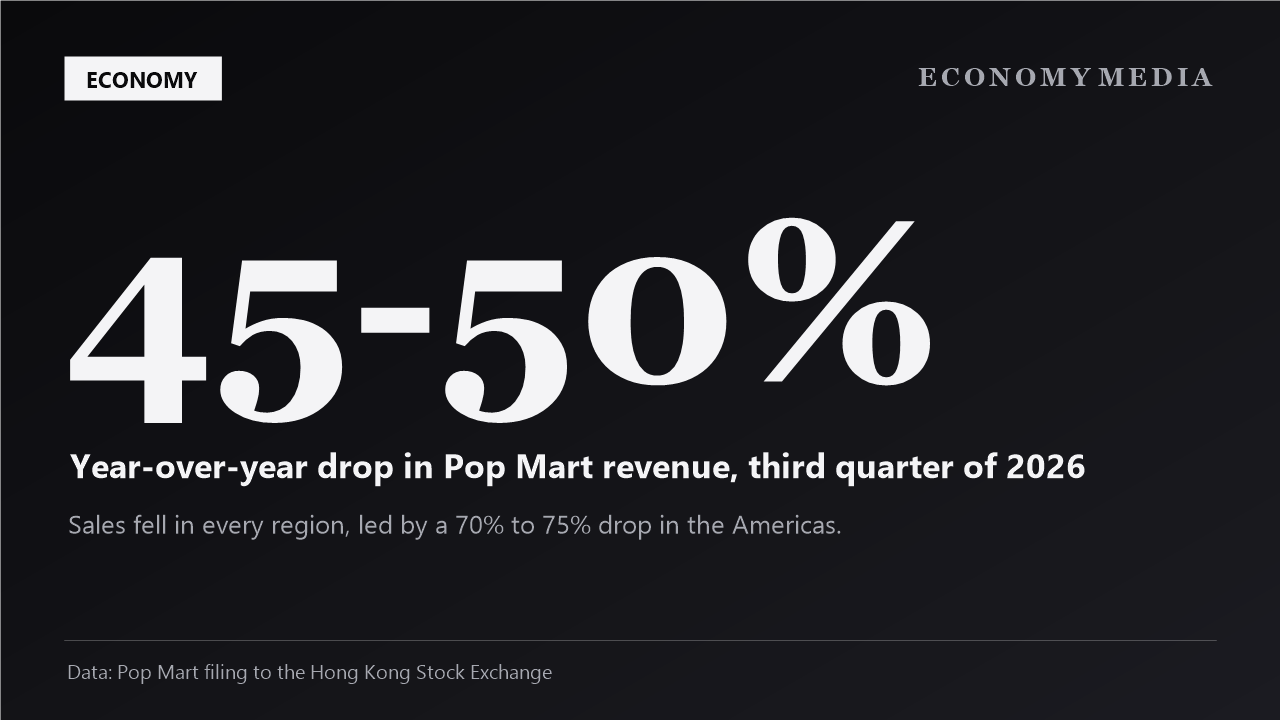
Pop Mart International Group, the Chinese toymaker behind the Labubu collectible craze, said its revenue fell 45% to 50% in the third quarter from a year earlier, with sales declining in every region where it operates. The steepest drops came in the Americas and in Asia-Pacific markets outside mainland China, a sign that the global frenzy for the toothy, fluffy monster has cooled sharply after its 2025 peak.
What happened
The Beijing-based company disclosed the figures in an unaudited business update filed with the Hong Kong Stock Exchange on Oct. 27, covering the three months through September. Pop Mart did not give revenue in yuan for the quarter, only percentage ranges compared with the same period of 2025.
According to the filing, as summarized by Inside Retail Asia and the Chinese business outlet 36Kr, revenue changed as follows:
- Americas: down 70% to 75%
- Asia-Pacific outside mainland China: down 65% to 70%
- Europe and other markets: down 50% to 55%
- Mainland China: down 25% to 30%
Within mainland China, sales through physical stores and the company’s vending machines, which it calls roboshops, fell only 5% to 10%, while online sales dropped 45% to 50%, 36Kr reported.
Investors had largely braced for the result. Pop Mart’s shares closed at HK$132 on Oct. 27, down 0.75%, giving the company a market value of about HK$175.8 billion, according to 36Kr, more than 60% below its peak in August 2025. Inside Retail Asia reported that the stock fell as much as 6% the following day to HK$123.80, an 18-month low, and that analysts at JPMorgan had predicted a revenue drop of about 37% in a note on Oct. 21.
Why it matters
Pop Mart became one of the most closely watched consumer stories of 2025 as Labubu, a mischievous elf-like character sold in surprise “blind boxes,” drew long lines at stores and fueled a booming resale market from Bangkok to Los Angeles. In the third quarter of last year, Pop Mart’s revenue rose 245% to 250% and overseas sales jumped 365% to 370%, Inside Retail Asia reported. That record quarter is the yardstick the new numbers are measured against.
The company has argued that the comparison is what makes the drop look so severe. Si De, Pop Mart’s chief operating officer, pointed to the unusually high base from 2025 as the main reason for the decline, according to Inside Retail Asia, which noted that Pop Mart’s sales are still roughly 70% to 90% above the same quarter of 2024. Si also said the Chinese market remained relatively stable and that he expects full-year growth there, 36Kr reported.
Critics see a deeper problem: dependence on a single hit. The Monsters, the character family that includes Labubu, generated about 14.2 billion yuan in revenue in 2025, more than a quarter of the company’s annual sales. In the first half of 2026, that line’s revenue fell 7.5% to about 4.4 billion yuan and its share of group revenue shrank to 26% from roughly 35%, Yicai Global reported. Pop Mart sharply increased Labubu production, and resale prices for many models fell by more than half, Inside Retail Asia said.
Background
Signs of strain appeared well before the latest update. In March, Wang Ning, Pop Mart’s founder and chief executive, set a goal of at least 20% revenue growth for 2026. By August, when the company reported first-half results, he acknowledged it might not reach that target, warning that the second half would face more pressure because the prior year’s third quarter “had a very high comparison base,” Yicai Global reported.
First-half revenue still rose 24% to 17.1 billion yuan, about $2.5 billion, driven by a 47% gain in China, according to Yicai Global. Overseas revenue, however, fell almost 12% to 5 billion yuan. Yang Jingbing, the chief financial officer, attributed the overseas weakness to Labubu’s cooling popularity abroad and to continued spending on the company’s international store network. Pop Mart also announced a share buyback of 2 billion to 5 billion yuan.
Newer characters are partly filling the gap. Twinkle Twinkle, a starry-eyed figure popular in China and other Asian markets, grew its first-half sales nearly sevenfold to about 2.6 billion yuan, becoming the company’s second-largest line, Yicai Global said. JPMorgan analysts, however, described first sales of some other recent launches as soft, Inside Retail Asia reported.
What comes next
Management expects revenue in every region to rise from the third quarter during the year-end holiday season, according to Inside Retail Asia. The company is also pressing ahead in the United States, where it aims to expand from 72 stores to more than 100 this year, with flagship locations planned on Fifth Avenue and in Times Square in New York.
Whether those steps can offset the fading of Labubu remains uncertain. A rebound in the fourth quarter would support the company’s case that 2026 is a reset year after an extraordinary run, while another weak quarter would add to doubts about how much of last year’s demand was a passing fad.