China’s Industrial Profits Jump 20.1% as AI Lifts Electronics
Profits at China's larger industrial firms rose 20.1% in October, the fastest pace since May, but gains are concentrated in AI-linked and upstream sectors.
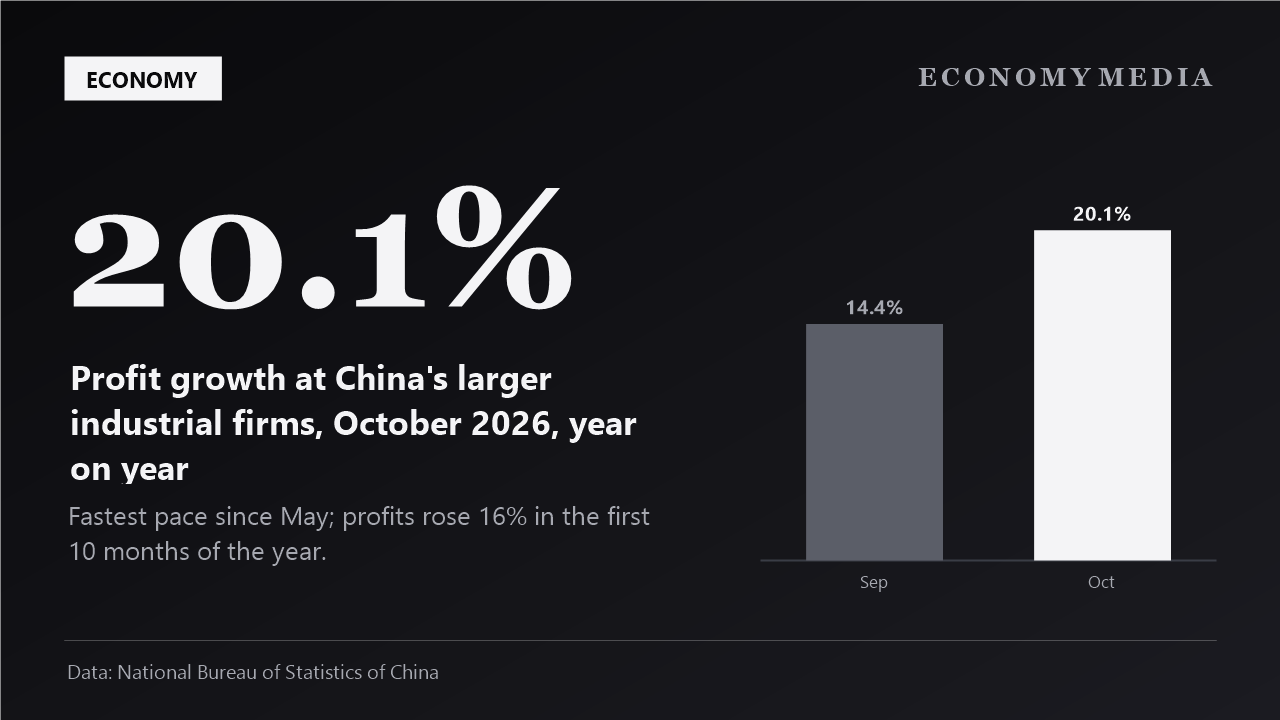
Profits at China’s larger industrial companies rose 20.1% in October from a year earlier, the fastest pace since May, as demand tied to artificial intelligence pushed electronics earnings sharply higher, according to data released Friday by the National Bureau of Statistics (NBS), China’s official statistics agency. The gain accelerated from a 14.4% increase in September, Reuters reported. Economists cautioned, however, that the rebound remains narrow, with consumer-facing industries and property-linked sectors still under pressure.
What the numbers show
For the first 10 months of 2026, industrial profits climbed 16% year on year, up from a 15.5% rise in the January-to-September period, both Reuters and CNBC reported. The figures cover firms with annual revenue from their main business of at least 20 million yuan, or roughly $3 million, a group the statistics bureau refers to as industrial enterprises above designated size.
The improvement follows a long slump. Industrial profits fell for three straight years before edging up 0.6% in 2025, CNBC noted, and this year is on track for the strongest annual growth since 2021.
The gains, though, were highly uneven across industries. According to Yu Weining, chief statistician at the NBS, as cited by CNBC, profits in the electronics sector doubled in the first 10 months as demand for AI computing power lifted memory chips and related manufacturing. Reuters likewise reported that profits at makers of computers, telecommunications and other electronic equipment were doubling over that period.
- High-tech manufacturing profits rose 50.9% in January through October, CNBC reported.
- Makers of spacecraft and launch vehicles posted a 63.2% gain.
- Petroleum processors swung to a combined profit from a loss a year earlier, helped by higher energy prices.
- Automakers saw profits fall 26%, a wider drop than the previous month, as costs outpaced modest revenue growth.
- Cement and glass producers saw profits drop 46.7%, and furniture makers 52.4%.
Why it matters
The data highlight what economists describe as a two-speed Chinese economy. AI-related manufacturing and exports are powering growth, while household spending and real estate lag. Retail sales grew just 0.4% in October, less than expected, and fixed-asset investment declines deepened to 8.1% over the first 10 months, CNBC reported. Industries tied to construction, such as building materials and furniture, continue to suffer from a prolonged property slump.
Tianchen Xu, a senior economist at the Economist Intelligence Unit, a research and advisory firm, told CNBC that the recovery “has yet to broaden into a more durable improvement in corporate profitability,” noting that much of the rebound has come from upstream sectors amid higher energy prices. Commodity producers benefited as demand from renewable energy and AI pushed up copper and aluminum prices, CNBC reported, while consumer-facing manufacturers struggled to pass rising input costs on to buyers.
Reuters, citing analysts, said Beijing’s recent support measures, including steps to lower borrowing costs, add liquidity to the financial system and channel financing to technology, manufacturing and infrastructure, have had a mixed impact, with weak household demand and property strains still weighing on the broader economy. Many firms have increasingly relied on overseas markets for growth, the news agency added.
What comes next
That reliance on exports carries risks. Leah Fahy, senior China economist at Capital Economics, a London-based research firm, told CNBC that October’s growth was “led by strong external demand and exports,” but warned that exports would become a “waning prop to growth” as AI-related investment slows. She added that local governments appeared to be struggling to make full use of their allocated funds, limiting how much fiscal policy can support the economy.
Trade tensions add further uncertainty. Reuters said concerns about possible tariff increases and other trade restrictions, particularly in the United States and the European Union, have clouded the export outlook. The U.S. has proposed new tariffs, including a 20% headline rate on Chinese goods, that would rise to 40% if the current U.S.-China trade truce is not extended beyond January, CNBC reported. Alicia Garcia Herrero, chief economist for Asia-Pacific at the French bank Natixis, told CNBC that Chinese firms increasingly export intermediate goods to the rest of Asia that reach the U.S. indirectly, which could expose economies that use more Chinese inputs to higher tariff risks.
China’s economy grew 4.6% in the first three quarters of the year, putting Beijing’s annual target of 4.5% to 5% within reach, according to CNBC. Whether the profit recovery can spread beyond AI-linked and commodity industries to consumers and the property market will be a key test for the year ahead.