Citigroup Shakes Up London Ranks After $35 Billion Capital Error
Citigroup replaced UK risk and reporting staff and added about $3 billion in capital after its London unit understated risk-weighted assets by $35 billion.
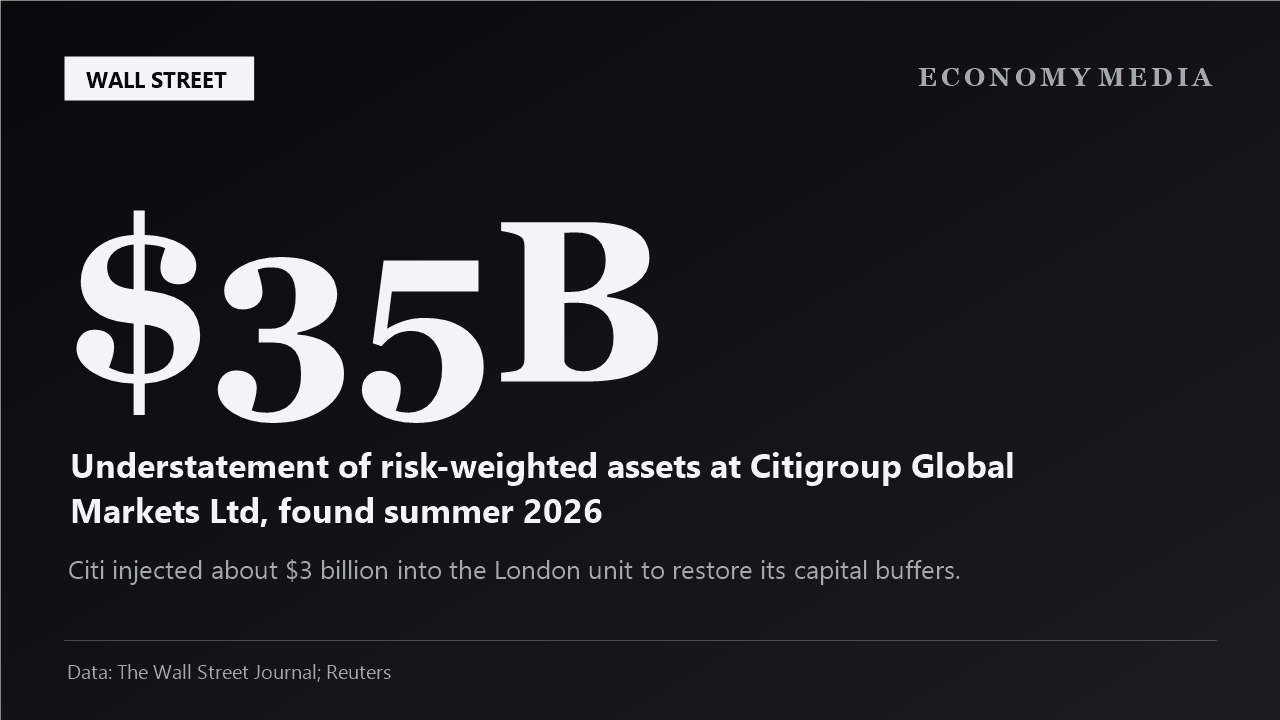
Citigroup is reshuffling senior staff in London after an error at its British brokerage unit understated the unit’s risk-weighted assets by about $35 billion, The Wall Street Journal reported on Friday, Nov. 27. To fix the shortfall, the bank put roughly $3 billion of fresh capital into the subsidiary over the summer. The episode comes as the third-largest U.S. bank by assets tries to persuade American regulators that it has fixed years of weaknesses in its risk controls.
What happened
Risk-weighted assets are the measure regulators use to decide how much capital a bank must hold against possible losses. Riskier holdings count for more. If that figure is set too low, the bank ends up holding less of a cushion than the rules require.
According to the Journal’s report, as summarized by Investing.com, an employee found the problem over the summer. It came from applying an internal capital model to a European trading desk that the Bank of England had not approved the model for. Reuters, which first reported the $35 billion figure on Thursday, Nov. 19, citing a person familiar with the matter, said the subsidiary is Citigroup Global Markets Ltd, the bank’s UK-based international brokerage. When the trades in question were run through the correct model, the measured risk rose sharply and the unit was left short of the loss-absorbing capital it needed.
Based on regulatory filings, Reuters calculated that the unit’s total risk-weighted assets were $155 billion at the end of 2025. That puts the misstatement at more than 20% of the total. The Journal described the error as about 20% of the subsidiary’s reported figure.
Citi has said it “identified and resolved an internal capital modeling issue at a European trading subsidiary this summer,” Reuters reported. The bank added that the unit stayed fully compliant with regulatory minimums throughout and that the parent holding company and its main operating bank were not affected. According to the Journal, Citi said it has completed remedial measures, restored the subsidiary’s capital buffers and opened an internal investigation. It has also discussed the error with Federal Reserve officials.
Who is leaving or moving
The Journal reported that at least two managing directors who oversaw financial reporting to regulators are no longer in those roles. It did not name them. Other changes in London include:
- Manjira Sen-Gosain, chief risk officer of Citi’s UK unit, left that role on Nov. 3, Reuters reported, citing UK regulator records. Reuters said it was unclear whether she had left the bank, and Citi did not name a successor.
- Zdenek Turek, Citigroup’s chief risk officer, has moved from New York to London and is working on the reporting problems. A bank spokeswoman told the Journal the move was planned before the error came to light.
- Tiina Lee, chief executive of Citi’s UK operations, announced in October that she would leave. The bank said her decision had nothing to do with the error, according to the Journal.
Why it matters
The mistake is a fresh setback for Jane Fraser, Citigroup’s chief executive. She has called getting out from under the bank’s regulatory consent orders her top priority. A consent order is a binding agreement with regulators that requires a company to fix specific problems. Citi’s orders date to 2020 and cover risk management, data governance and regulatory reporting. In 2024, U.S. regulators fined the bank $136 million for not making enough progress on those fixes. Reuters has reported that Citi was aiming to submit its remediation paperwork to the Federal Reserve and the Office of the Comptroller of the Currency, the national bank regulator, by the end of 2026 or in the first quarter of 2027.
Analysts quoted by Reuters disagreed on how much the London error matters. Sheila Bair, former chair of the Federal Deposit Insurance Corp., said the error was not huge for a bank of Citi’s size. But she warned that “any misstep is going to complicate their efforts to escape their consent order.” She added that it shows how unreliable models can be for setting risk-based capital requirements.
A Wells Fargo team led by analyst Mike Mayo told clients the mistake was not material from a regulatory point of view. Mayo still noted that “the perception is not great since the bar is higher for Citi after its prior mistakes.” Austin Taggart, a banking analyst at Morningstar, told Reuters the episode could plausibly lengthen the period in which regulators test whether Citi’s fixes are working over time, but was unlikely to restart the process. Jeremy Kress, an associate professor of business law and a former Fed attorney, said the bigger worry for supervisors is what else the bank might be missing.
Background and what comes next
This is not the first time the London unit has gotten this measure wrong. In 2019, the Bank of England’s Prudential Regulation Authority fined Citi’s UK operations about £44 million over failings in their regulatory reporting. The regulator found that errors had led Citigroup Global Markets Ltd to understate its risk-weighted assets by $15.4 billion as of December 2016. Citi has had other high-profile operational slips too, including a trader’s mistaken order in London in 2022 that briefly jolted European stock markets.
The Federal Reserve declined to comment to Reuters, and the OCC did not respond to a request for comment. Citi declined to say whether the error could affect its consent orders. Investors and analysts will be watching for any word from U.S. supervisors on whether the bank’s timeline for closing out the orders still holds.