United Fidelity Bank Fails; First Citizens Takes Over $5.9B Lender
Regulators closed Indiana's United Fidelity Bank, the biggest US bank failure in two years. First Citizens takes over its deposits and branches.
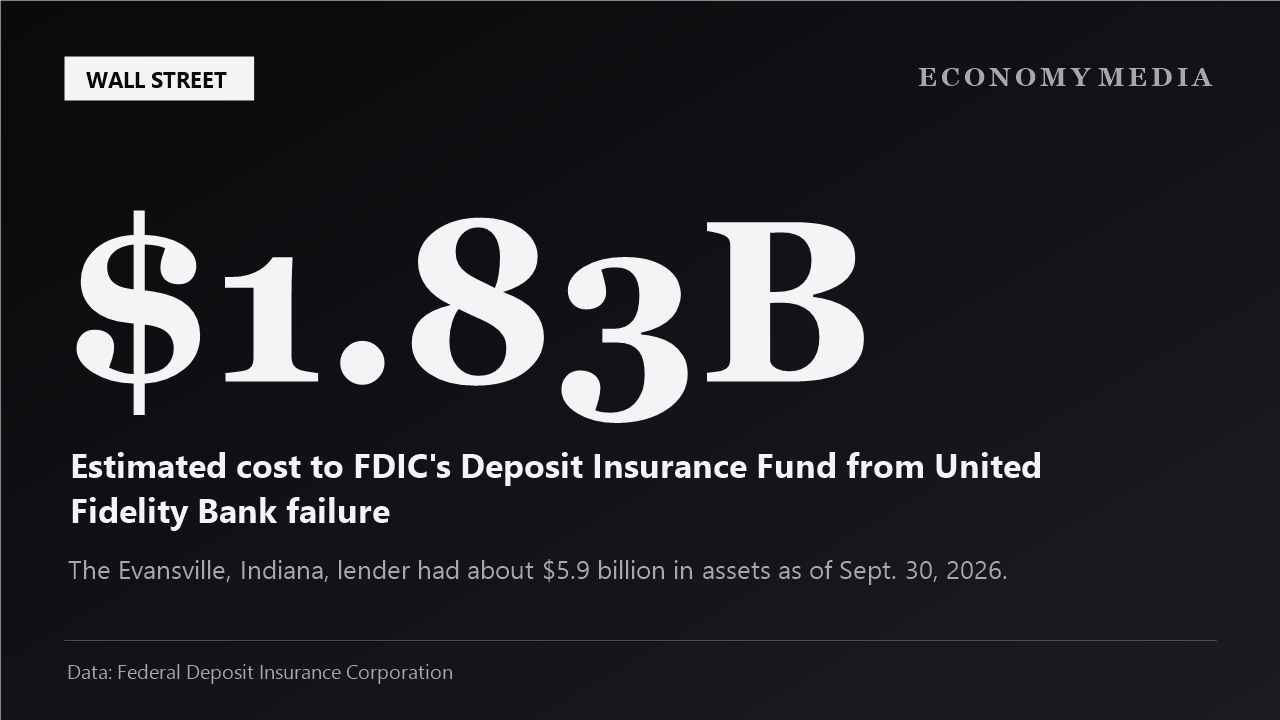
Federal regulators closed United Fidelity Bank, a lender based in Evansville, Indiana, with about $5.9 billion in assets, on Friday, Nov. 27, 2026. It is the largest U.S. bank failure in two years. First-Citizens Bank & Trust Company, the Raleigh, North Carolina, bank that bought the remains of Silicon Valley Bank in 2023, agreed to take over substantially all of United Fidelity’s deposits and assets. The Federal Deposit Insurance Corporation (FDIC) estimates the failure will cost its Deposit Insurance Fund $1.83 billion.
What happened
The Office of the Comptroller of the Currency (OCC), the federal agency that charters and supervises national banks and federal savings associations, shut United Fidelity Bank, fsb, and named the FDIC as receiver, the FDIC said in a statement. As of Sept. 30, the bank had about $5.9 billion in total assets and $5.4 billion in total deposits, according to the agency.
Its 22 branches in Indiana, Illinois, Florida, Colorado and the U.S. Virgin Islands are reopening as First Citizens branches. Locations that normally open on Saturdays reopen on Saturday, and the rest reopen on Monday, the FDIC said. Two of the branches are in the Virgin Islands and operate as Bank of St. Croix, a division of United Fidelity, American Banker reported.
Depositors automatically become First Citizens customers and keep their deposit insurance coverage, the regulator said. For at least six months after the failure, transferred deposits will be insured separately from any accounts customers already hold at First Citizens. One group is excluded: the FDIC said the deposits moving to First Citizens do not include “certain brokered deposits,” which elsewhere on its website it identifies as deposits held through Cede & Co. The agency told customers who hold United Fidelity deposits through a broker to contact that broker.
The bank’s holding company, Fidelity Federal Bancorp of Evansville, owns all of United Fidelity’s shares. It was not part of the closing or the receivership, according to the FDIC.
The terms of the deal
First Citizens said it will assume $4.5 billion of United Fidelity’s deposits and $3.1 billion of its loans, American Banker reported, citing a company release. That leaves a gap of roughly $900 million against the $5.4 billion deposit total the FDIC reported. The sources did not say how much of that gap is the excluded brokered deposits. First Citizens bid a $2.6 billion discount on the assets and paid no premium for the deposits, according to the report. The deal also includes United Fidelity’s subsidiaries, among them Pedcor Homes Corporation, a real estate development and management company. Final amounts will depend on the bank’s closing balance sheet and the settlement process.
Frank B. Holding Jr., chairman and chief executive of First Citizens, called the transaction “both financially and strategically compelling” in a statement quoted by American Banker. He said the bank looks forward to welcoming its new customers. First Citizens has about $241 billion in assets and has won bids for failed banks roughly 20 times since 2009, according to the publication. In March 2023 it acquired the deposits, loans and branches of the failed Silicon Valley Bank.
Why it matters
The FDIC’s cost estimate comes to roughly a third of United Fidelity’s total assets, American Banker noted. That is a large loss relative to the bank’s size. The Deposit Insurance Fund is financed by premiums paid by insured banks, not by taxpayers.
United Fidelity is the seventh U.S. bank to fail in 2026, according to American Banker. Only two banks failed in each of 2025 and 2024. Seeking Alpha described the closure as the biggest U.S. bank failure in two years. American Banker said each of this year’s failures appears to have had its own causes, and that the FDIC still considers the number of “problem” banks on its watch list to be within its normal range.
Background
- United Fidelity grew quickly, helped by affordable-housing finance ventures and the acquisition of eight other banks in several states since 2014, American Banker reported.
- In June 2024, the Federal Reserve issued a cease-and-desist order against the firm over concerns about bank management, according to the same report.
- Regulators did not give a detailed public explanation of what caused the collapse in the closing announcements reviewed for this article.
For Wall Street, the deal adds to First Citizens’ record of buying failed banks. Investors will be watching how quickly it integrates the branches and what the final settlement figures turn out to be. Customers with questions can reach the FDIC’s call center at 1-866-431-1725, the agency said.