Some Companies Steer Trump Tariff Refunds Into Bonuses, ProPublica Finds
At least nine public companies say tariff refunds will fund bonuses, while shoppers who paid higher prices are largely left out, ProPublica reports.
At least nine publicly traded U.S. companies have disclosed that they are putting part of their refunds from President Donald Trump’s struck-down tariffs toward executive or employee bonuses, rather than passing the money back to the consumers who often absorbed the cost through higher prices, according to an investigation published Monday by ProPublica, the nonprofit investigative newsroom.
The findings land as the federal government works through a refund bill of roughly $170 billion, the figure ProPublica cited, after the Supreme Court ruled that the president needed approval from Congress to impose the sweeping duties. Common Dreams, a progressive news site that covered the report, said more than $100 billion has already been paid out.
What ProPublica found
Reporters Robert Faturechi and Nick McMillan searched thousands of securities filings and earnings call transcripts for language about refunds. They used an AI model to flag possible cases and then checked the records by hand. Because private companies do not have to disclose such details, the review covered only public companies.
Among the companies named:
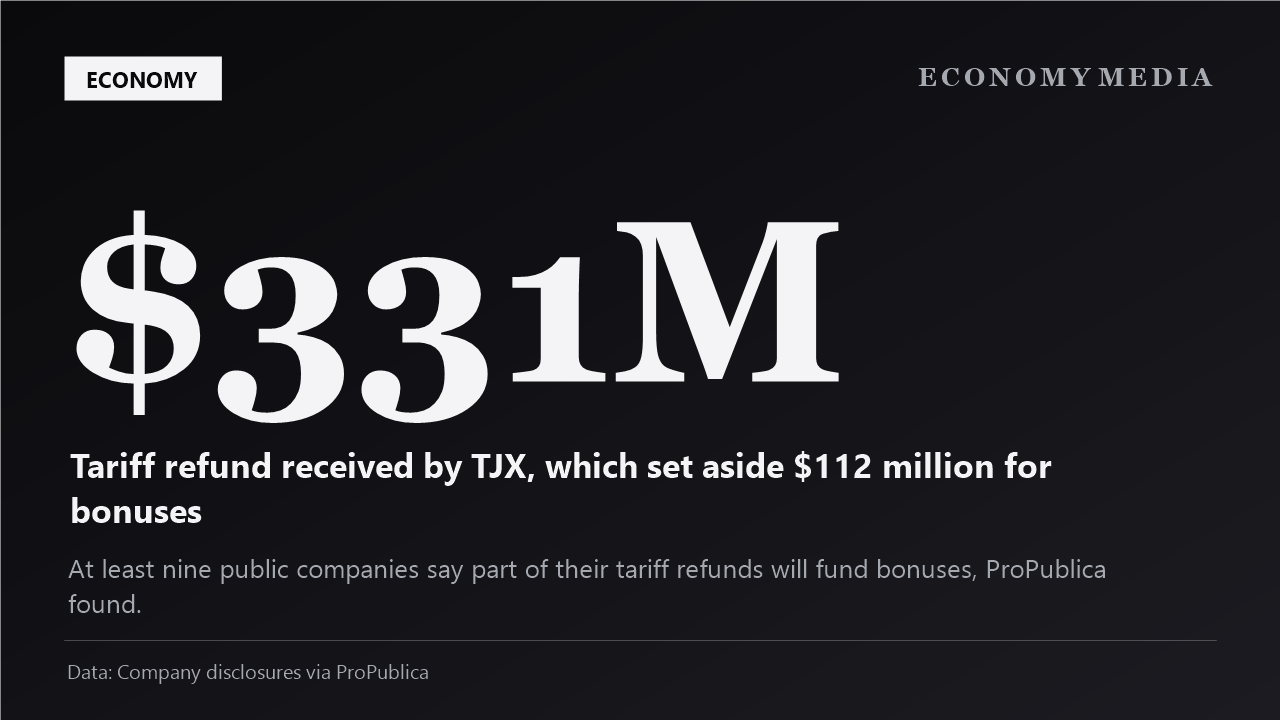
- TJX Companies, the parent of TJ Maxx and Marshalls, said it received $331 million and “accrued incremental expenses of $112 million” for year-end incentive pay and discretionary bonuses. It said the rest would support future growth and did not say whether customers would see lower prices.
- Stanley Black & Decker, the tool maker, expects at least $298 million. Its filings say part of the gain was offset by costs for variable incentive compensation, without saying how much went to executives. The company did not answer ProPublica’s questions on that point.
- Acushnet, the maker of Titleist golf equipment, disclosed about $12.0 million in incentive compensation expense tied to its refund. It declined to comment.
Not every company took that route. Burlington Stores, the off-price retailer, said it received $55 million, and its chief executive, Michael O’Sullivan, said the company would rather “deliver even sharper values to our shoppers” than book a one-time earnings boost. A spokesperson told ProPublica none of the money would fund bonuses. Shipping giants UPS and FedEx, which paid duties on customers’ behalf, have set up portals to reimburse them.
Why it matters for households
Only so-called importers of record, the businesses that formally paid duties at the border, can claim refunds through the online system run by U.S. Customs and Border Protection. Shoppers who paid higher shelf prices have no direct way to get money back, and no federal rule requires companies to share the refunds.
Estimates of how much of the tariff burden consumers carried vary. ProPublica cited a Federal Reserve Bank of New York analysis putting the customer share at 26% and a Harvard Business School study putting it at 43%. The Tax Foundation, a Washington think tank, estimated the tariffs cost a typical household about $1,000 last year, while NPR, citing the Yale Budget Lab, put the cost at about $1,100 a year.
Many companies have said they will return refunds “through pricing,” but Common Dreams noted ProPublica found that language vague; it could mean holding back future price increases rather than cutting prices. Tariffs have not disappeared either. Theo Francis, a Wall Street Journal business reporter, told NPR in August that new and remaining duties mean many companies still expect large tariff costs this year.
Competing views
Gregory Germain, a corporate law professor at Syracuse University, told ProPublica that executive bonuses are “probably the least just way to use this money,” calling the refund the result of a government mistake. Nick Guest, an accounting professor at Cornell University, said compensating executives for tariff hits could be reasonable but that penalized customers could be rewarded too, adding that companies are “not obligated to give refunds or reduce prices.”
Treasury Secretary Scott Bessent predicted in February, “I got a feeling the American people won’t see it,” and blamed Democratic state attorneys general, whose lawsuit led to the refunds going only to importers.
What comes next
Democratic Sens. Elizabeth Warren of Massachusetts, Cory Booker of New Jersey and Peter Welch of Vermont have asked Trump to require companies to pass refunds to consumers, ProPublica reported, and Common Dreams said Democratic senators have also urged the Federal Trade Commission to investigate. Rep. Pramila Jayapal, a Washington Democrat, wrote online: “That’s money straight from your pocket into theirs.”
Consumers have also sued dozens of companies, including Walmart, Target, Nike and Lululemon, seeking a share of refunds, though legal analysts doubt the suits will succeed. One lawsuit alleges Stanley Black & Decker “stands to recover the same tariff payments twice”; the company has not responded to the allegations. The administration has not disclosed which companies received refunds or how much, and ProPublica said its requests for that information were denied.