Japan’s Economy Unexpectedly Shrinks as Energy Costs Hit Households
Japan's GDP fell at a 0.1% annualized pace in July-September as pricier energy imports and weaker spending offset earlier gains.
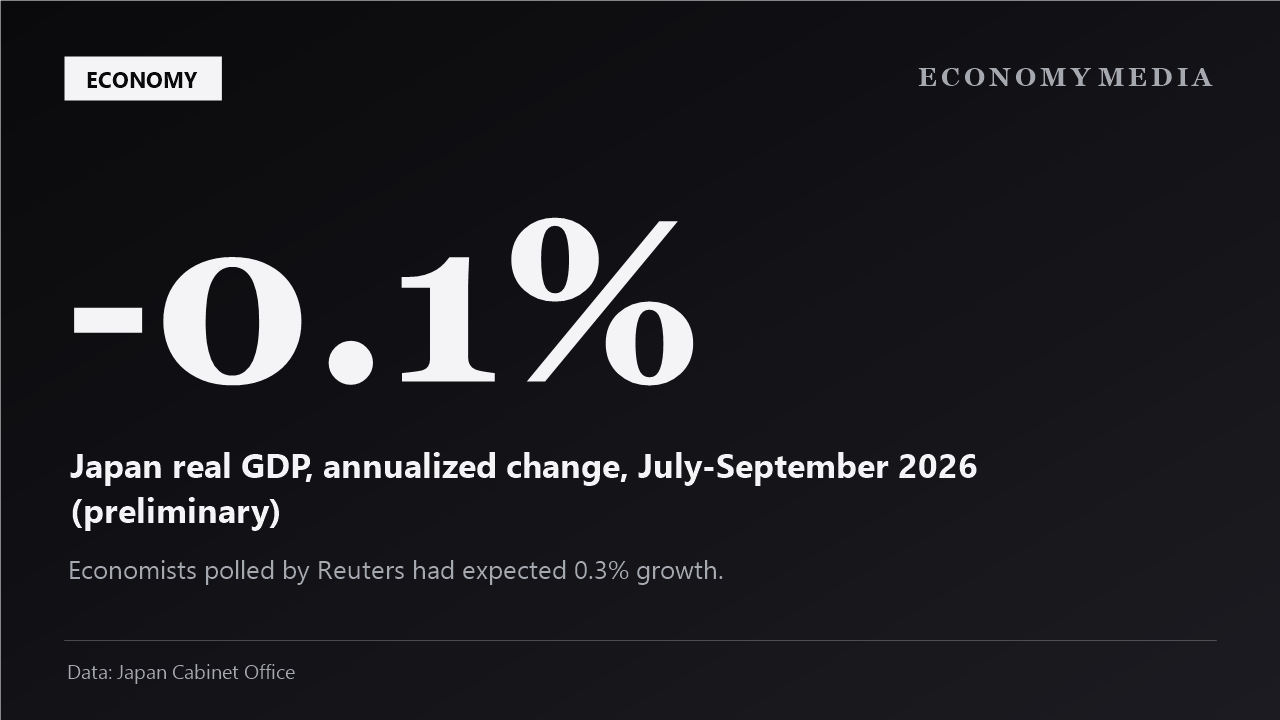
Japan’s economy unexpectedly contracted in the third quarter, as higher energy import bills and softer household spending wiped out the modest growth that economists had expected. Preliminary figures from Japan’s Cabinet Office, the government agency that compiles national accounts, showed real gross domestic product shrank at an annualized rate of 0.1% in the July-September period, CNBC reported. Economists polled by Reuters had forecast growth of 0.3%.
The miss was small in size but notable in timing. It comes just weeks before the Bank of Japan, the country’s central bank, decides whether to raise interest rates again in December, and it arrives as households absorb higher fuel prices tied to the war involving Iran.
What the numbers show
Measured without annualizing, output slipped about 0.02% from the previous quarter, against a median forecast of a 0.1% gain, according to figures cited from the Associated Press. That ended a run of three straight quarters of growth. In the April-June quarter, the economy had expanded at an annualized 1.4%, CNBC noted.
Trade was the biggest drag. Net exports, the difference between what Japan sells abroad and what it buys, subtracted 0.6 percentage points from growth. Cabinet Office data showed imports rose 2.5% from the prior quarter while exports dipped 0.2%. CNBC attributed the jump in imports mainly to costlier energy purchases, even though exports beat expectations in two of the three months of the quarter.
Other key components of the report, based on the Cabinet Office’s quarter-on-quarter figures, included:
- Private consumption, which makes up more than half of Japan’s economy, fell 0.3%, its second consecutive quarterly decline.
- Residential investment dropped 1.1%.
- Business investment rose 1.6%, rebounding after two quarters of declines.
- Nominal GDP, which is not adjusted for inflation, grew 0.4%.
Why it matters for households
Energy is at the heart of the slowdown. Government subsidies that had cushioned household energy bills reportedly expired in September, CNBC reported, leaving consumers more exposed to the jump in oil and gas prices linked to the Iran war. Japan imports nearly all of its fuel, so higher global prices feed quickly into utility bills, gasoline costs and the overall import bill.
A weak currency has compounded the pressure. The yen traded around 159.76 per dollar after the release, near its weakest level in more than two months, which raises the cost of imported goods. Even so, the yen-denominated value of output kept rising, as the gap between nominal and real GDP growth reflected higher prices across the economy.
Some measures looked less gloomy. Compared with a year earlier, GDP grew 1.1%, the strongest since the second quarter of 2025. Marcel Thieliant, head of Asia Pacific at the research firm Capital Economics, said that figure largely reflected a weak base in the third quarter of 2025, when the economy shrank under the impact of U.S. tariffs.
Minoru Kiuchi, Japan’s economy minister, said in a statement carried by Reuters that it would be necessary to keep “closely monitoring the impact of the Middle East situation.”
What comes next for the Bank of Japan
The data complicate the outlook for the Bank of Japan, which held its policy rate at 1.25% in late October. At that meeting, the bank said its 2% underlying inflation target had been met for the first time in 13 years, and core consumer inflation reached 2.1% in September, the highest this year. Traders still see a December move as likely: LSEG data put the probability of a quarter-point hike at 75.6%, according to CNBC.
Economists disagree about how much weight the central bank should give the contraction. Krishna Bhimavarapu, Asia-Pacific economist at State Street Investment Management, said the report was “hardly a green light for the BOJ to hike in December.” He pointed to a 2.1% annualized drop in real final sales of domestic product, a measure that strips out business inventories, calling it the largest fall outside the Covid-19 pandemic and the first quarter of 2022 and describing it as “a loss of momentum.”
Thieliant took the opposite view. He still expects a rate increase and argued that the bank may need to tighten more aggressively than anticipated because inflation is poised to surge.
Financial markets reacted cautiously. The Nikkei 225 stock index fell about 0.6% after the release, and the yield on Japan’s 10-year government bond stood at 2.885%. A revised GDP estimate, incorporating fuller data on business investment, is due in early December, shortly before the central bank’s next policy meeting.