DoorDash Slides as Amazon-Uber Deal Clouds $17 Billion Instacart Bet
DoorDash shares fell 9.4% after Amazon gave Prime members free Uber Eats delivery, days after DoorDash agreed to buy Instacart for about $17 billion.
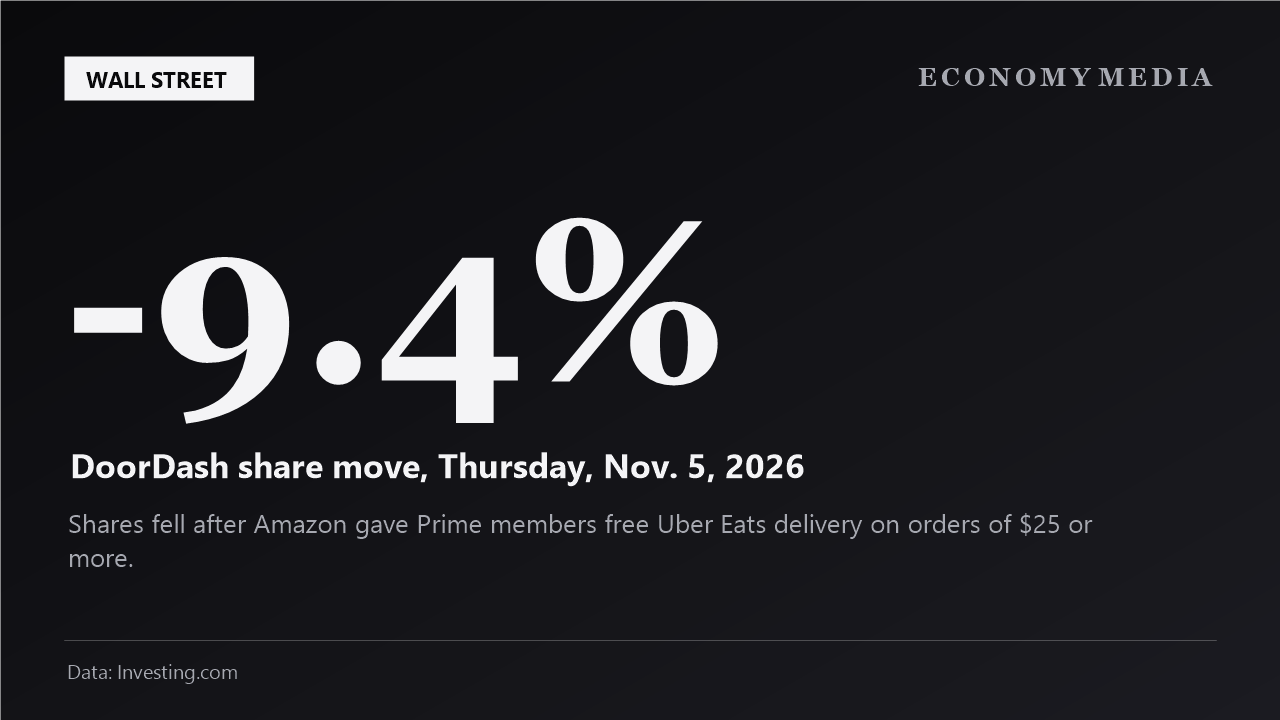
DoorDash shares have handed back their gains from the company’s $17 billion agreement to buy grocery delivery service Instacart, after Amazon struck a restaurant delivery partnership with rival Uber Eats that investors fear could erode DoorDash’s lead. The stock fell 9.4% on Thursday, Nov. 5, and was little changed on Friday, leaving it about 3% below where it traded before reports of the Instacart deal surfaced, Investing.com reported.
What happened
On Nov. 5, Amazon said members of Prime, its paid subscription program, can now order from Uber Eats directly through Amazon’s website and app, with no delivery fee on restaurant orders of $25 or more and no separate Uber account required. The benefit covers nearly 10,000 U.S. cities and towns, according to Nation’s Restaurant News, a food-service trade publication.
The arrangement replaces a partnership Amazon had run since 2022 with Grubhub, the Chicago-based delivery app, which gave Prime members free delivery on orders above $12. Wonder, Grubhub’s owner, said the two companies mutually agreed to end the tie-up, and existing Grubhub+ members on Prime keep that perk through Dec. 31, 2027, Nation’s Restaurant News reported. Amazon estimates that frequent users could save up to $175 a year.
“Prime’s new Uber Eats membership benefit makes getting dinner delivered even easier,” Jamil Ghani, Amazon’s worldwide vice president of Prime, said in a statement quoted by the publication.
Reports of the size of DoorDash’s drop varied with the timing. Nation’s Restaurant News put the decline at 14% in Thursday afternoon trading, while Uber shares slipped 1.86%. Investing.com reported the day’s loss as 9.4%. Stocktwits, the investor social platform, said a decline of about 10% would be DoorDash’s steepest in a year and noted that the stock is down roughly 22% so far in 2026.
The Instacart deal
The sell-off came barely a week after DoorDash, on Oct. 29, announced a definitive agreement to acquire Maplebear Inc., the company that operates Instacart, for $65 a share. According to DoorDash’s announcement, that values Instacart’s equity at about $17 billion and represents a 26% premium to its closing price on Oct. 22, the last trading day before media reports of talks emerged.
Key terms disclosed by DoorDash include:
- Instacart holders can choose $65 in cash, 0.3372 DoorDash shares, or a mix, with stock capped at 25% of the total payout.
- The cash portion is backed by cash on hand and debt, including a 364-day bridge loan commitment from JPMorgan Chase.
- Holders of about 19% of Instacart’s shares have agreed to vote in favor, and Instacart’s board approved the deal unanimously.
- Closing is expected at the end of 2027 or in the first half of 2028, pending antitrust clearance in the U.S. and approvals in Canada and Israel.
“Grocery is one of the hardest things to get right online,” Tony Xu, DoorDash’s co-founder and chief executive, said in the announcement. Chris Rogers, Instacart’s chief executive, said Instacart had “transformed online grocery” over the past 14 years.
DoorDash announced the deal alongside record third-quarter results. Revenue rose 34% from a year earlier to $4.6 billion, total orders climbed 28% to 993 million and net income attributable to shareholders jumped 91% to $466 million, the company said. Part of that growth came from DoorDash’s acquisition of Deliveroo, the British delivery company; excluding Deliveroo, revenue rose 23%.
Why it matters
The Instacart purchase is DoorDash’s bid to become a bigger force in groceries, but even combined the two companies would remain well behind the sector’s giants. Citing estimates from research firm Emarketer, Investing.com reported that Amazon holds about 40% of U.S. online grocery sales and Walmart about 27%, against roughly 19% for DoorDash and Instacart together.
The Amazon arrangement adds pressure on DoorDash’s core restaurant business, where it holds a dominant share of U.S. delivery spending, according to Stocktwits. Giving Uber Eats a direct channel to Amazon’s Prime members could sharpen competition for the customers that fund DoorDash’s expansion. Neither Amazon nor Uber has disclosed who pays for the free deliveries, a detail that will shape how much the deal costs Uber.
Investing.com noted that DoorDash now trades at about 40 times expected earnings, down from more than 70 times late last year, and that Instacart shares sit about 11% below the $65 offer price, a gap that suggests some investors doubt the deal will close on its current terms.
What comes next
Regulatory review is likely to be the biggest hurdle. Investing.com said investors still face questions about execution costs, pricing and approval, and that DoorDash will need to spend more on warehouses and autonomous delivery, without saying how much. Amazon and Walmart, meanwhile, can use their purchasing power and advertising businesses to support lower prices. DoorDash has guided for fourth-quarter marketplace gross order value of $35.4 billion to $36.4 billion, giving investors the next checkpoint on whether its growth is holding up as competition intensifies.