Eric Trump-Backed Robot Startup Foundation Misses Payroll, CNBC Says
Foundation Future Industries, a military humanoid robot maker, has not paid staff since Oct. 30 after its CEO took a $4.6 million company loan, CNBC reported.
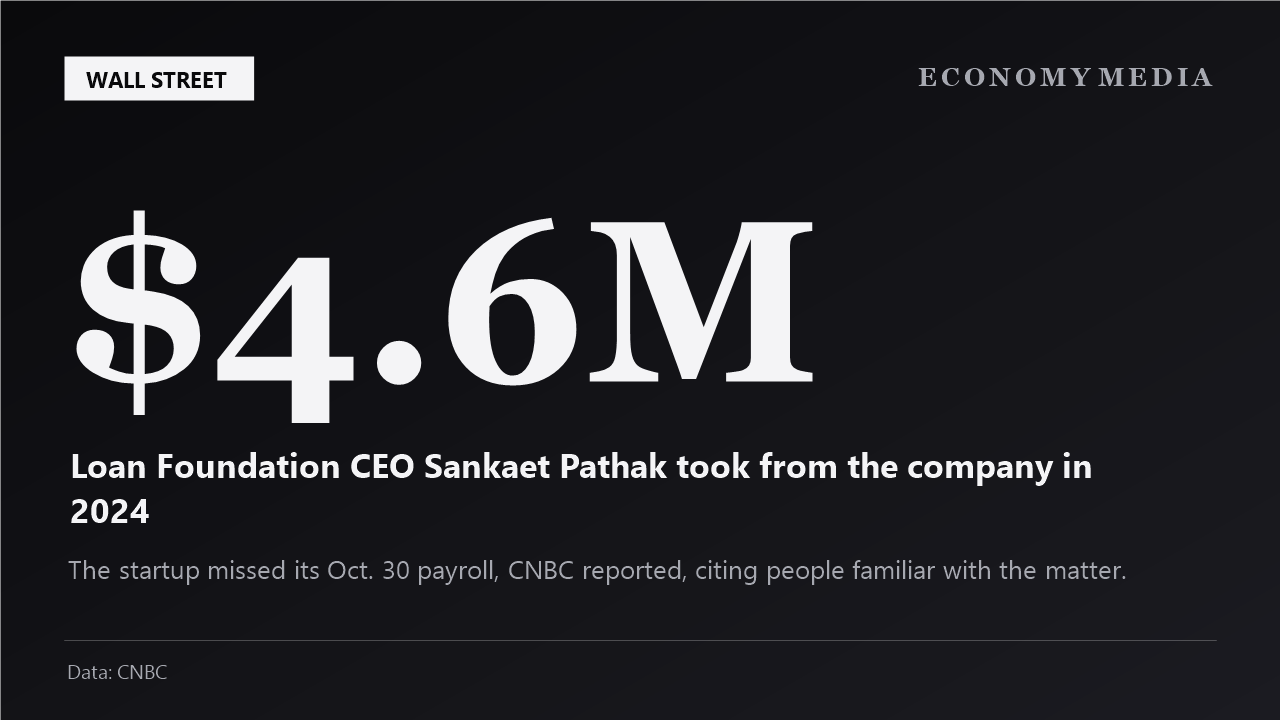
Foundation Future Industries, a San Francisco startup that builds humanoid robots for military use and counts Eric Trump as an investor and adviser, missed its Oct. 30 payroll and had still not paid employees as of Nov. 14, CNBC reported, citing people with direct knowledge of the matter. The report also said the company’s chief executive borrowed $4.6 million from the company in 2024, money that people familiar with the matter said went toward buying a home.
What happened
According to CNBC, Foundation has run low on cash and is struggling to close a new funding round. The October payroll was not the first strain: in August, the company also came up short on payroll cash, and employees waited about two days for their pay until an existing investor provided a bridge loan, the network reported.
Sankaet Pathak, Foundation’s co-founder and chief executive, has told employees he is working to find money to cover the back wages, according to CNBC. Pathak is also the company’s only board member and holds most of its shares, the report said.
The $4.6 million loan is at the center of the scrutiny. CNBC said Pathak described the money as a short-term loan. Property records cited by the network show that a limited liability company with Pathak as its sole principal bought a $4.6 million property in Sausalito, California, in October 2025. Other outlets that followed the report said existing investors were aware of the loan.
Pathak did not respond to CNBC’s requests for comment, though a company spokesman acknowledged receiving a detailed list of the article’s main points, the network said. Eric Trump, the president’s son and an executive vice president of the Trump Organization, also did not respond to CNBC. A spokesperson for Eric Trump has previously told the Financial Times that he has “no involvement” in Foundation’s management, operations, strategic decisions or government contract work.
Why it matters
The cash crunch comes as Foundation has been trying to raise money at a valuation that would put it among the most richly valued defense-technology startups. CNBC reported that the company has been seeking hundreds of millions of dollars at a $3 billion valuation since at least January. The Next Web, a technology news site, reported that Foundation was looking for $500 million at a valuation above $3 billion, despite having raised roughly $21 million in total.
Prospective investors have raised concerns about the company’s governance, including its single-member board, CNBC said. People inside the company fear it could collapse if new funding does not arrive, according to the report.
The episode also adds to political questions about the company’s ties to the Trump family. In April, Foundation was widely reported to have won $24 million in Pentagon contracts. Eric Trump promoted the work on Fox Business that month, saying, “We are America First. We have to win this race,” in reference to competition with China. Sen. Elizabeth Warren, a Massachusetts Democrat, responded by questioning whether the company had benefited from nepotism and called the situation “corruption in plain sight.”
CNBC’s sources now say those contracts did not originate with Foundation itself. Instead, they came with the company’s late-2024 acquisition of Boardwalk Robotics, a Florida firm that already held government research contracts. The Next Web had earlier described the awards as research agreements with the Army, Navy and Air Force, not production orders, and noted that at least some came through the Boardwalk deal.
Background
Foundation was founded in April 2024. Its co-founders include Arjun Sethi, chief executive of venture firm Tribe Capital, and Mike LeBlanc, a Marine Corps veteran who previously co-founded Cobalt Robotics. Its first robot, the Phantom MK-1, was built on Boardwalk’s robot, called Alex, according to CNBC. The company has said it sent two Phantom units to Ukraine earlier this year for support and reconnaissance testing.
Pathak has made bold claims about the company’s technology. In an April interview with Fox Business, he said Foundation’s next robot would be “the strongest humanoid robot that exists anywhere in the world, including China.” He has also suggested the robots could eventually handle battlefield tasks or patrol the U.S.-Mexico border, CNBC reported.
Before Foundation, Pathak led Synapse, a financial-technology company that connected apps such as Mercury and Dave with small community banks. Synapse’s collapse in 2024 left more than 100,000 Americans locked out of about $265 million in deposits, and a bankruptcy trustee said up to $96 million in customer funds was missing, according to CNBC. The Consumer Financial Protection Bureau, the federal consumer-finance regulator, sued Synapse, which led to a $55 million relief fund for customers. Pathak has blamed Synapse’s banking partner, Evolve Bank & Trust, which in turn blamed Synapse. CNBC noted that a federal grand jury had looked into possible criminal misconduct at Synapse; the report on that probe did not name Pathak, and he has not been charged with any wrongdoing.
What comes next
The immediate question for Foundation is whether Pathak can secure enough money to pay staff and keep the company running. Key points to watch:
- Whether Foundation closes a funding round, and at what valuation.
- Whether employees receive back pay for the missed Oct. 30 payroll.
- Any response from Pathak, Eric Trump or Foundation’s investors to CNBC’s reporting.
- Whether lawmakers such as Warren renew calls for scrutiny of the company’s government contracts.
The company had been close to unveiling a new, weapons-ready robot, CNBC reported, but its future now appears to depend on new investors stepping in.