Fed’s Musalem Says Up to Four Rate Hikes May Be Needed by Spring
St. Louis Fed chief Alberto Musalem says inflation above 3% may require rate hikes totaling 1 to 1.5 points before spring 2027.
Alberto Musalem, president of the Federal Reserve Bank of St. Louis, said on Tuesday that the U.S. economy will likely need “several interest rate increases before the spring of 2027” to bring inflation back to the central bank’s 2% goal. CNBC described it as one of the most hawkish outlooks any Fed policymaker has offered so far. By CNBC’s reading, his math points to as many as four quarter-point hikes, one at each of the Fed’s next four meetings, in December, January, March and April.
Musalem spoke at the Central Bank of Argentina’s 2026 Money and Banking Conference in Buenos Aires, according to the text of the speech published by the St. Louis Fed. He said the views were his own and not necessarily those of his colleagues on the Federal Open Market Committee (FOMC), the Fed panel that sets interest rates.
What Musalem said
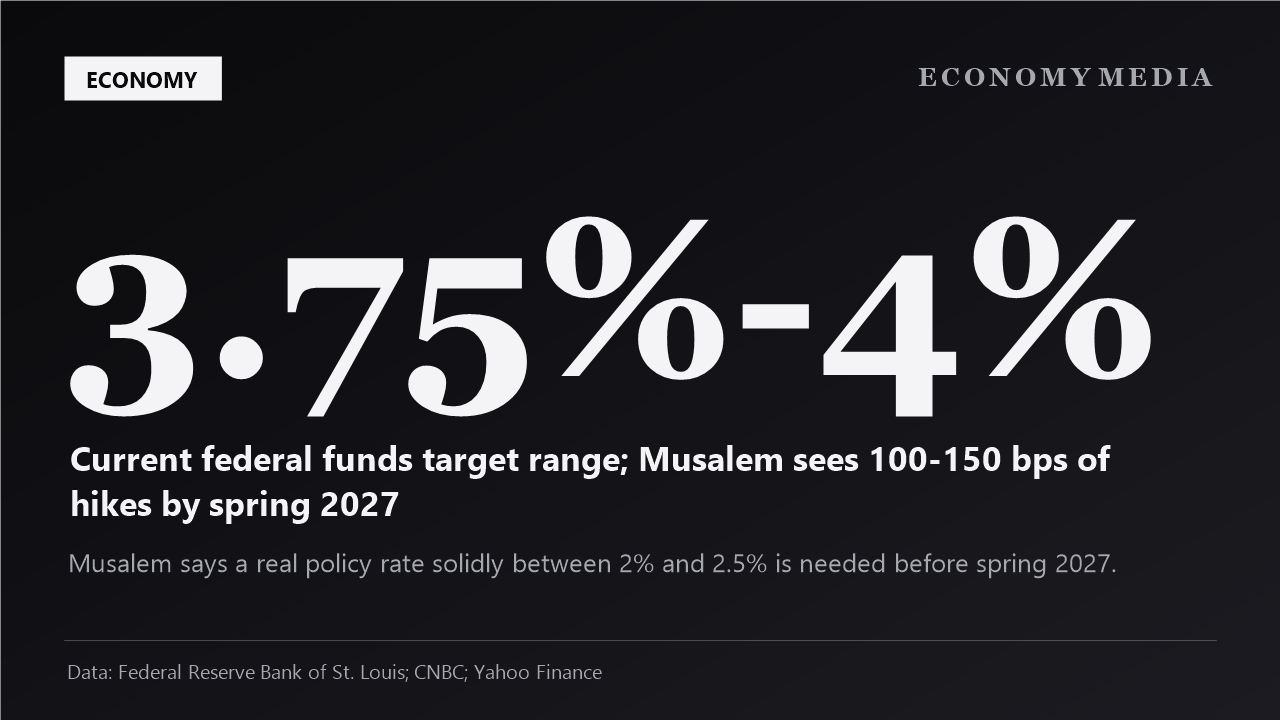
The argument centers on the “real” policy rate, which is the Fed’s benchmark rate minus inflation. Musalem said he expects the economy to need a real rate “solidly between 2% and 2.5%” before next spring. He put the current real rate at the lower end of a 1% to 1.5% range. CNBC reported that this leaves policy about a full percentage point short of where he thinks it should be.
Yahoo Finance reported that closing the gap would mean 100 to 150 basis points of increases, or 1 to 1.5 percentage points. That would lift the federal funds rate from its current range of 3.75% to 4% to roughly 4.75% to 5% by spring. Musalem did not name specific meetings. The four-meeting timeline is CNBC’s reading of his numbers.
Musalem said he would prefer the real rate to rise partly because inflation falls and partly because the Fed raises rates. Even so, he said the nominal rate “may need to do most of the work.” He also argued for acting early. Moving sooner, he said, “while inflation expectations are anchored, has a better chance of succeeding” without hurting jobs or growth.
He referred to the Fed’s most recent increase, which came in September. He agreed with Kevin Warsh, the Fed’s chair, that the move removed “a dose of accommodation,” meaning it made policy less stimulative. But he said policy is “not yet restraining inflation.”
Why it matters for households
Musalem’s case rests on inflation that has stayed high and spread widely. In the speech, he said headline and core inflation are both running above 3%. Core inflation leaves out volatile food and energy prices. He said October consumer price figures came in above expectations. He added that consumer and producer price data point to October readings near 3.8% for headline inflation and 3.2% for core, measured by the personal consumption expenditures (PCE) price index, the Fed’s preferred gauge.
He said goods inflation rose in September, driven by energy, while services inflation stayed “sticky above 3%.” He also noted that far more spending categories now show price increases above 3% than when core PCE was near 2%. Survey measures of what consumers expect inflation to be have drifted higher, mostly because of energy and commodity prices, which he called “concerning.” He said longer-term expectations priced into markets remain anchored.
For households, higher Fed rates usually feed into the cost of credit card balances, auto loans and other borrowing, while savers can earn more on deposits. Musalem argued that letting inflation run would do more damage. He called it “a distortionary tax, and a regressive one at that,” meaning it hits lower-income families hardest. He also noted that average wages have not kept pace with prices.
The economy behind the call
Musalem said growth is strong. He pointed to solid consumer spending and to artificial intelligence-related investment that is driving double-digit growth in business spending on structures and equipment. He said the unemployment rate was 4.1% in October. Yahoo Finance reported that he called the job market “remarkably stable and balanced.” He listed some weak spots, including housing, flat real disposable income and rising loan delinquencies among subprime and younger borrowers. He said he sees these as less powerful than the forces supporting growth.
He laid out a less likely path in which no further hikes would be needed, calling it “an unlikely but still plausible scenario.” In that case, inflation would ease toward 2% within about 18 months because of lower energy prices and shipping costs, faster productivity growth, or a sharper slowdown in demand, for example if AI spending cools.
What comes next
Musalem does not hold a vote on the FOMC during the period when he expects the increases. CNBC noted that his next turn as a voter comes in 2028. He still takes part in policy debates and submits projections to the Fed’s “dot plot,” the chart of officials’ rate expectations. The Fed’s next meeting is in December. His remarks add to a string of hawkish comments from Fed officials as markets weigh how far the central bank will go to bring inflation down.